
Our school has adopted the Next Generation Science Standards and one of my favorite units in 1st grade is our Sound Unit. NGSS asks that students conduct experiments to explain that vibrations make sounds and sound can make materials vibrate. Today I’m sharing some of my favorite ways to keep sound hands-on and writing based!

Typically our sound unit takes place in the late spring, but this year our school was blessed with the opportunity to attend a Christmas Concert put on by the Kentucky Orchestra. Our 1st grade team decided it was the perfect opportunity to integrate our science, arts, and music curriculum with a two week unit!

With a real-world sounds experience under our belts, we read the book – Sounds All Around (Amazon affiliate link) – a great introduction to sounds and where they can be found. The books uses kid-friendly language to explain how vibrations make sound and how sound can travel through different materials (solids, liquids, and gases).

After reading Sounds All Around, we brainstormed a list of sounds in our worlds. From the silly to the every day, we named things that make sounds and the verbs that match the sound. (In Quarter 2, our 1st grade friends focus on verbs and adjectives). Then, students wrote in their journals about something that made a sound, circling the verbs. (Ignore my mis-spelling of trumpet…oops!)

After we had been to the orchestra and made observations about sounds all around us, it was time to answer the question – how are sounds made? We read the book – How Does Sound Change (Amazon affiliate link)- and learned that sounds are made when materials vibrate back and forth very quickly. Making it to this photograph, our 1st grade friends decided to try our own rubber-band experiment.

Each of our table groups received their own rubber band and had to work together to create and feel different vibrations. It tools several of my groups SEVERAL rounds/attempts of plucking, picking, and pulling of the rubber bands before they felt their first vibration!
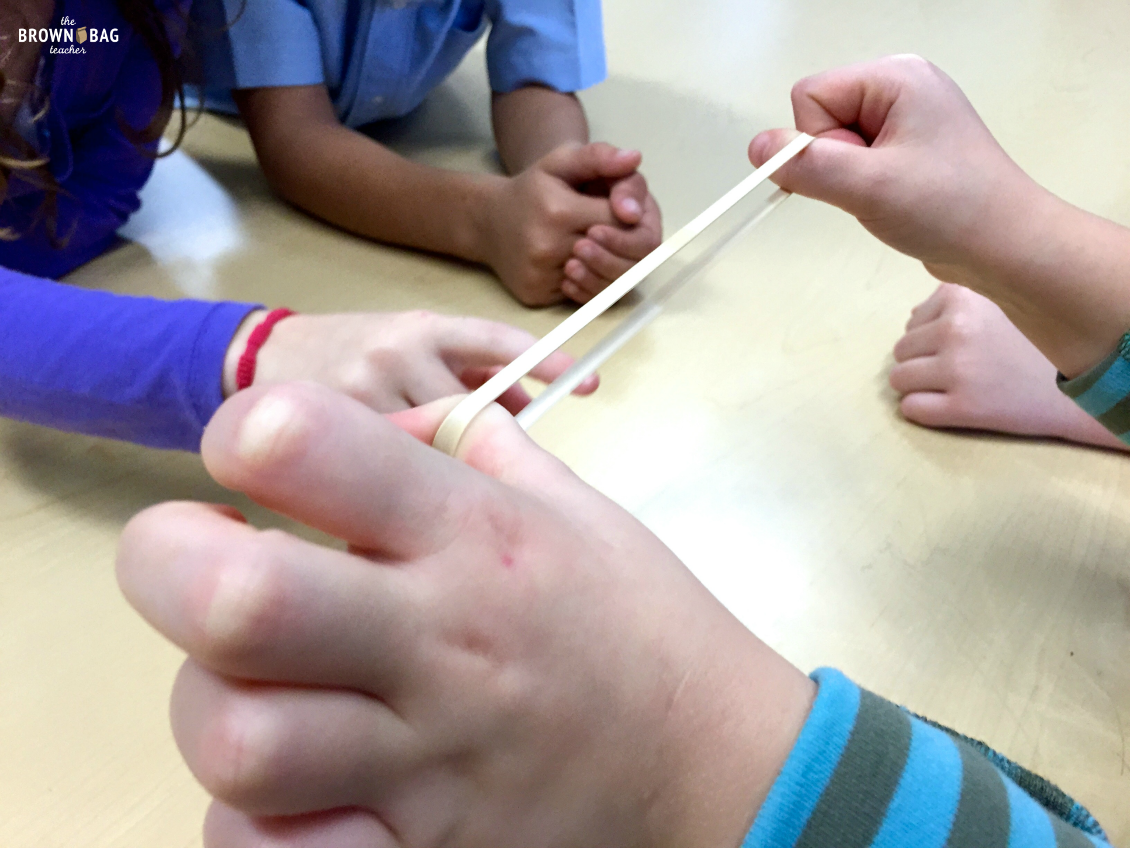
While my friends loved being able to feel the vibrations of the rubber band, my 1st graders struggled to hear the sound produced and really couldn’t see the vibrations. So, for the first time this year, we pulled out the Slow Motion feature on my iPhone. My friend K videoed as we plucked the rubber band and the results were AMAZING!
After learning what vibrations were and that sound is created by vibrating materials, we started our conversation about different types of sound. We brainstormed a list of things that made sound and how they sound (airplanes – loud, violin – high, babies – low and slow, etc.).
Introducing pitch, we used a metal spoon to ‘play’ glasses with different amounts of water. My friends took turns playing the glasses, making songs, and moving the glasses. Before introducing new sound vocabulary and writing our learning, my friends talked about their observations – which glasses sounded higher? which sounded lower? why do you think it is?

Then, we watched the BrainPop Jr. video about pitch and made the connection to our experiment! My friends were so confident in writing about their observations.


Borrowing a set of handbells (Amazon affiliate link) from my church, we spent an afternoon comparing the sound of the bells and explaining how the bells make their sound (each bell had a spring and a hard ball inside, so the length of the spring affected the sound made by the bell). My 1st graders had never heard or used Handbells, so it was definitely a magical experience. Plus, it was the perfect time to put into action all of our sound vocabulary – sound waves, vibrations, pitch, echo, etc.

After playing the handbells, one of my sweet littles asked to bring in her violin to play for us and teach us how she makes music using her bow. It was such a sweet moment and a perfect opportunity for her to shine in front of her friends. PLUS, I love seeing music valued and my 1st grade friends were in awe. Music is magical, but even more magical when your friend is explaining how everything we learned is working. Our learning definitely became real with H’s concert! 🙂

All throughout the unit, we took time to write about our learning, vocabulary, and thinking in our science journal (response pages found here). At the end of the first week, I gave my friends the main idea – “This week we have been learning about sound.” asking them to share something they had learned about sound and an example of sound in the real world. I LOVED seeing these responses from 2 of my on-grade level friends. Even our littlest learners can have huge take-aways from hands-on learning!
This week we learned about sound. Sound is made by vibrating- that means back and forth. A ukulele vibrates when you strum its strings. It makes music.

This week we are learning about sound. Sound is noise that is made by vibrations. Vibrations are things that move back and forth really fast. A whistle vibrates because the little ball inside moves back and father really fast when you blow into it.

Our week was hands-on, real-world and it was a blast. Honestly, I was blown away with how much my friends learned and how they were able to explain their learning. If you’re interested in using the resources that our team used, you can snag them here.

Is your school using the Next Generation Science Standards? If so, what are your favorite ways to make sound real for your friends? I’d love to hear your ideas!

8 Responses
Really helpful post! Thank you for sharing the wonderful ideas.
You are a great blogger and professional teacher. It's all about science. The best essay writing services are provided by the most qualified and competent specialists particularized in any types of academic disciplines.
Since subject is my favorite subject and this article tell us how to study in high level thanks for share it personal statement for mental health nursing .
Hi, thank you so much! Where can I access the worksheets/materials for the colored glasses activity?
Thank you!,
Mary