Hi friends! Today I wanted to stop by and give you a general writing round-up of what our 1st grade writing looks like. I always love the chance to see what writing looks like in other classrooms, so I wanted to give you a sneak peek of our room. Writing seems to be one of the subjects that is always ‘pushed’ so integrating writing across all subjects has been huge. This post is specifically looking at the writing going on in our Daily 5 Reading Block. I still have explicit writing instruction (either first thing in the mornings or after our afternoon RtI class), but the bulk of student practice and motivation comes from our reading block.
1st Grade Writing & Research
After wrapping-up our how-to writings in March, our 1st grade team partnered with our Computer Lab teacher to work on animal research projects. As a part of read-to-self, students began researching their chosen animal – habitats, diet, etc.
After researching, students brought their new learning to my teacher table and we started constructing our paragraphs (which students finished independently in Work on Writing). The research was pretty cursory and just a first introduction. As we take computer-lab time to research, we’ll start developing multiple paragraphs. As you see below, there are lots of facts included in this piece, but we’re still lacking developing. Still, you can see the basic outline of a paragraph including a main idea and a wrap-up sentence!
Responding to Short Answer Questions
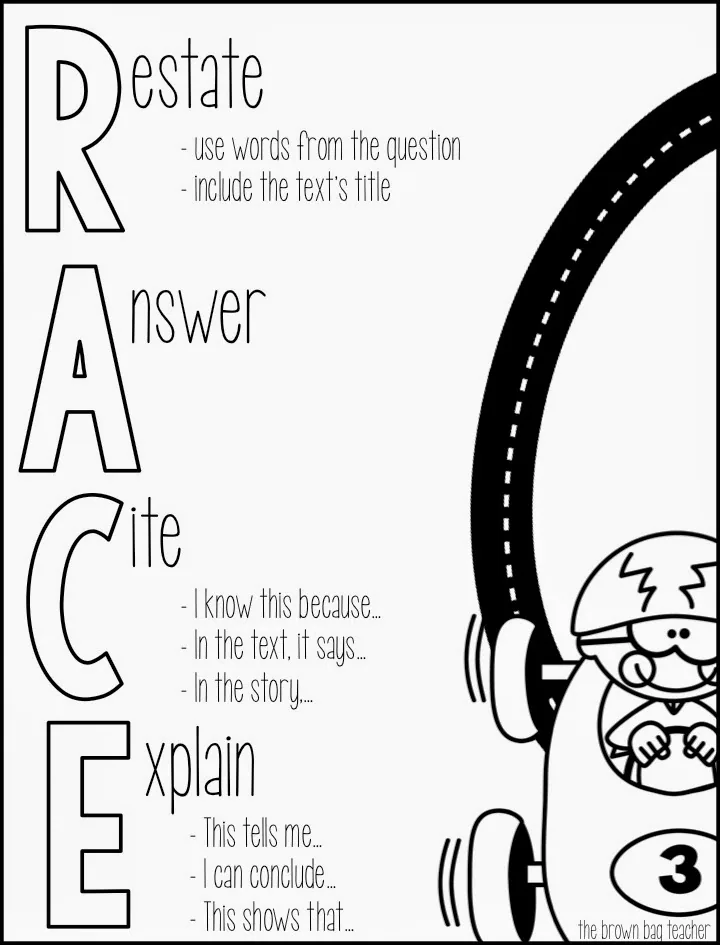
During the Guided Writing portion of Guided Reading, we’re also learning how to respond to questions about a text. We always start with oral writing – sharing our ideas verbally, but also use a RACE (restate, answer, cite evidence, explain) structure to organize our ideas. It’s an easy acronym to remember and it is very pointed…it’s hard to get lost in RACE. In 5th grade I used to RUN (read the question, underline, number) the RACE. In 1st grade writing, we’re just RACEing (with a wrap-up sentence on the end)! 😉 For my more developed readers and writers, they RACECE to beef-up their writing.
Here is a sample response from one of my grade-level writers. She’s done a great job of restating and answering. Then, she pulls evidence from the text and explains the evidence (Peter was starting…). This writer ran the RACE, but forgot to wrap-up.
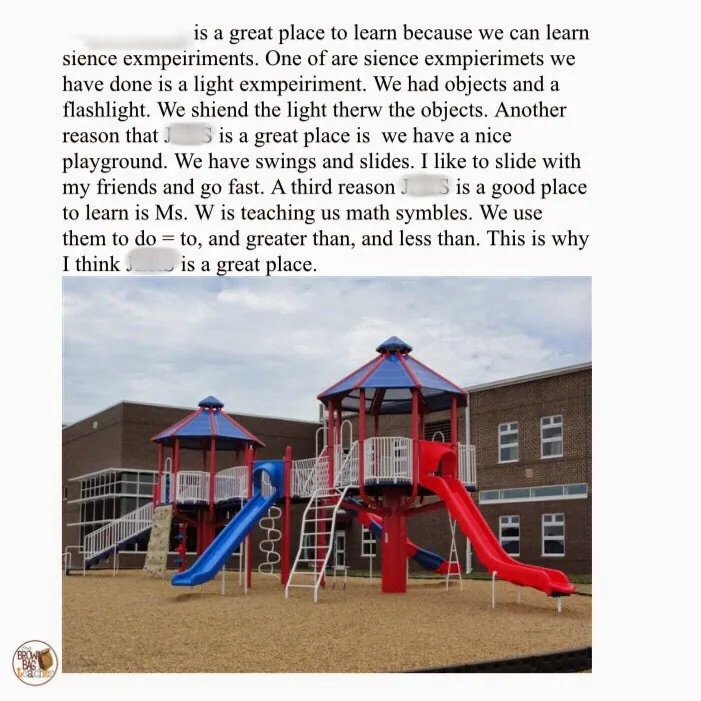
Here is another friend’s response to the same question. Although the writing is difficult to read, I can still see the foundation for a fabulous paragraph. I love the restating and the answer. Then, I love seeing one of our sentence stems – “This tells me…” Like the sample above, I would have loved to see a wrap-up sentence. Still, I am so proud of this writer! Since the response was done independently, it’s a true teaching tool. Reading these I know that I need to reteach and practice wrap-up sentence.
If you’re interested in using RACE in your classroom, you can snag this anchor chart here from DropBox. Although, I would definitely consider making a chart as a class, so there is student investment.
Here is another example of one of our independent responses using the RACE formula. Notice, though, I have scaffolded students with the writing checklist at the bottom of the paper. This is one of my strategies, and one that is very appropriate for 1st grade. It helps guide students in their thinking, but doesn’t provide the content/answer.
Leveraging Work on Writing
Much of our writing takes place during our Daily 5’s Work on Writing time. Students are expected to visit Writing at least 3 times a week. On the wall you’ll see 2 anchor charts we made as a class (I know they’re not ‘cute’ but they are real and what my friends need to keep on track.)
At the beginning of the year, I used to keep stools at Work on Writing, but they were never being used. So, I stole the stools for guided reading, and my friends love standing. If they want to sit, they can grab a clipboard or find a spot around the room.
Students may write in their writing journals or on Pacon Newspaper. It’s really writer’s choice. I don’t love the Pacon paper but it’s so much more environmentally friendly. I felt like I was killing a million trees each week. Now, I can plan on going through 1 pack of paper each quarter.
Publishing our Work
After students have finished hand-writing their pieces, shared with a partner, and shared with me, they have the option to publish their pieces during Daily 5. Not all friends decide to do this, but for most, it is very motivating. Students know to grab one of our classroom laptops or iPads and get to work. If a student is publishing for the first time, they’ll often pull a stool next to me at the teacher table. Since I’m leading Guided Reading, they know not to interrupt, but still my being there provides a comfort level. Typically, it takes 2 rounds for students to publish a piece.
This morning, after a long Spring Break, we wrote an opinion paragraph as a class on the white board. I wanted to quickly re-fresh opinion paragraphs, so students would be ready for Work on Writing. I was *blown* away when one of my friends showed me her opinion-piece draft that she worked on during the 1st rotation. Then, during the 2nd rotation, my friend chose to publish her piece on Microsoft Word. (Disclaimer – this is friend is a strong writer) After she shared her writing with the class, several of my other friends were motivated to go-back and ‘beef-up’ their opinions.
FREE Work on Writing Papers
Sweet! Thanks so much for joining me. Now check your email to confirm your address & snag your freebies. Happy Teaching! -Catherine
I would love for you to share your teaching ideas for 5th grade writing and how to answer extended response. Thanks
Where can I purchase the animal research forms?
It would be so great if you had a snip-it of video to show. I love your posts and would be interested to see how you do some of the things in action! You are very inspiring!
I taught first grade for many years.
You are doing a GREAT Job!! I am So impressed!!
Love the RACE acronym… 🙂
A very awesome blog post. We are really grateful for your blog post. You will find a lot of approaches after visiting your post.
This is certainly hence attractive plus artistic. I like a colorations plus whichever company may get them while in the mailbox might be smiling.
Get teaching tips and free resources
Practical K-2 math and upper-elementary morphology ideas, straight to your inbox. No spam, unsubscribe any time.






28 Responses
I would love for you to share your teaching ideas for 5th grade writing and how to answer extended response. Thanks
Where can I purchase the animal research forms?
It would be so great if you had a snip-it of video to show. I love your posts and would be interested to see how you do some of the things in action! You are very inspiring!
I taught first grade for many years.
You are doing a GREAT Job!! I am So impressed!!
Love the RACE acronym… 🙂
A very awesome blog post. We are really grateful for your blog post. You will find a lot of approaches after visiting your post.
This is certainly hence attractive plus artistic. I like a colorations plus whichever company may get them while in the mailbox might be smiling.