

Counting on, the addition strategy, sounds simple: keep one number and count on from there.
But if you’ve ever watched a student look at a die, confidently tell you it shows 5, and then immediately recount all five dots before adding 2 more, you know there’s more thinking involved than it first appears.
A student rolls a 5 and a 2.
You ask:
“How many?”
5.
Then you ask how many there are altogether and suddenly…
1, 2, 3, 4, 5…6, 7.
Wait.
They just told you it was 5.
So why did they count it again?
If your kindergarten or first grade students count every object by ones, even when they already know one quantity, they may not be ready to use the counting on strategy consistently yet.
It doesn’t mean they need to count faster.
It usually means they are still learning to trust a known quantity, hold it in their thinking, and use it as a starting point.
That’s where counting on begins.
Counting on means keeping one quantity in mind and counting forward from that number instead of starting again at 1.
For example:
A student who is counting all might say:
1, 2, 3, 4, 5…6, 7.
A student who is counting on might say:
4…5, 6, 7.
Same answer.
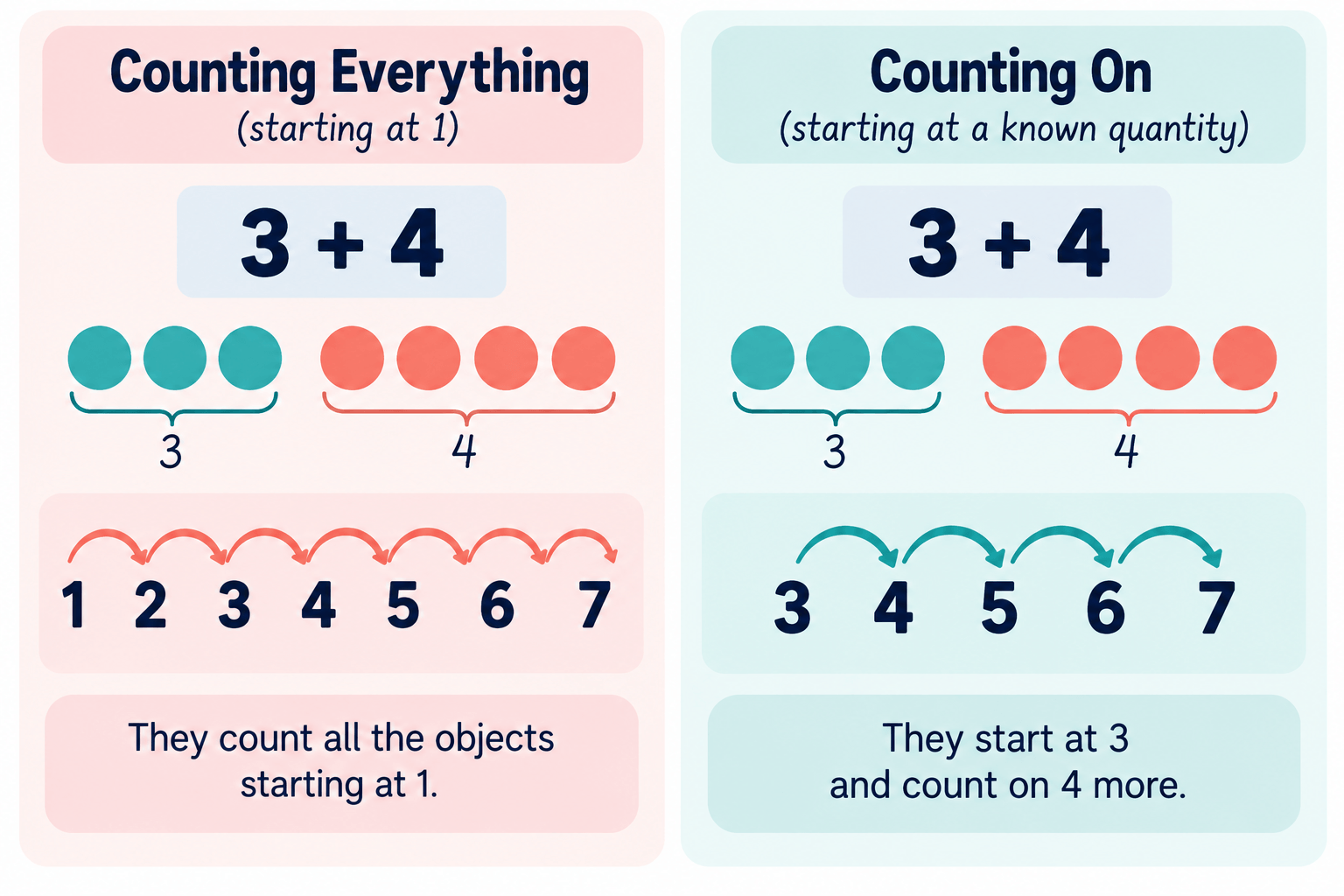
Very different thinking.
When students begin counting on, they’re learning:
I already know this amount. I don’t need to build it again.
That shift matters much more than getting to the answer a few seconds faster.
First, counting all is not wrong.
Counting objects one by one is an important part of early number sense.
Our goal isn’t to stop students from counting.
The problem comes when counting everything from 1 remains the only strategy students trust, even as numbers get larger.
Think about:
A student can absolutely count all 14 objects.
But that requires tracking a lot of individual counts.
Counting on reduces some of that work:
8…9, 10, 11, 12, 13, 14.
Still, we can’t simply tell a student:
“Start at 8.”
Before students can count on, they have to trust that 8 is already there. 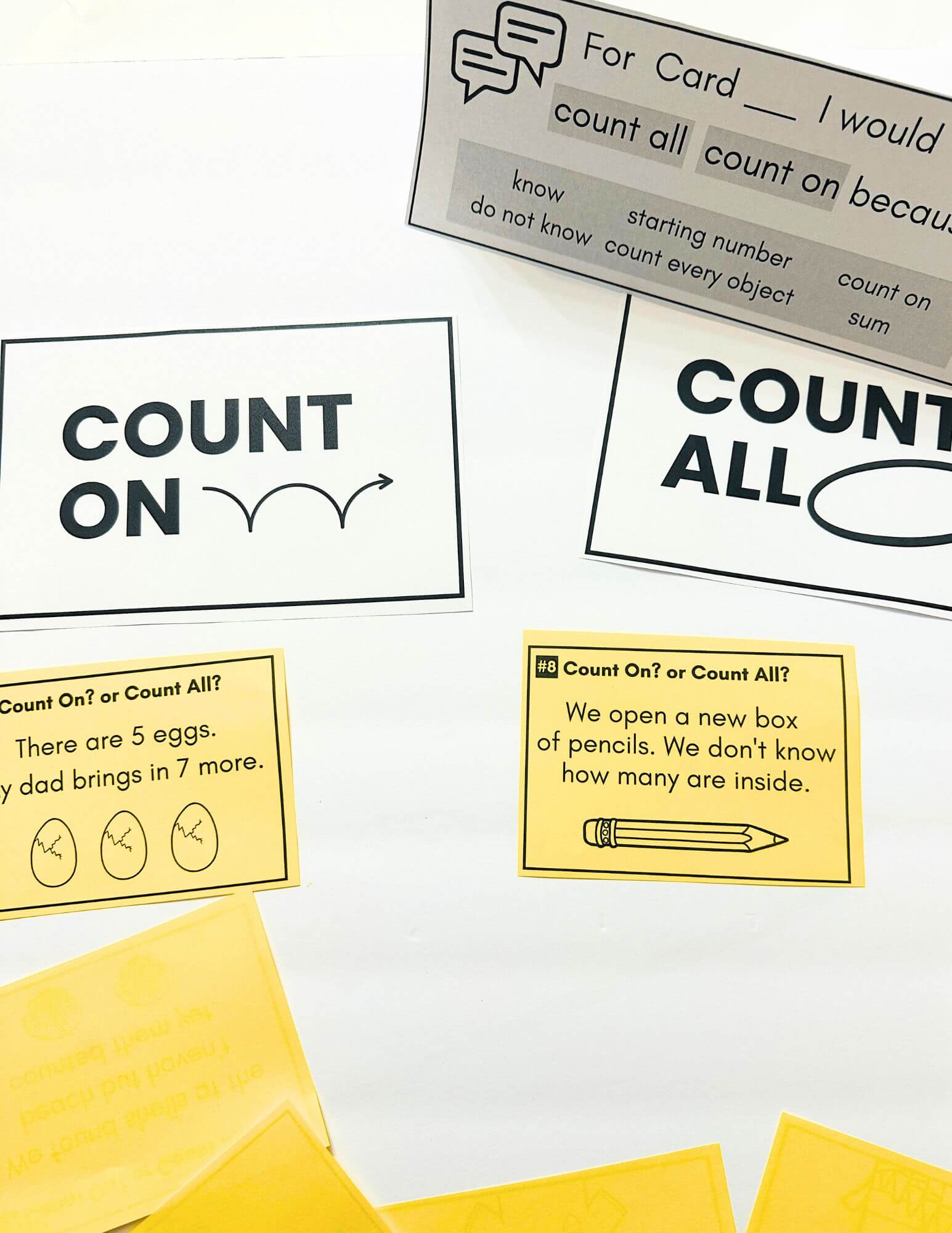
That’s the part we sometimes skip.
This is one of my favorite math moments to watch for.
You show five dots.
“How many?”
5.
Then the student immediately touches every dot:
1, 2, 3, 4, 5.
They knew it was 5.
But they weren’t ready to use 5 without confirming it again.
Holding a quantity while counting on asks students to do several things at once:
That’s a lot.
So instead of:
❌ “You already counted that.”
or
❌ “Don’t count those again.”
give students a simple structure for using what they already know.
You can try this tomorrow with two dice, dot cards, counters, dominoes, or ten frames.
Show a quantity.
Ask:
“How many?”
Let students name the amount before anything moves.
Say:
“You know that’s 5. Keep 5.”
You’re helping students understand that the amount stays known even when something is added to it.
Ask:
“Now count on 2 more.”
Student:
5…6, 7.
That’s it.
No worksheet required.
No new center required.
Just a small shift in the language you’re already using.
Grab two dice.
Roll. 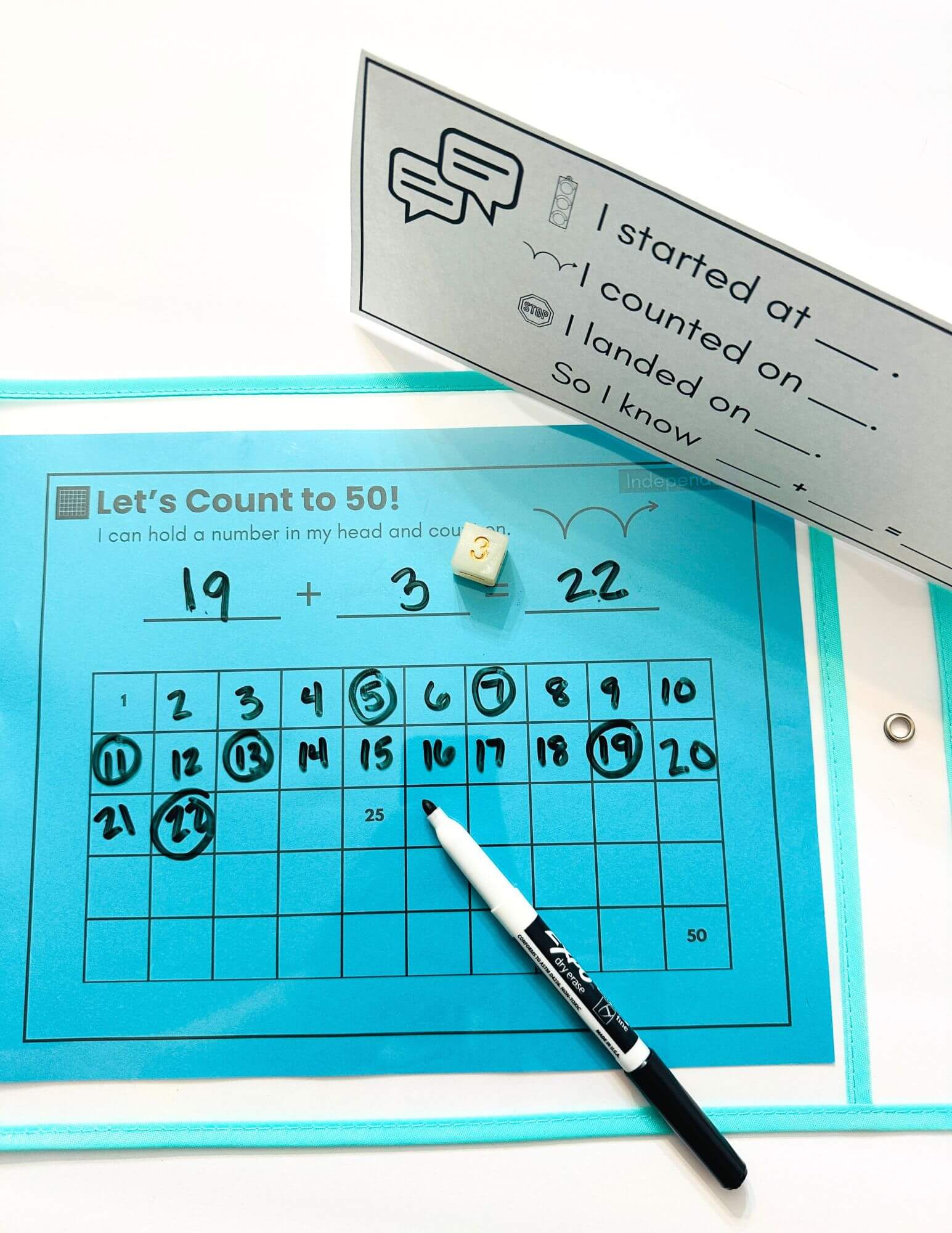
Before students combine or recount anything, ask:
Name it: “How many?”
Keep it: “You know that’s ___. Keep ___.”
Count on: “Now count on ___ more.”
Then listen.
Where does the student start?
That tells you far more than how quickly they get the answer.
This is where our teacher brains immediately want to jump in.
Give a student:
They say:
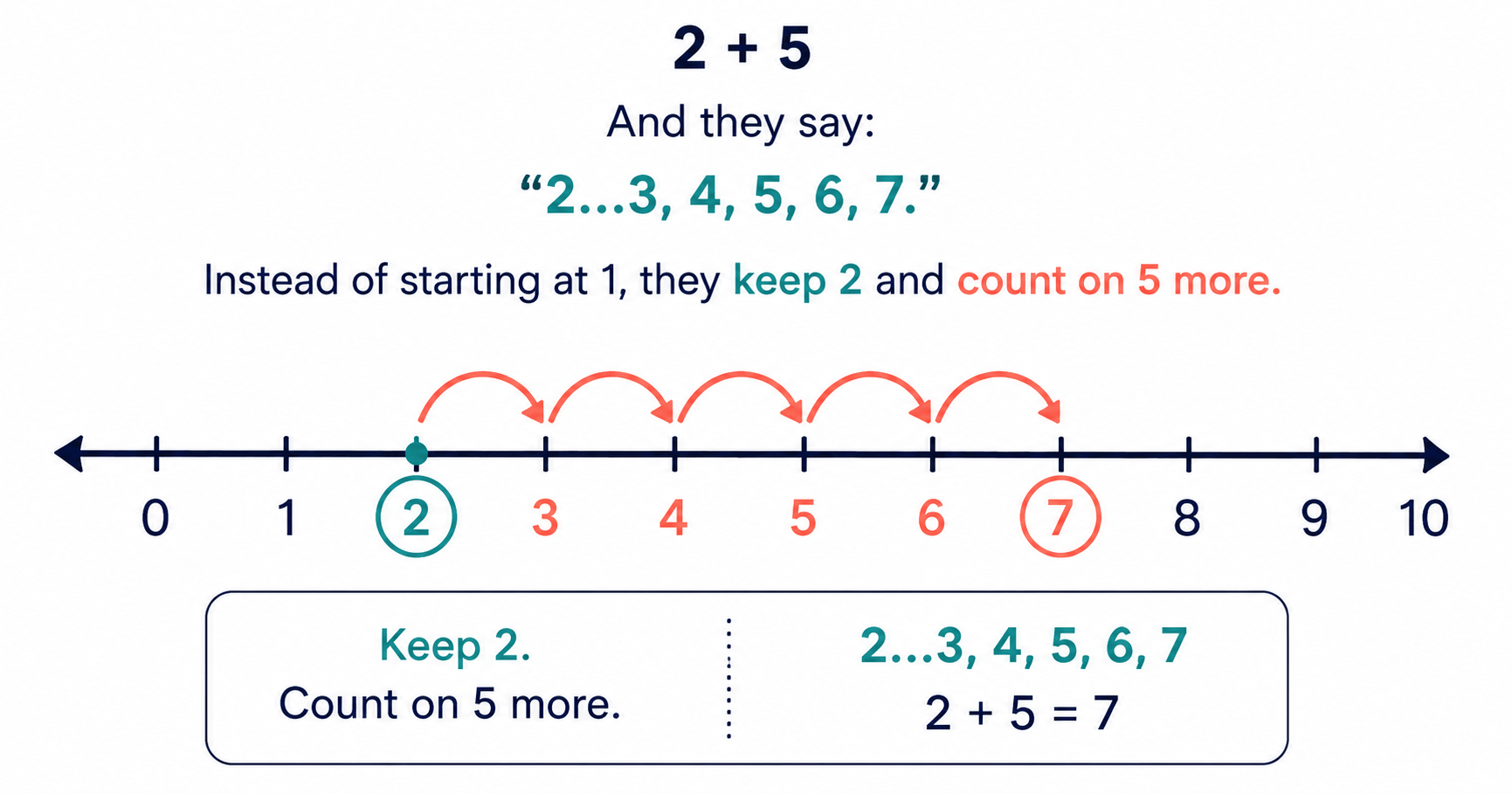
2…3, 4, 5, 6, 7.
And we want to say:
“Start with 5!”
Because yes:
5…6, 7
is more efficient.
But look at what the student actually did.
They:
That is progress.
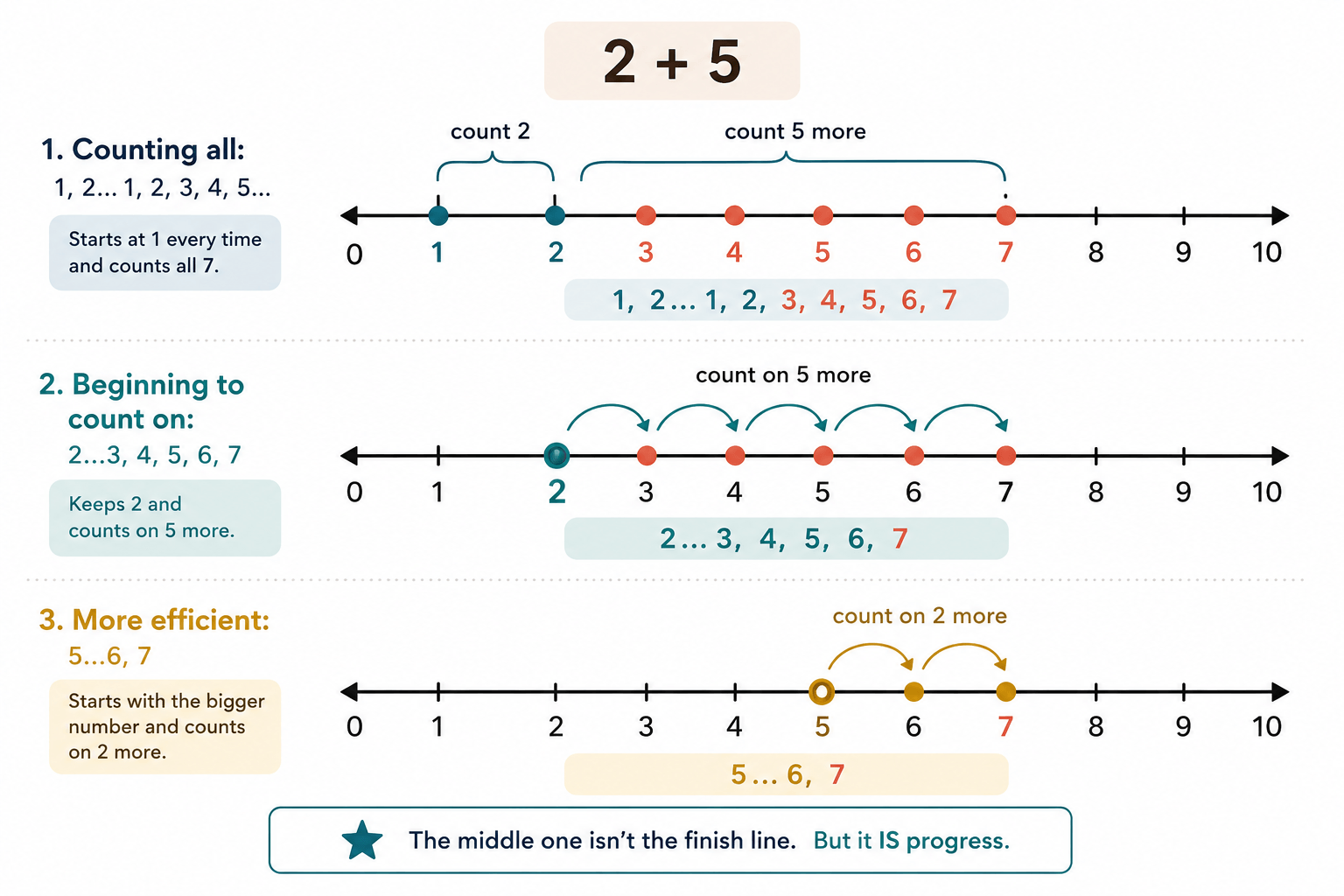
Compare the thinking.
Counting all:
1, 2…1, 2, 3, 4, 5…
Beginning to count on:
2…3, 4, 5, 6, 7
More efficient counting on:
5…6, 7
That middle strategy isn’t the finish line.
But it IS progress.
First, I want students to understand:
I can keep a number and count on from there.
Once that thinking is secure, then we can ask:
“Is there a number that would make counting on easier?”
Now choosing 5 isn’t another rule.
It’s a mathematical decision.
Ten frames, number lines, dot patterns, and counters can all support counting on addition.
And I would be very careful about taking those visual models away too quickly.
Imagine a student solves:
They see a full ten frame and immediately say:
10…11, 12, 13, 14.
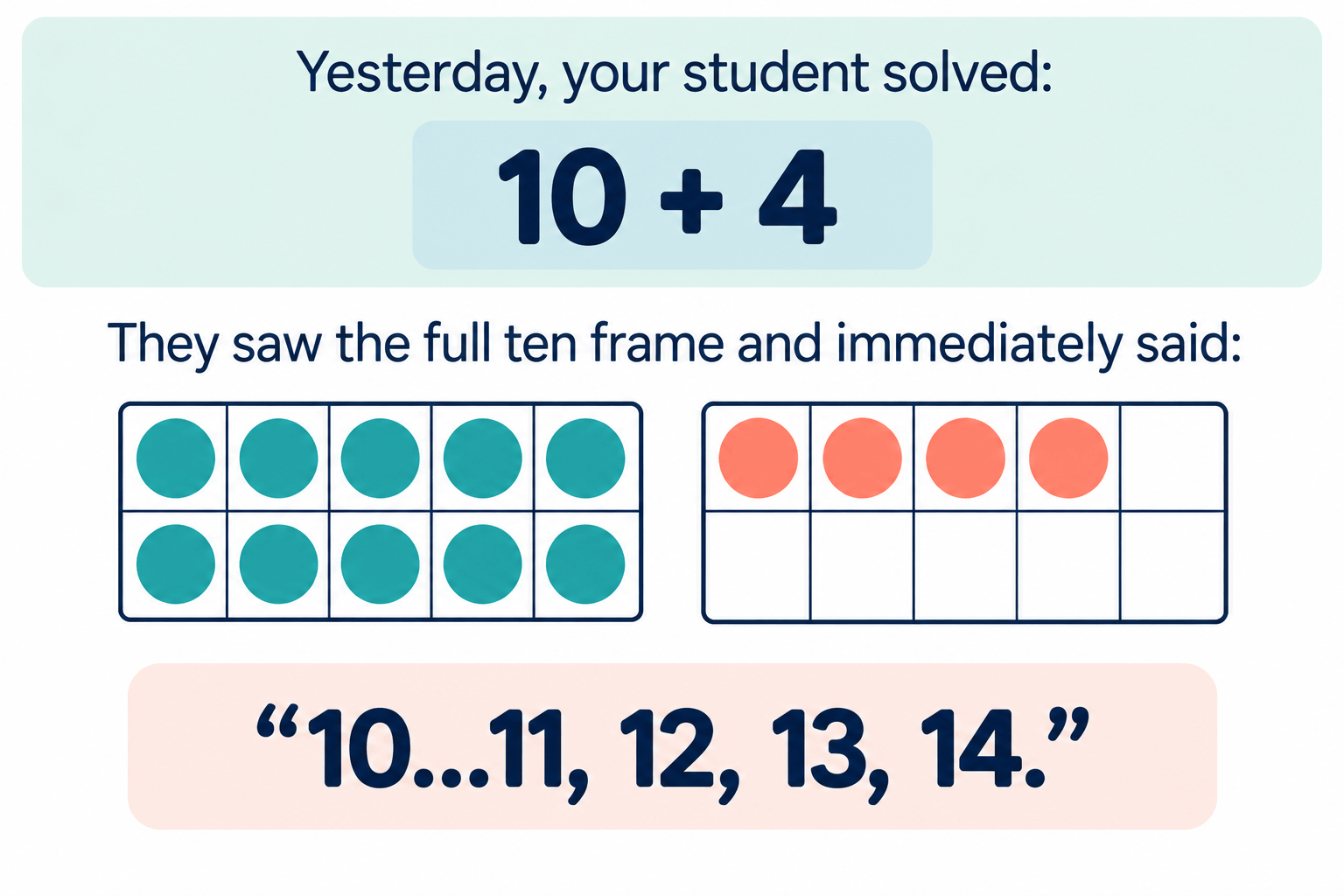
The next day, you remove the ten frame.
Same problem.
Suddenly they’re back to counting everything from 1.
It is tempting to think:
But you could do this yesterday!
They could.
With structure.
The ten frame was doing important mathematical work.
It allowed the student to see 10 as one known quantity instead of ten individual objects that needed to be rebuilt.
Instead of:
❌ “You don’t need the ten frame anymore.”
Try:
“How many do you KNOW are here?”
“Great. Keep 10. Now count on 4.”
10…11, 12, 13, 14.
Then repeat it.
New numbers.
Same structure.
Over time, students may begin needing the model less.
That’s different from removing the model because we think they shouldn’t need it anymore.
Models support thinking until the structure becomes something students can hold mentally.
Students don’t usually jump from counting everything to flexible counting on overnight.
There are important stages in between.
Students recount every object.
1, 2, 3, 4, 5…6, 7
The answer may be correct, but every quantity has to be rebuilt.
Students begin keeping one amount and starting there.
2…3, 4, 5, 6, 7
They may not choose the most efficient starting number yet.
That’s okay.
Students count on successfully with supports such as:
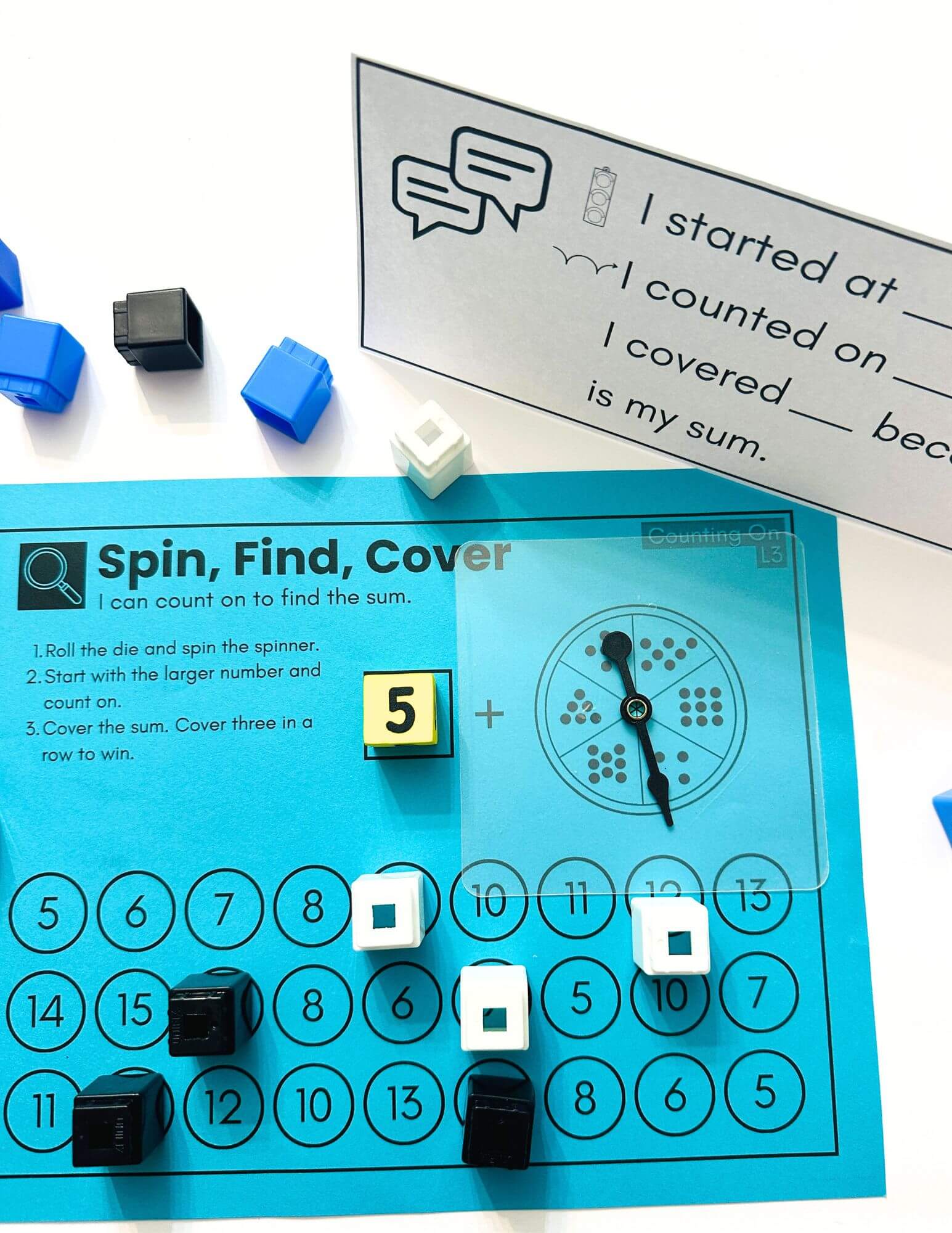
They may return to counting all when those supports disappear.
That’s useful information.
The structure is still doing important work.
Eventually, students begin choosing useful starting quantities on their own.
Now you might hear:
“I started at 5 because then I only had to count 2 more.”
That’s what we’re working toward.
Not a rule.
Not speed.
Strategy choice.
Students need more than a page of addition equations to develop counting on addition. 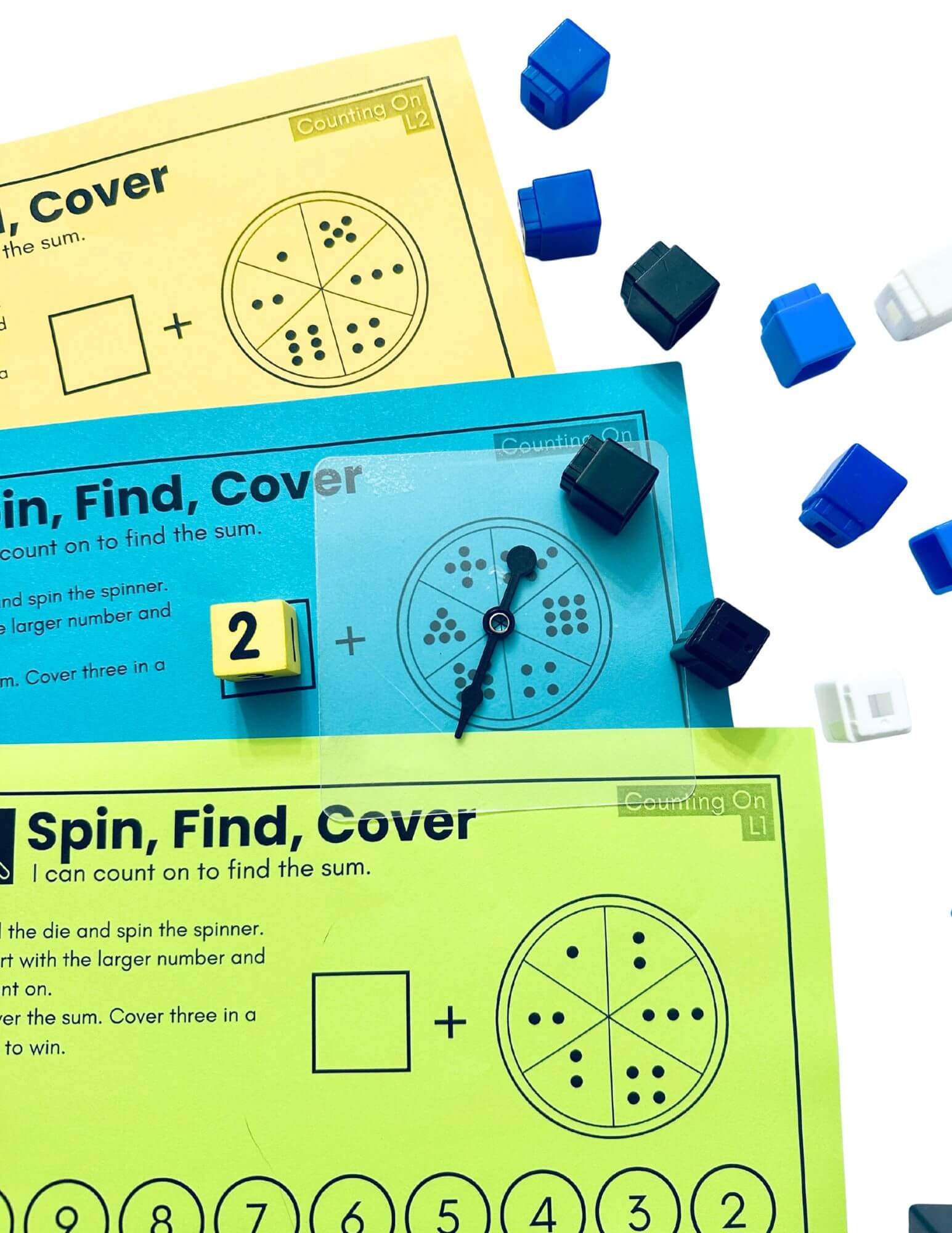
Good counting on activities give students repeated opportunities to:
And here’s something I think matters:
Familiar routines let students focus on the math instead of figuring out new directions.
Keep the routine.
Change the numbers.
Change the model.
Increase the thinking.
Structure first. Confidence follows.
Knowing how counting on develops is one thing.
Finding enough intentional practice to help students move through it is another.
And I don’t want you spending your planning time creating all of that yourself.
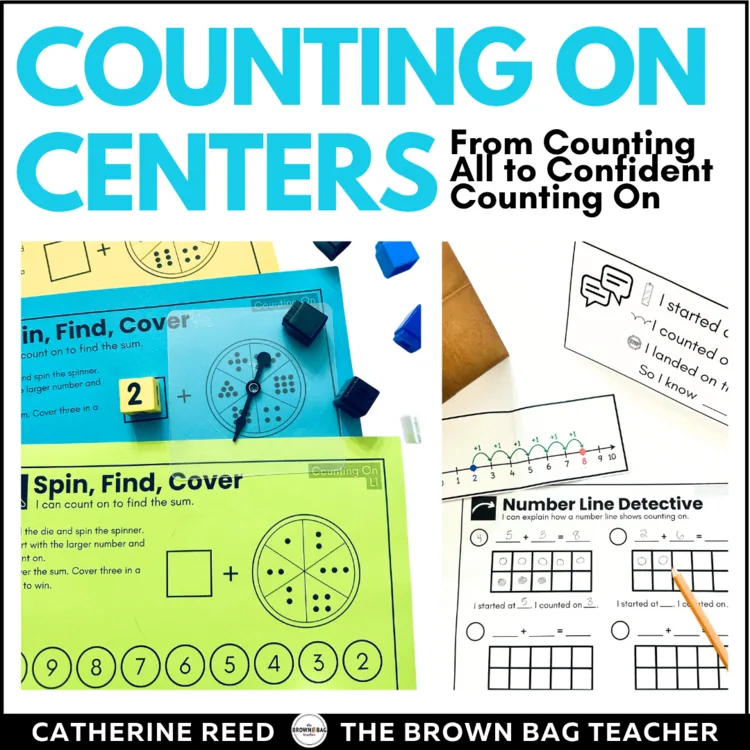
That’s why I created my Counting On Games & Centers.
These aren’t random addition games where students can keep counting everything from 1 and technically get the answer right.
The centers are intentionally organized around how counting-on thinking develops.
Students learn to trust a known quantity and start from it.
Students count on repeatedly across different models and number ranges.
Students use number lines, equations, and visuals to make their thinking visible.
Students begin deciding when counting on makes sense instead of using one strategy automatically.
The resource includes:
So instead of creating three different centers for three different groups, you can keep the routine familiar and adjust the mathematical demand.
Your students get meaningful independent practice.
You get to pull your small group.
Eventually, counting on becomes a strategy students understand and trust.
Then we can start looking for even more structure.
Consider:
Could a student count on?
Absolutely.
8…9, 10, 11, 12, 13, 14, 15.
It works.
But there’s something very useful sitting right in the middle.
Once students can hold quantities and count on confidently, we can begin helping them notice how numbers can be broken apart and recombined around 10.
That’s where making 10 becomes powerful.
Counting on isn’t the finish line.
It’s one important step in helping students move from counting by ones toward reasoning with number structure.
Starting with the larger addend is often more efficient, but students first need to reliably hold a known quantity and count on from it. If a student begins with the smaller number but no longer restarts at 1, that is meaningful progress.
Keep working with quantities and visual models students can recognize. Ask students to name the amount, keep it, and count on. Recounting tells you they are not yet consistently trusting the starting quantity.
Yes. Ten frames help students see a quantity as structured rather than as individual objects. That makes them especially useful when students are beginning to hold a known quantity and count on.
Yes. Number lines make counting-on thinking visible. Students can show where they started, how many counts or jumps they made, and where they landed. 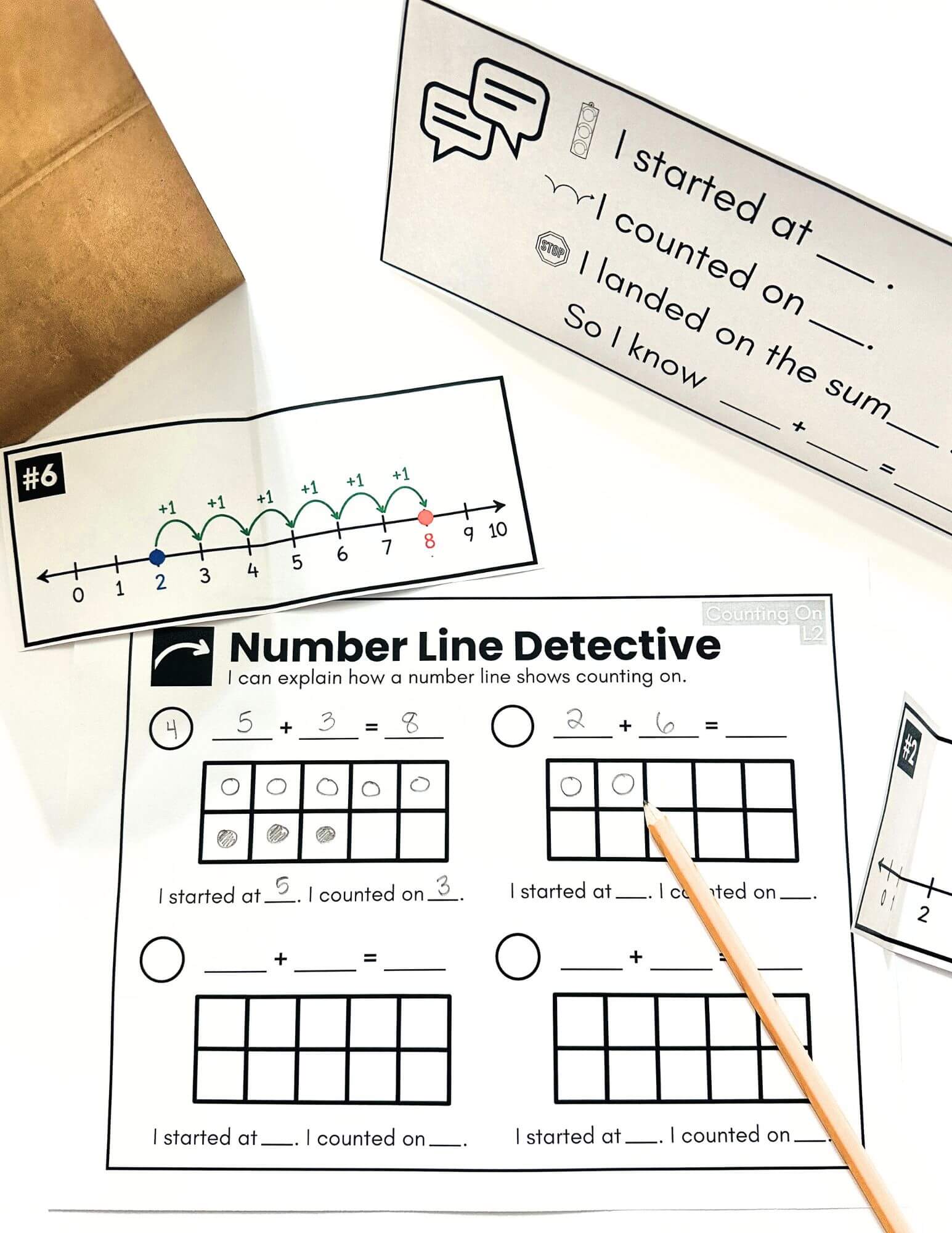
No. Counting on is one addition strategy that supports fluency. Flexible fact fluency develops as students understand number relationships and begin choosing strategies that fit the numbers.