Build vocabulary skills and strengthen word analysis with this comprehensive Greek and Latin Root of the Week resource! Designed for grades 4–6, this low-prep morphology routine helps students recognize meaningful word parts (affixes), unlock unfamiliar vocabulary, and become confident word thinkers.
Build vocabulary skills and strengthen word analysis with this comprehensive Greek and Latin Root of the Week resource! Designed for grades 4–6, this low-prep morphology routine helps students recognize meaningful word parts (affixes), unlock unfamiliar vocabulary, and become confident word thinkers.
Perfect for whole-group instruction, morning meeting, literacy block, or word study, this resource provides everything you need to teach one meaningful root each week through explicit instruction, discussion, and repeated practice.
Instead of memorizing definitions, students learn to recognize patterns, make connections among words, and apply their understanding while reading and writing.
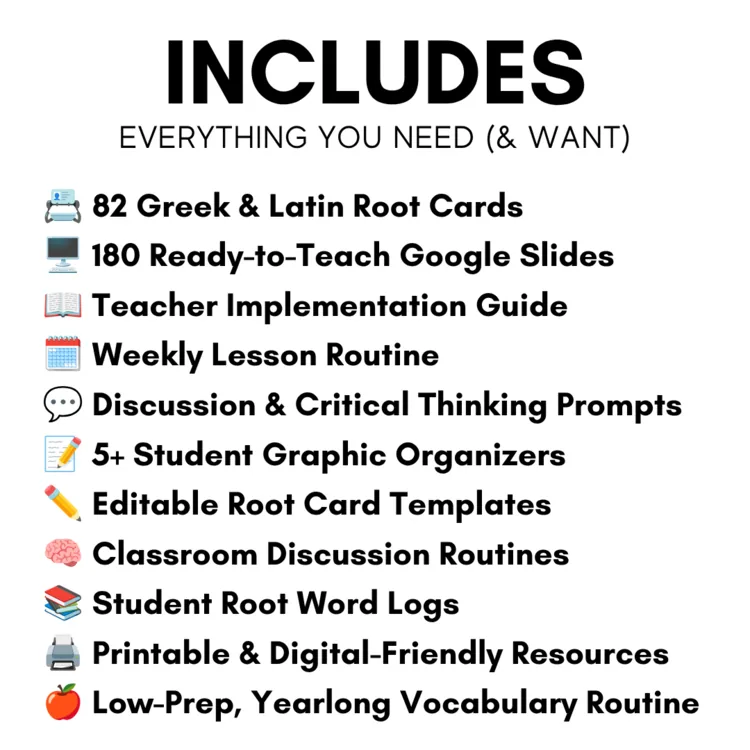
What’s Included:
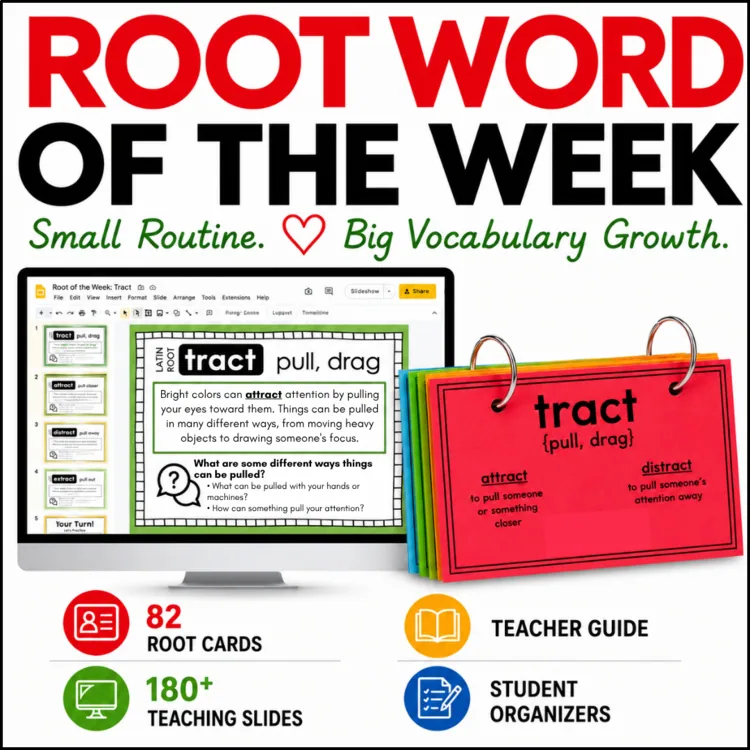
⭐ 82 Root of the Week Cards
Display as a classroom rolodex or word wall.
Introduce one Greek or Latin root each week.
Includes the root meaning, example words, and contextual sentences.
⭐ 180 Teaching Slides
2 instructional slides for every root.
Introduce each root through meaningful context.
Practice with carefully selected example words.
Encourage discussion, reasoning, and vocabulary development.
Perfect for whole-group instruction, interactive whiteboards, or digital learning.
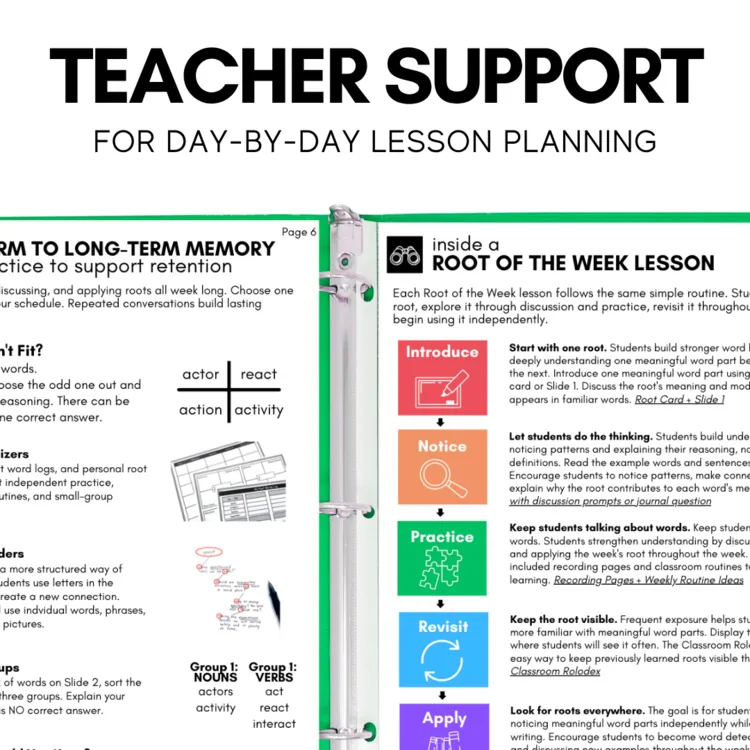
⭐ Implementation Guide
A teacher-friendly guide that includes:
Why morphology matters
A simple instructional routine
Weekly lesson structure
Discussion prompts that build word thinkers
Flexible implementation ideas
Classroom routines and extension ideas
⭐ Graphic Organizers & Recording Pages
Students can:
Record new roots
Collect related words
Draw connections
Build vocabulary over time
⭐ Editable Root Card Template
Customize or create additional root cards using the included PowerPoint template.
Why Teachers Love Root of the Week
✔ Builds academic vocabulary through meaningful conversations
✔ Strengthens decoding of unfamiliar multisyllabic words
✔ Supports reading comprehension across all subject areas
✔ Encourages students to think about how words work
✔ Requires just a few focused minutes each day
✔ Easily fits into morning meeting, literacy block, or transitions
A Simple Weekly Routine: Each week students:
🌱 Learn one new Greek or Latin root.
👀 Notice patterns across related words.
💬 Discuss and explain their thinking.
✏️ Practice using meaningful word parts.
📚 Apply their learning while reading and writing.
Repeated exposure throughout the year helps students independently recognize meaningful word parts and unlock unfamiliar vocabulary.
Perfect For
Vocabulary instruction
Morphology
Greek and Latin roots
Word study
Reading intervention
Small groups
Whole-group instruction
Literacy centers
Morning meeting
Grades 4–6
✅Download the preview to get a closer look at these templates and examples from my classroom!
___________________________________
2569 reviews for Greek and Latin Roots, Affixes of the Week: Daily Morphology Root Word Practice
Rated 5 out of 5
venus K. –
My students looked forward to this lesson each day. It took little to no time to prep and 5 minutes a day to practice. I included Family Fued as a review. It is a great way to improve their vocabulary skills.
Rated 5 out of 5
Stephanie Barker –
Love!
Rated 5 out of 5
Kelly E. –
This is a great resource!
Rated 5 out of 5
Tina C. –
Great for small group practice.
Rated 5 out of 5
shirley G. –
Looks and works great!
Rated 5 out of 5
Karyn H. –
Great extension activity for my fast workers!
Rated 5 out of 5
Lisa Cole –
Student really enjoyed using this resource.
Rated 5 out of 5
Brittany Thurston –
Love this. I homeschool my 4th and 8th graders and this is a great resource to teach and review with them together.
Rated 5 out of 5
Katie F. –
Great resource!
Rated 5 out of 5
Elizabeth A. –
This daily practice is engaging and easy to use. Thank you so much!
Rated 5 out of 5
Kathryn F. –
Makes teaching roots so much easier! Thank you!
Rated 5 out of 5
Megan P. –
Great way to get daily practice in!
Rated 5 out of 5
noelle mcgarry –
Very helpful for my students.
Rated 5 out of 5
Mary C. –
This is an Excellent resource to teach root words and for students to understand Greek and Latin roots. This is the foundation for strong reading and developing a solid vocabulary.
Rated 5 out of 5
Claire D. –
I set up the rolodex on a key ring and it’s hanging near my desk for reference. We also sometimes print the individual roots and glue them in to our books for further reference. I love it and use it all the time.
Rated 5 out of 5
Magdalena V. –
This program helps them deconstruct words to derive meaning
Right after you check out, your download links are on the order confirmation page, and your receipt email has the same links. Don’t see the email? Check your spam or promotions folder.
Each resource downloads as a .zip folder that holds all of its files.
iPhone or iPad: open the Files app, find the zip in Downloads, and tap it. It unzips into a folder you can open.
Mac: double-click the zip.
Windows: right-click the zip and choose Extract All.
My file won’t open or shows a file-path error.
This usually happens on Windows when the files are unzipped inside the Downloads folder, because the folder path gets too long. Move the zip to your Desktop, then right-click it and choose Extract All.
Still stuck? Reach out and I’ll help.
Do I need an account?
No, you can check out without signing up. An account is created for you automatically with the email you use at checkout, and you’ll get an email to set your password. If you already have an account, your order is added to it.
All major credit and debit cards, Apple Pay and Google Pay (through Stripe), plus PayPal and Venmo. Payments are processed securely, and your card details never touch this site.
What is your refund policy?
Because these are digital resources, they can’t be returned once they’re downloaded. Please look over the product description and preview before you buy.
If something is wrong with a file, or you bought the same resource twice by mistake, reach out and I’ll make it right.
Practical K-2 math and upper-elementary morphology ideas, straight to your inbox. No spam, unsubscribe any time.
They can make ten. Can they use it?
Help students turn “I know ten” into “I can use ten.”
Join me for a hands-on workshop exploring what to model, which questions to ask, and how to respond when students get stuck using ten to add and subtract.
Includes a printable Teacher Toolkit, ready-to-use Number Talks, and the workshop recording.



venus K. –
My students looked forward to this lesson each day. It took little to no time to prep and 5 minutes a day to practice. I included Family Fued as a review. It is a great way to improve their vocabulary skills.
Stephanie Barker –
Love!
Kelly E. –
This is a great resource!
Tina C. –
Great for small group practice.
shirley G. –
Looks and works great!
Karyn H. –
Great extension activity for my fast workers!
Lisa Cole –
Student really enjoyed using this resource.
Brittany Thurston –
Love this. I homeschool my 4th and 8th graders and this is a great resource to teach and review with them together.
Katie F. –
Great resource!
Elizabeth A. –
This daily practice is engaging and easy to use. Thank you so much!
Kathryn F. –
Makes teaching roots so much easier! Thank you!
Megan P. –
Great way to get daily practice in!
noelle mcgarry –
Very helpful for my students.
Mary C. –
This is an Excellent resource to teach root words and for students to understand Greek and Latin roots. This is the foundation for strong reading and developing a solid vocabulary.
Claire D. –
I set up the rolodex on a key ring and it’s hanging near my desk for reference. We also sometimes print the individual roots and glue them in to our books for further reference. I love it and use it all the time.
Magdalena V. –
This program helps them deconstruct words to derive meaning