Help students build strong number sense as they explore combinations to 10 with hands-on Making 10 activities, addition games, ten frames, math centers, and assessments designed for Kindergarten and 1st grade. Making 10 is more than memorizing addition facts.
Help students build strong number sense as they explore combinations to 10 with hands-on Making 10 activities, addition games, ten frames, math centers, and assessments designed for Kindergarten and 1st grade.
Making 10 is more than memorizing addition facts.
Ten is an important benchmark students can use to reason about numbers. When students understand how 10 can be composed and decomposed, they begin seeing relationships they can use for addition, subtraction, place value, and future mental math.
This resource gives students repeated opportunities to build 10, practice combinations to 10, use ten frames and manipulatives, and explain the number relationships they notice.
A teacher-friendly Making 10 Learning Progression helps you choose the activities and practice that match what you notice in your students’ thinking. Use the activities during whole-group math, number talks, small groups, intervention, or independent math centers.
⭐ Making 10 Learning Progression
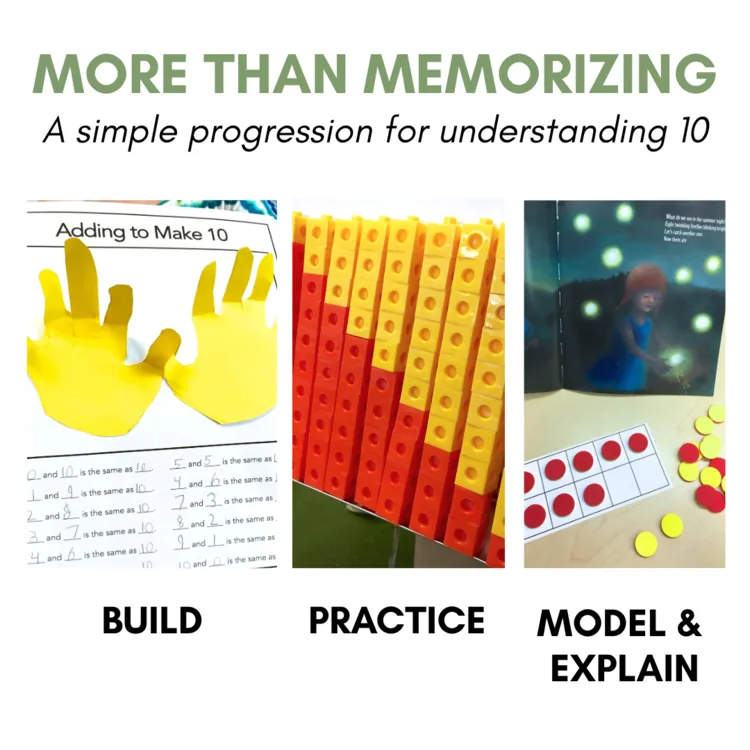
Activities are organized around three stages of student thinking:
BUILD 10
Students build, break apart, and represent 10 in different ways while beginning to see 10 as a whole made of smaller parts.
PRACTICE COMBINATIONS TO 10
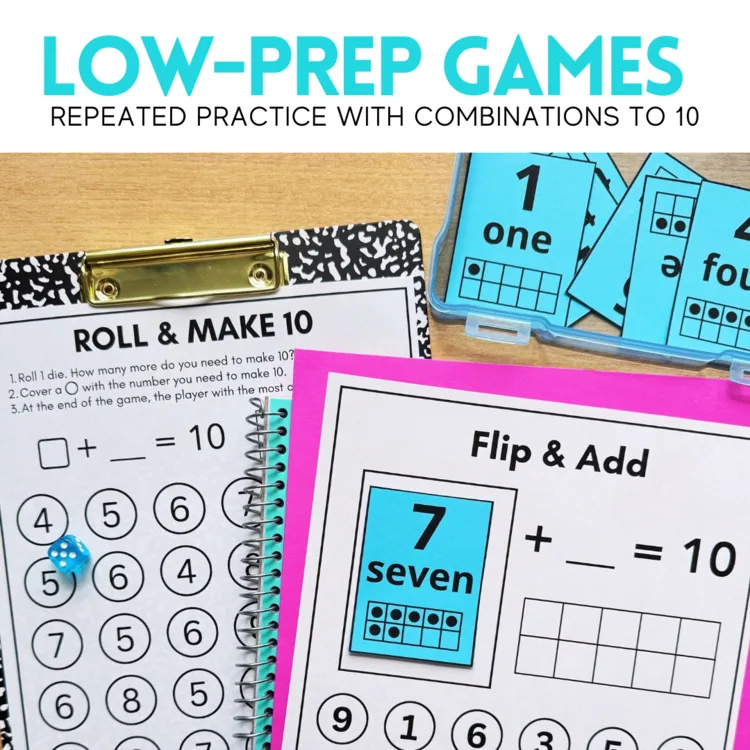
Students get repeated practice with combinations that make 10 through familiar, low-prep games and routines.
MODEL & EXPLAIN RELATIONSHIPS
Students use ten frames, equations, manipulatives, and words to show and explain how two parts make 10.
The goal isn’t speed. It’s helping students see 10 as a structure they understand, trust, and can use flexibly.
🧮 Included in This Making 10 Resource
Teacher Support + Assessments
Making 10 Learning Progression
Teacher directions and instructional prompts
Building 10 Quick Check
Knowing Combinations to 10 Quick Check
Modeling & Explaining 10 Quick Check
Making 10 Activities & Routines
Build It with Cubes
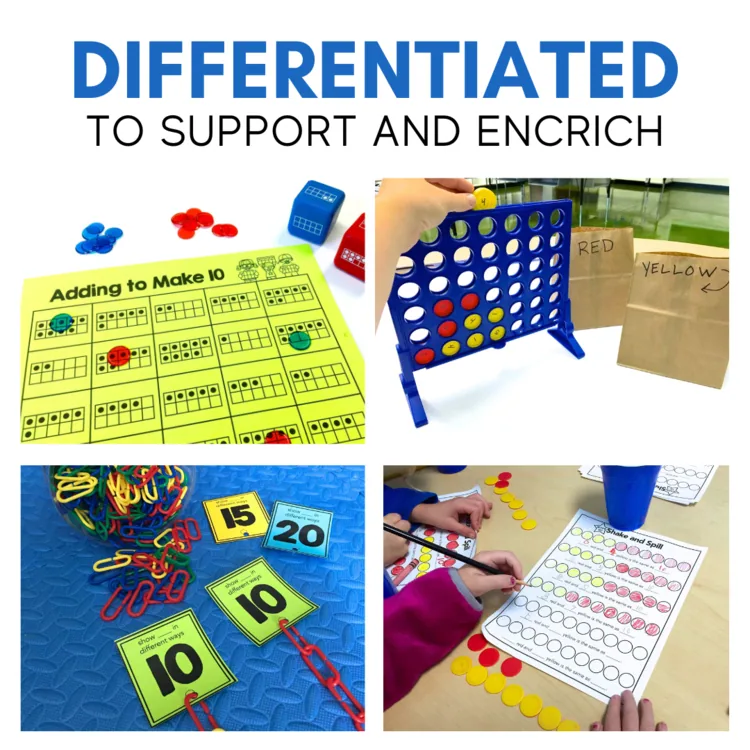
Shake & Spill
Making 10 Hand Game
Number Combinations
Ten Flashing Fireflies activity
Making 10 Hand Craftivity
Making 10 Games & Math Centers
Making 10 Go Fish
Making 10 Solitaire
Roll & Make 10
Flip & Add
4 in a Row
Connect 4
Ten Frames, Number Cards & Math Tools
10 Frame Mats
20 Frame Mats
Addition and subtraction equation options
Combinations to 10 Cards
Number combination recording pages
Additional Practice & Extensions
Making 20 activities
Number combination chains for 10, 15, and 20
10 Frame Song lyrics + video link
Additional addition games and practice
👩🏫 Perfect For Kindergarten and 1st grade teachers can use these Making 10 activities for math centers, small-group math, number talks, intervention, whole-group lessons, morning work, or extra addition practice.
Students can use counters, connecting cubes, fingers, ten frames, and other visual models as they develop their understanding. The activities are designed to be reused as students become more confident recognizing and explaining combinations that make 10.
💡 Why Making 10 Matters
Students don’t need another stack of addition facts to memorize.
They need opportunities to see how numbers fit together.
Building a strong understanding of combinations to 10 gives students an important foundation for addition and subtraction fluency, number relationships, place value, and mental math strategies they’ll continue using as the numbers get bigger.
Structure first. Confidence follows.
✅ Download the preview for a closer look at the Making 10 activities, math games, assessments, and teacher support included in this resource!
1193 reviews for Making 10: Adding to 10 Strategy & Games for Building Mental Math & Number Sense
Rated 5 out of 5
GlueSticks and Crayons by Michelle Lanning –
this is perfect, thanks!
Rated 5 out of 5
Dawn E. –
Great addition for centers.
Rated 5 out of 5
Breanna K. –
Love all the activities!
Rated 5 out of 5
Rachel Elder –
I love all of these ideas and think they are great for building that numeracy foundation. Can you explain to me a little more about Number Combinations activity. I’m assuming the kiddos put that number of clips on that card? But I was a little confused by the wording “Make _____ in different ways” and then a large print number below. Are they making the number that is in large print (like 10, 15)? What is the ____ (blank space) for? Thanks so much for your help!!!
Catherine –
Hi Rachel! Thanks so much for the question. As shown the visual directions, students make the number shown using different colored chains. So, your lowest group might show three or four ways to make 10 (8 yellows and 2 reds, 9 blues and 1 red). The middle group might be mastering 15 and your highest group might be mastering 20. Hope this helps! 🙂
Rated 5 out of 5
Merle G. –
Will help to build number sense for 10.
Rated 5 out of 5
Angelia – Extra Special Teaching –
Just the types of activities I was looking for! Thank you!
Rated 5 out of 5
Susan S. –
Wonderful!
Rated 5 out of 5
Positively Learning –
Great ideas for this important math skill! Thank you 🙂
Rated 5 out of 5
Penelope S. –
I can’t wait to use this to help my kiddos with their facts. Thank you!
Rated 5 out of 5
Hands On Inquiry – Melissa Reed –
This product has so many great activities to help my first graders solidify their understanding of making 10! Thank you for another amazing product!
Rated 5 out of 5
Melissa G. –
Great!
Rated 5 out of 5
Chris S. –
This is great! Wonderful activities for teaching the important “make ten” concept!
Rated 5 out of 5
LYNN R P. –
Thank you, my students will love these!
Rated 5 out of 5
Janet M. –
I used two of the activities to teach my youngest student about numbers 1 through 10. I started with the snap cubes, as she needed to see how adding puts two groups together. She was also able to see how changing from 7 magenta cubes and 3 yellow cubes to 3 magenta cubes and 7 yellow cubes changed the remaining rows of cubes in parallel ways and is beginning to understand that 7 + 3 = 3 + 7. I would suggest changing the written portion under each row to read, ____ + _____ equals ____. Using the phrase, “is the same as” was a bit misleading.
Catherine –
Hi Janet! I can appreciate your students are used to the terminology but I use both the equals sign and the “same as” to explain =. It can mean both things and when students move to doing algebra it’s important for students to be flexible in their thinking and math vocabulary! 🙂
Right after you check out, your download links are on the order confirmation page, and your receipt email has the same links. Don’t see the email? Check your spam or promotions folder.
Each resource downloads as a .zip folder that holds all of its files.
iPhone or iPad: open the Files app, find the zip in Downloads, and tap it. It unzips into a folder you can open.
Mac: double-click the zip.
Windows: right-click the zip and choose Extract All.
My file won’t open or shows a file-path error.
This usually happens on Windows when the files are unzipped inside the Downloads folder, because the folder path gets too long. Move the zip to your Desktop, then right-click it and choose Extract All.
Still stuck? Reach out and I’ll help.
Do I need an account?
No, you can check out without signing up. An account is created for you automatically with the email you use at checkout, and you’ll get an email to set your password. If you already have an account, your order is added to it.
All major credit and debit cards, Apple Pay and Google Pay (through Stripe), plus PayPal and Venmo. Payments are processed securely, and your card details never touch this site.
What is your refund policy?
Because these are digital resources, they can’t be returned once they’re downloaded. Please look over the product description and preview before you buy.
If something is wrong with a file, or you bought the same resource twice by mistake, reach out and I’ll make it right.
Practical K-2 math and upper-elementary morphology ideas, straight to your inbox. No spam, unsubscribe any time.
They can make ten. Can they use it?
Help students turn “I know ten” into “I can use ten.”
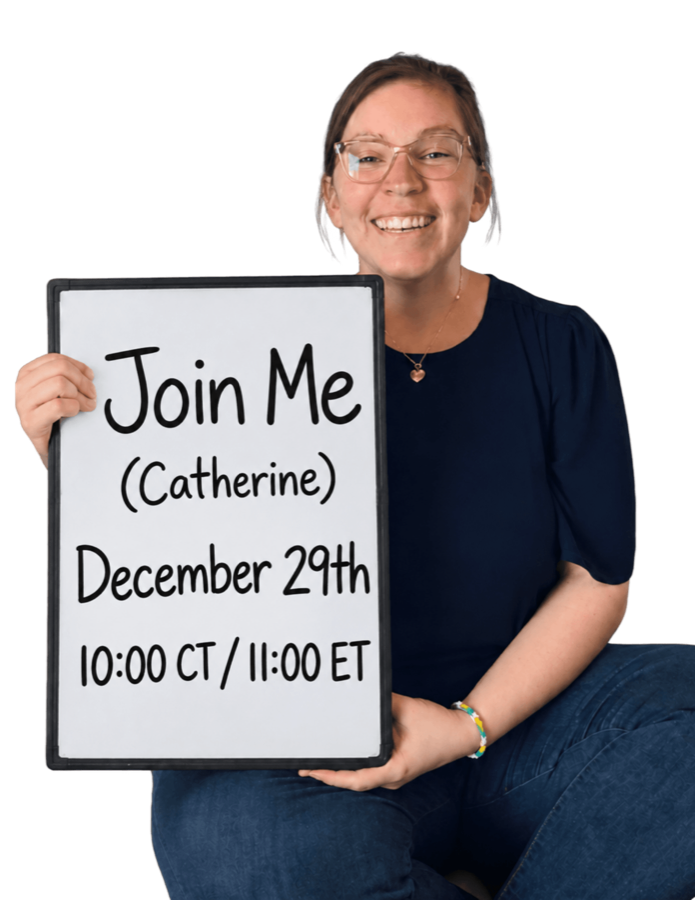
Join me for a hands-on workshop exploring what to model, which questions to ask, and how to respond when students get stuck using ten to add and subtract.
Includes a printable Teacher Toolkit, ready-to-use Number Talks, and the workshop recording.

GlueSticks and Crayons by Michelle Lanning –
this is perfect, thanks!
Dawn E. –
Great addition for centers.
Breanna K. –
Love all the activities!
Rachel Elder –
I love all of these ideas and think they are great for building that numeracy foundation. Can you explain to me a little more about Number Combinations activity. I’m assuming the kiddos put that number of clips on that card? But I was a little confused by the wording “Make _____ in different ways” and then a large print number below. Are they making the number that is in large print (like 10, 15)? What is the ____ (blank space) for? Thanks so much for your help!!!
Catherine –
Hi Rachel! Thanks so much for the question. As shown the visual directions, students make the number shown using different colored chains. So, your lowest group might show three or four ways to make 10 (8 yellows and 2 reds, 9 blues and 1 red). The middle group might be mastering 15 and your highest group might be mastering 20. Hope this helps! 🙂
Merle G. –
Will help to build number sense for 10.
Angelia – Extra Special Teaching –
Just the types of activities I was looking for! Thank you!
Susan S. –
Wonderful!
Positively Learning –
Great ideas for this important math skill! Thank you 🙂
Penelope S. –
I can’t wait to use this to help my kiddos with their facts. Thank you!
Hands On Inquiry – Melissa Reed –
This product has so many great activities to help my first graders solidify their understanding of making 10! Thank you for another amazing product!
Melissa G. –
Great!
Chris S. –
This is great! Wonderful activities for teaching the important “make ten” concept!
LYNN R P. –
Thank you, my students will love these!
Janet M. –
I used two of the activities to teach my youngest student about numbers 1 through 10. I started with the snap cubes, as she needed to see how adding puts two groups together. She was also able to see how changing from 7 magenta cubes and 3 yellow cubes to 3 magenta cubes and 7 yellow cubes changed the remaining rows of cubes in parallel ways and is beginning to understand that 7 + 3 = 3 + 7. I would suggest changing the written portion under each row to read, ____ + _____ equals ____. Using the phrase, “is the same as” was a bit misleading.
Catherine –
Hi Janet! I can appreciate your students are used to the terminology but I use both the equals sign and the “same as” to explain =. It can mean both things and when students move to doing algebra it’s important for students to be flexible in their thinking and math vocabulary! 🙂
Buyer A –
Thank You!
Elsa M. –
Student friendly!!