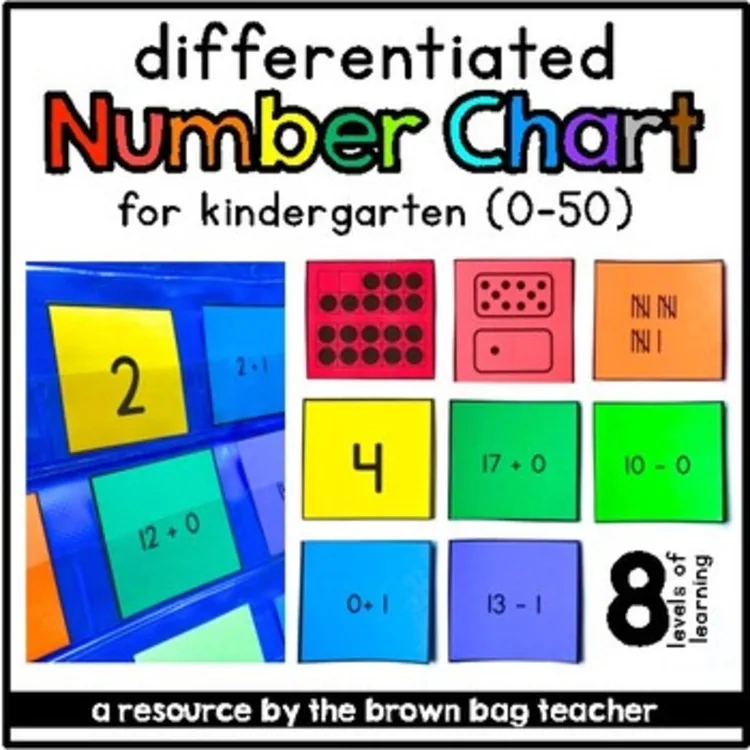
Build number recognition and early math skills with our Number Chart Center (0-50) for Kindergarten! This differentiated pocket chart math center offers engaging activities that help students master numbers 0-50 through interactive and hands-on learning.
Build number recognition and early math skills with our Number Chart Center (0-50) for Kindergarten! This differentiated pocket chart math center offers engaging activities that help students master numbers 0-50 through interactive and hands-on learning. Perfect for math centers.
A number chart is a great tool for practicing subitizing, representing numbers, as well as, addition/subtraction with 0 and 1. Throughout the second semester, this is a continuous center in our kindergarten math rotations. As students become faster in completing the chart (many times it initially takes 25-30+ minutes to complete the chart, while only 10-12 minutes when they have mastered the patterns/skill). Students ‘level-up’ as they work with the chart.
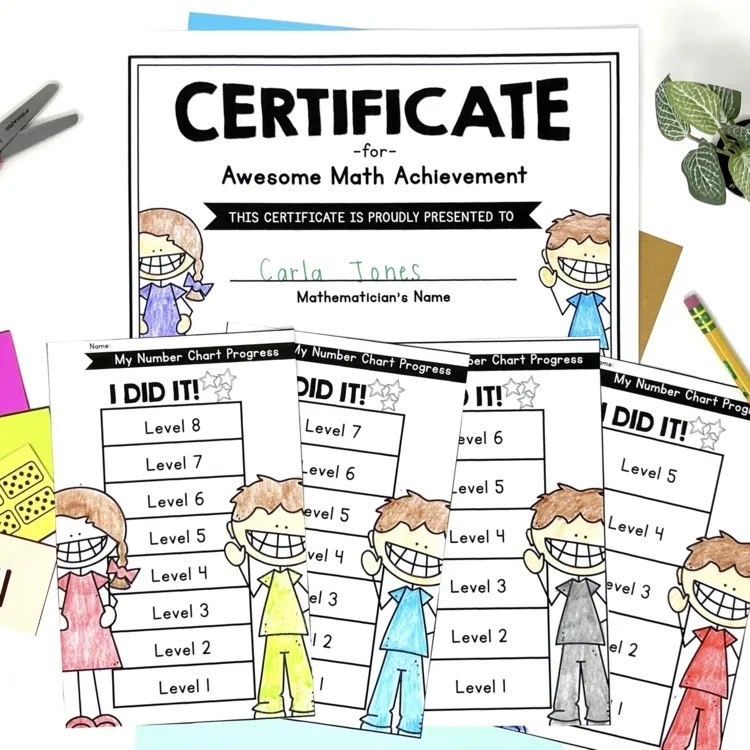
There are 8 levels of cards included in this resource, with sets 5 and 6 including two types of cards (a set of addition and a set of subtraction). You can order and rearrange these sets to meet the needs of your learners.
8 Levels of Cards Included (0-50):
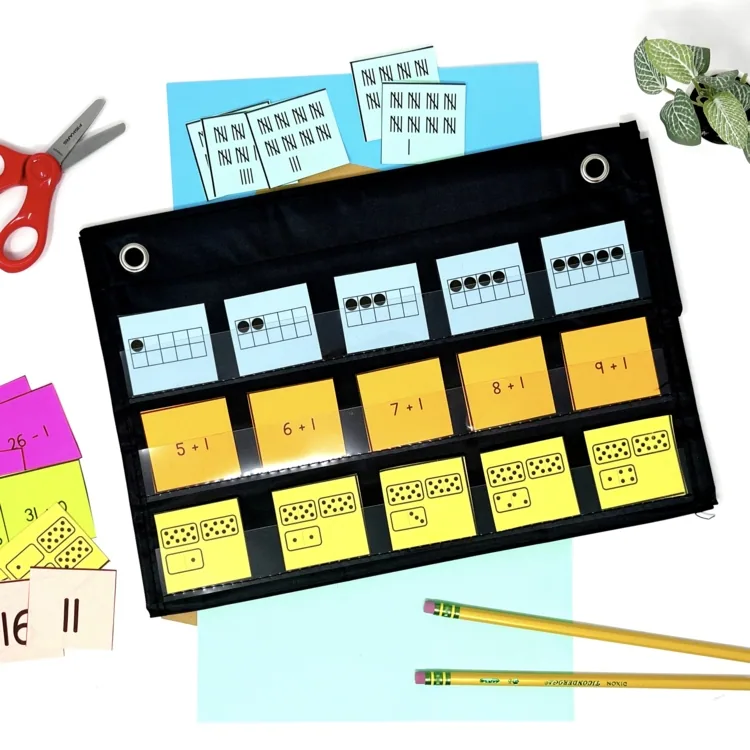
Level 1: Ten Frame Cards
Level 2: Domino Cards
Level 3: Tally Mark Cards
Level 4: Number Cards
Level 5: Plus 0 Cards
Level 6: Minus 0 Cards
Level 7: Plus 1 Cards
Level 8: Minus 0 Cards
Initially I only use the ten frame cards (1-10 then 1-20, 1-30 etc.) for all 3 of my math groups. Students pull a number and then, place it in its home. Many students will individually count each square on the number chart until they find the desired home. Eventually, students will discover ‘tricks’ for finding the number’s home – counting by fives/tens, noticing the number’s relationship to other numbers in the chart, etc. During this phase, you might have students pull out their ten frames, counters, or other manipulatives and show the number card they are placing.
After students are successful using the ten frame cards, I introduce the domino and tally cards. These cards are perfect for practicing different ways to show or represent numbers. During these initial rounds with number representations, I have the number cards (Set 4) already placed on the chart. Students place the representations on top of the numbers as a scaffold. Additionally, I want students to start connecting the amount shown in the picture (semi-concrete) with the written numbers (abstract).
Next, I introduce the number cards with a blank number chart. Students use Set 5 to practice working with 0 and Set 6 for addition/subtraction 1.
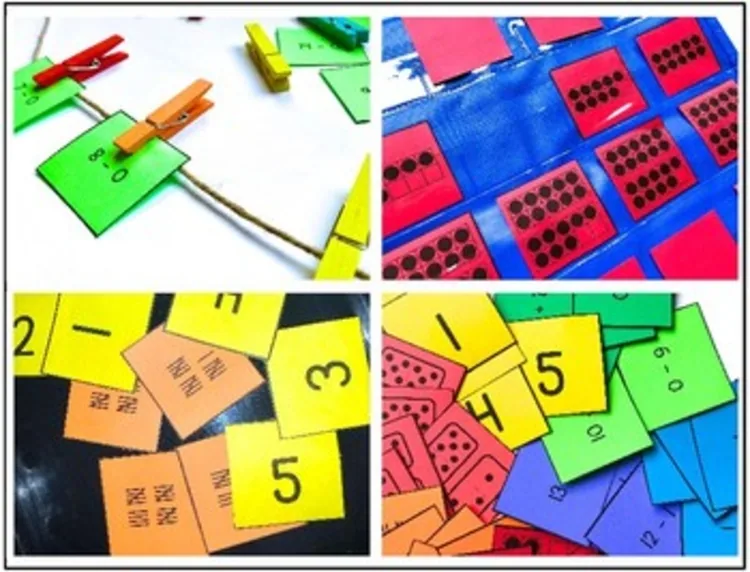
To keep the cards organized and easy to sort, I copy them on colored cardstock (ROYGBIV), each set in a plastic baggies, magnet-ed to the back of a filing cabinet where our number chart hangs. Students know which baggies to grab and love to beat their fastest time!
✅Download the preview to get a closer look at these templates and examples from my classroom!
327 reviews for Number Chart Center (0-50): Differentiated Pocket Chart Math Center for Kinder
Rated 5 out of 5
Donna E. –
I already own the first product that you made for the 120 chart and was very happy to see that you’ve expanded the options by adding ten frames and tally marks. Thank you!
Rated 5 out of 5
Alice N. –
Very engaging!
Rated 5 out of 5
Alondra V. –
Thank you
Rated 5 out of 5
Angela F. –
Great resource, thanks for sharing!
Rated 5 out of 5
Pineapple Princess Education –
Helpful tool.
Rated 5 out of 5
Sarah E. –
This is an awesome resource!!
Rated 5 out of 5
Jacqueline W. –
Great Resourse
Rated 4 out of 5
Jackie A. –
Great resource.
Rated 5 out of 5
Ying M. –
Thanks!
Rated 5 out of 5
Julia G. –
This is a great product! I love the differentiation it allows and the hands-on manipulating. Thank you!
Rated 5 out of 5
Casey Z. –
This was an awesome early finisher activity for my students who needed some enrichment.
Rated 4 out of 5
Cindy B. –
Thanks
Rated 5 out of 5
Melanie H. –
Super resource for the beginning of first grade!
Rated 5 out of 5
Karrlie Carbajal –
Love, love, love this resource! Great for whole class, small group, or independent practice!
Rated 5 out of 5
Kelly L. –
A great way to breakup the visual of our number chart and practice additional skills
Rated 4 out of 5
Marsha T. –
This is a great center activity for my students with severe disabilities.
Right after you check out, your download links are on the order confirmation page, and your receipt email has the same links. Don’t see the email? Check your spam or promotions folder.
Each resource downloads as a .zip folder that holds all of its files.
iPhone or iPad: open the Files app, find the zip in Downloads, and tap it. It unzips into a folder you can open.
Mac: double-click the zip.
Windows: right-click the zip and choose Extract All.
My file won’t open or shows a file-path error.
This usually happens on Windows when the files are unzipped inside the Downloads folder, because the folder path gets too long. Move the zip to your Desktop, then right-click it and choose Extract All.
Still stuck? Reach out and I’ll help.
Do I need an account?
No, you can check out without signing up. An account is created for you automatically with the email you use at checkout, and you’ll get an email to set your password. If you already have an account, your order is added to it.
All major credit and debit cards, Apple Pay and Google Pay (through Stripe), plus PayPal and Venmo. Payments are processed securely, and your card details never touch this site.
What is your refund policy?
Because these are digital resources, they can’t be returned once they’re downloaded. Please look over the product description and preview before you buy.
If something is wrong with a file, or you bought the same resource twice by mistake, reach out and I’ll make it right.

Donna E. –
I already own the first product that you made for the 120 chart and was very happy to see that you’ve expanded the options by adding ten frames and tally marks. Thank you!
Alice N. –
Very engaging!
Alondra V. –
Thank you
Angela F. –
Great resource, thanks for sharing!
Pineapple Princess Education –
Helpful tool.
Sarah E. –
This is an awesome resource!!
Jacqueline W. –
Great Resourse
Jackie A. –
Great resource.
Ying M. –
Thanks!
Julia G. –
This is a great product! I love the differentiation it allows and the hands-on manipulating. Thank you!
Casey Z. –
This was an awesome early finisher activity for my students who needed some enrichment.
Cindy B. –
Thanks
Melanie H. –
Super resource for the beginning of first grade!
Karrlie Carbajal –
Love, love, love this resource! Great for whole class, small group, or independent practice!
Kelly L. –
A great way to breakup the visual of our number chart and practice additional skills
Marsha T. –
This is a great center activity for my students with severe disabilities.