Three years ago our 1st grade team transitioned from a transitional math block to a guided math block. By far, reading was our strongest subject and our reading growth has been amazing. While we were growing in math, it was definitely not at our reading rate. So, we started to compare the 2 blocks. For reading, we use a Daily 5 model, so 80% of our instruction is in small groups during guided reading. Rather, in math, 80% of my instruction was whole group with enough time for a math center 3-4 times a week. This was a disconnect.
Organizing Our Time
Realizing that a majority of my instruction was not targeted and after reading several books (Number Sense Routines, It Makes Sense!, Number Talks), I knew it was time to transition to Guided Math in which whole-group instruction was traded for small-group instruction. Our math block takes a little longer (around 75 minutes), but it is completely worth it! Our math routine looks like this – Number Talks (5-7 minutes), 3 Rotations of Small Groups/Technology/Centers (17-20 minutes/each), Reflection (5 minutes).
Small-Group Instruction
My small-groups offer targeted instruction and practice. This time is hands-on and engaging. Students are building a conceptual understanding of numbers and that is critical! From learning to balance equation with number scales to composing/decomposing numbers with a rekenreks, we trade traditional worksheets for hands-on learning experiences.
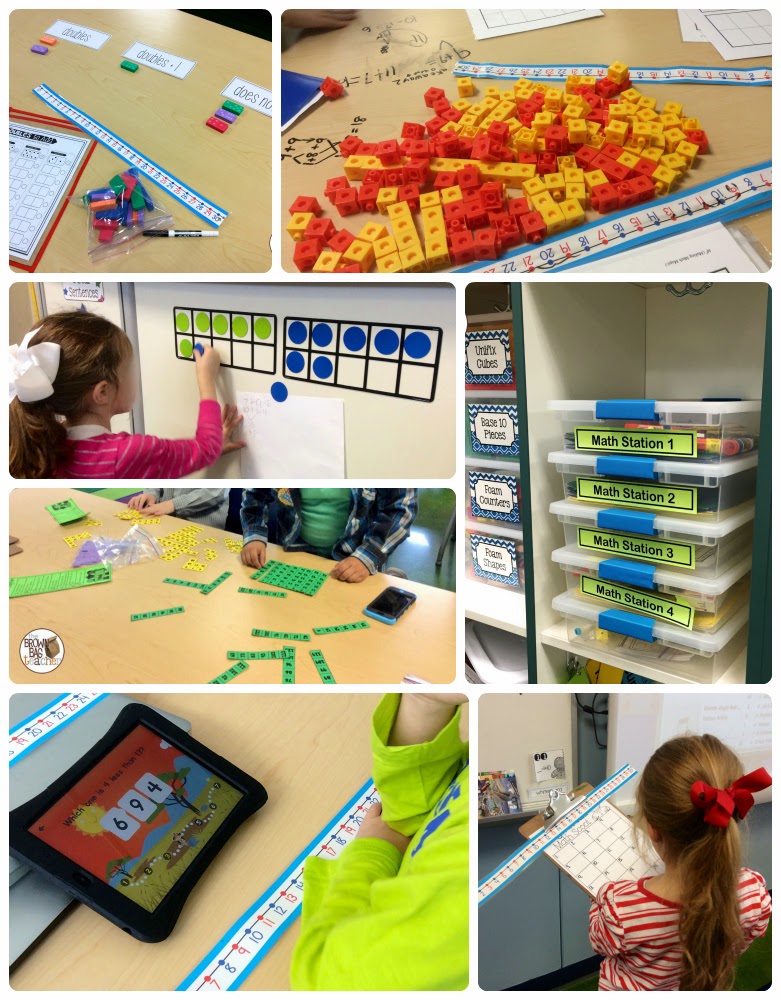
I’ll be honest, it’s definitely messy. My teacher table routinely looks like this – piles of unifix cubes, ten frames, and number lines strewn about…but that’s okay! We accomplish so much in our 17-20 minutes together, and I am loving teaching targeted skills to my small groups. For my classroom and my group of kids, guided-math is the answer!
Math Centers in Action
So, the question- What are students doing when they’re not with the teacher? While I am working with a group of students (6-8 students at a time), my other friends are working with technology or working with a partner at centers. Each day students visit all three rotations – me, technology and a center. I offer students 5 centers a week and students choose which center to visit each day. One center is always math notebook, one center is always Versatiles, and one center is always a Solve the Room; so I am only introducing 2 new centers each week (although we have practiced these activities in small groups at some point, so they’re not completely new).
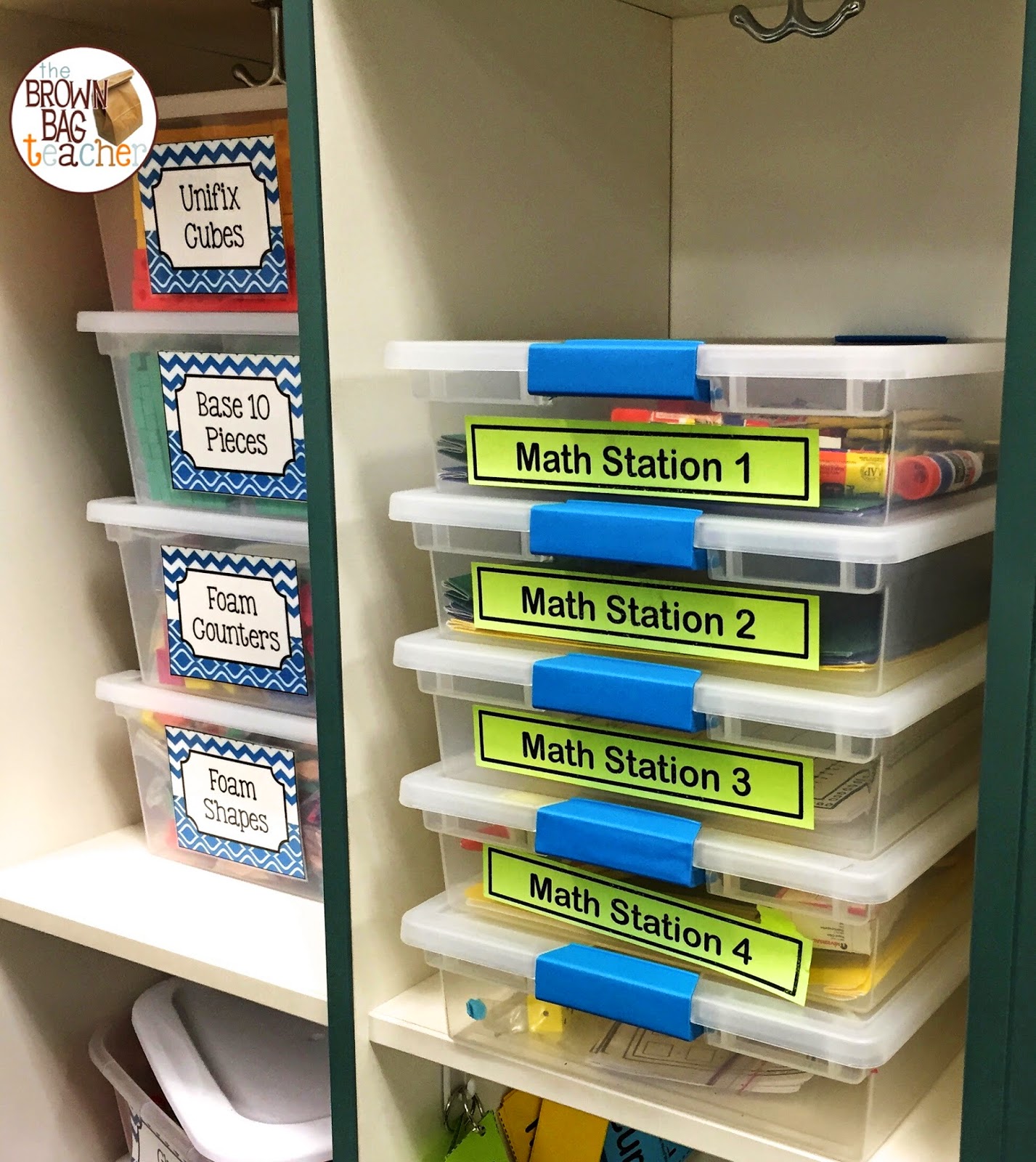
I store our math centers in large Sterilite containers with all the materials students might need. Our number lines are hung in the front of the room for students to grab, and our manipulatives are to the left of the math tubs for easy access. Students know they can grab whatever math tool they need to do their work.
Leveling Centers – Meeting Every Student
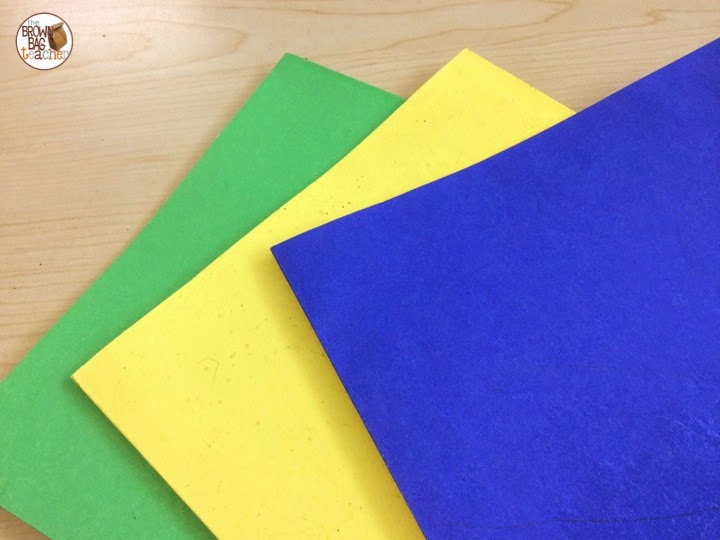
As I do with reading, students have a math color (green, yellow, or blue). When they visit the individual centers/pick a tub, they know to grab their colored folder. Each bin contains the same activity, just a different set of numbers or a different pack of dice. (Green = approaching grade-level, yellow = on-grade level, blue = above-grade level)
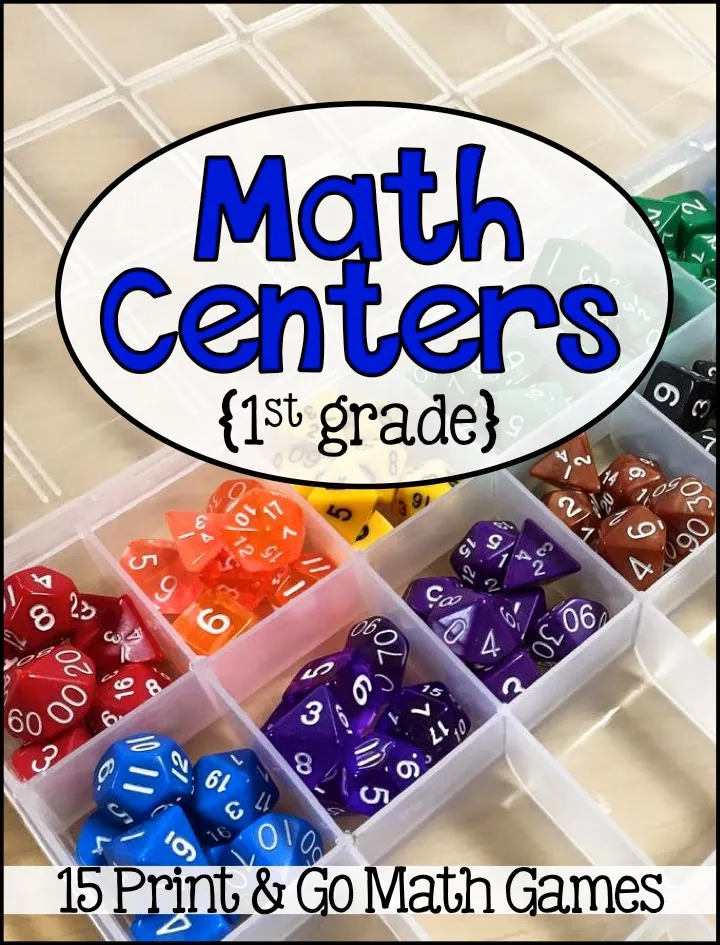
Since I picked up this set of dice on Amazon for $20, differentiating has been especially easy. Each colored set of dice came with 6-7 dices with 3 sides to 20 sides.
Centers in Action
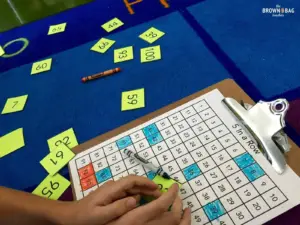
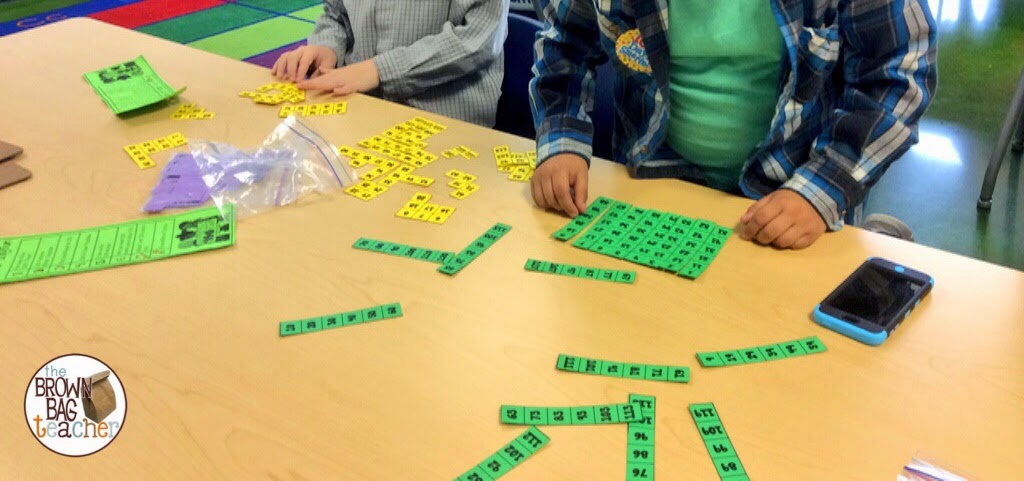
So, what’s in those bins?! Great question. Here are pictures of some of the activities we’re using or have used in the last 4-5 weeks. As a number-sense review, we’ve been rebuilding the 120s chart. I copy charts on color card stock and then, cut them into pieces. I color-coded the puzzles ROY-G-BIV with red being the most difficult and purple being the simplest (the more pieces/the more intricate the cut the more difficult). My kids are so ‘gamey’ that they love the idea of leveling up!
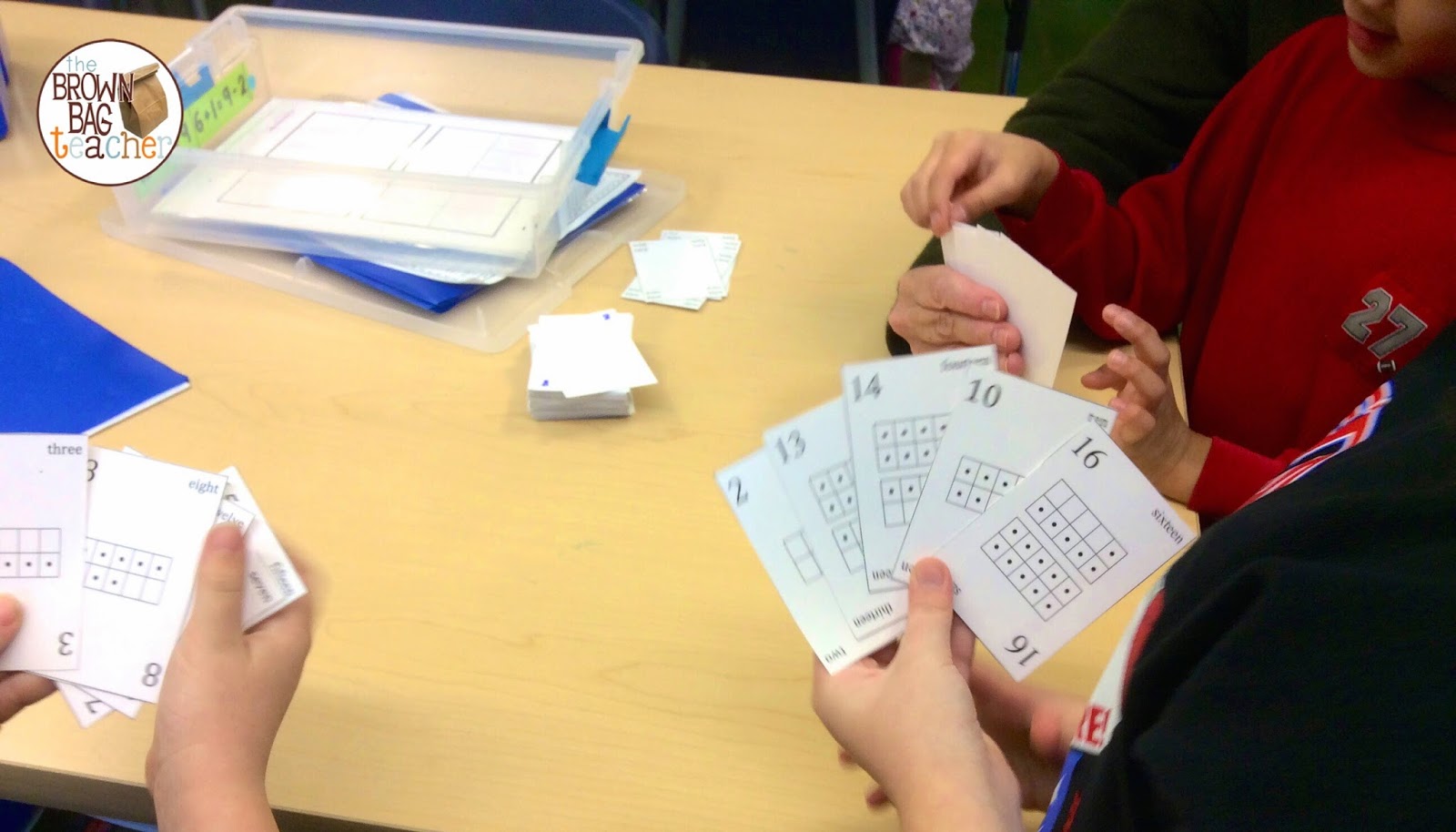
Using ten-frame and twenty-frame cards from our school’s Making Math Magic program (THE most fabulous number-sense program), we are also enjoying Making 10/15/20 Go Fish with our math center partners.
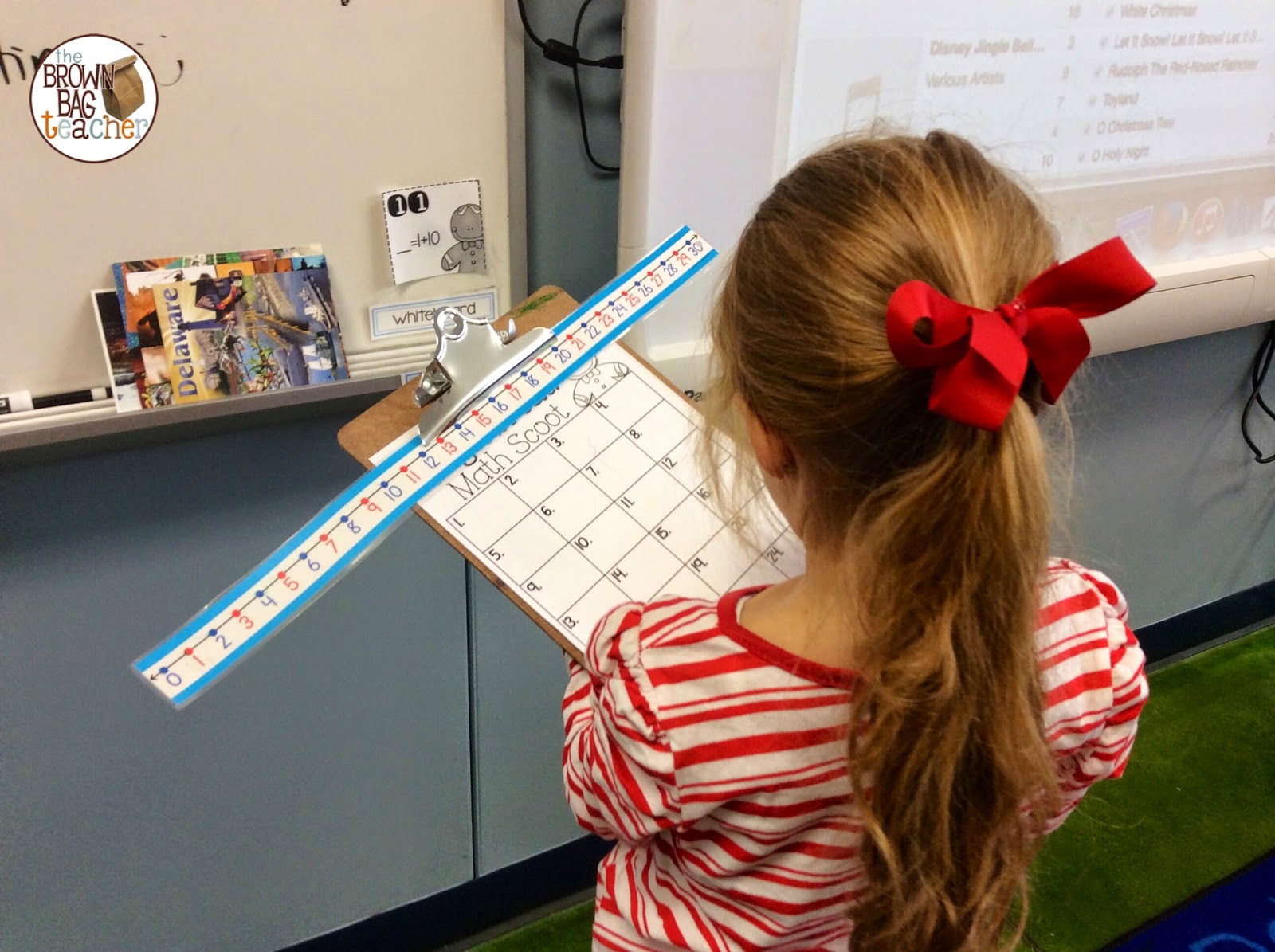
Solve-the-Room is one of our consistent centers each week. From subtraction to addition to greater than/less than, to missing addends, it is the perfect time to practice using a number line. Students grab a recording sheet, a clipboard, a number line, and a pencil. I love pulling from Crazy for 1st Grade and Thank God It’s First for many of our solve-the-room cards.
We also use our set of foam dominoes for sorts. They’re perfect for adding and sorting types of strategies we might use to solve the addition sentences. For my above-grade level friends, they will often use double dominos and then, create word problems to accompany the sorts.
Use our DI dice, one of my favorite centers is Add my 3 Numbers! Students roll 3 dice (the number of sides are based on their color group). Their first step it NOT to go to a number line; rather choose 2 ‘easy’ numbers to add. Once they’ve turned the 3 addends into 2 addends, they may go to their favorite math tool. It’s really neat to see what relationships the students see (counting on, doubles, doubles plus one, etc.) and it is great fluency practice. We use this recording sheet to save our answers.
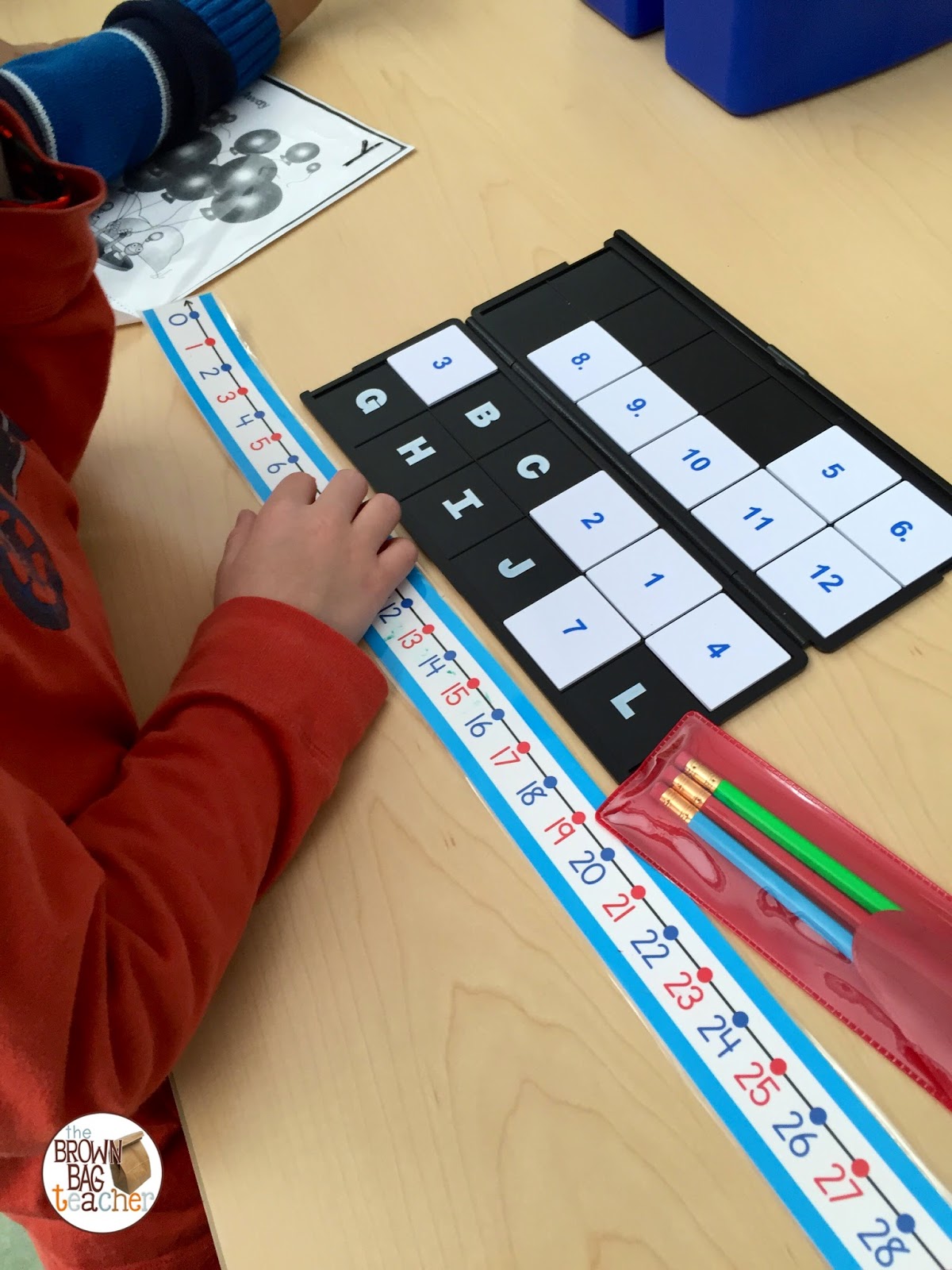
Another of our always-centers is Versatiles. Versatiles are an awesome self-checking resource for math and reading. For centers, I pull 3 pages on the same skill at different levels. On the bottom of each page there is a visual answer key. When students finish placing the numbers, they file the tiles to ‘see’ if they are right.
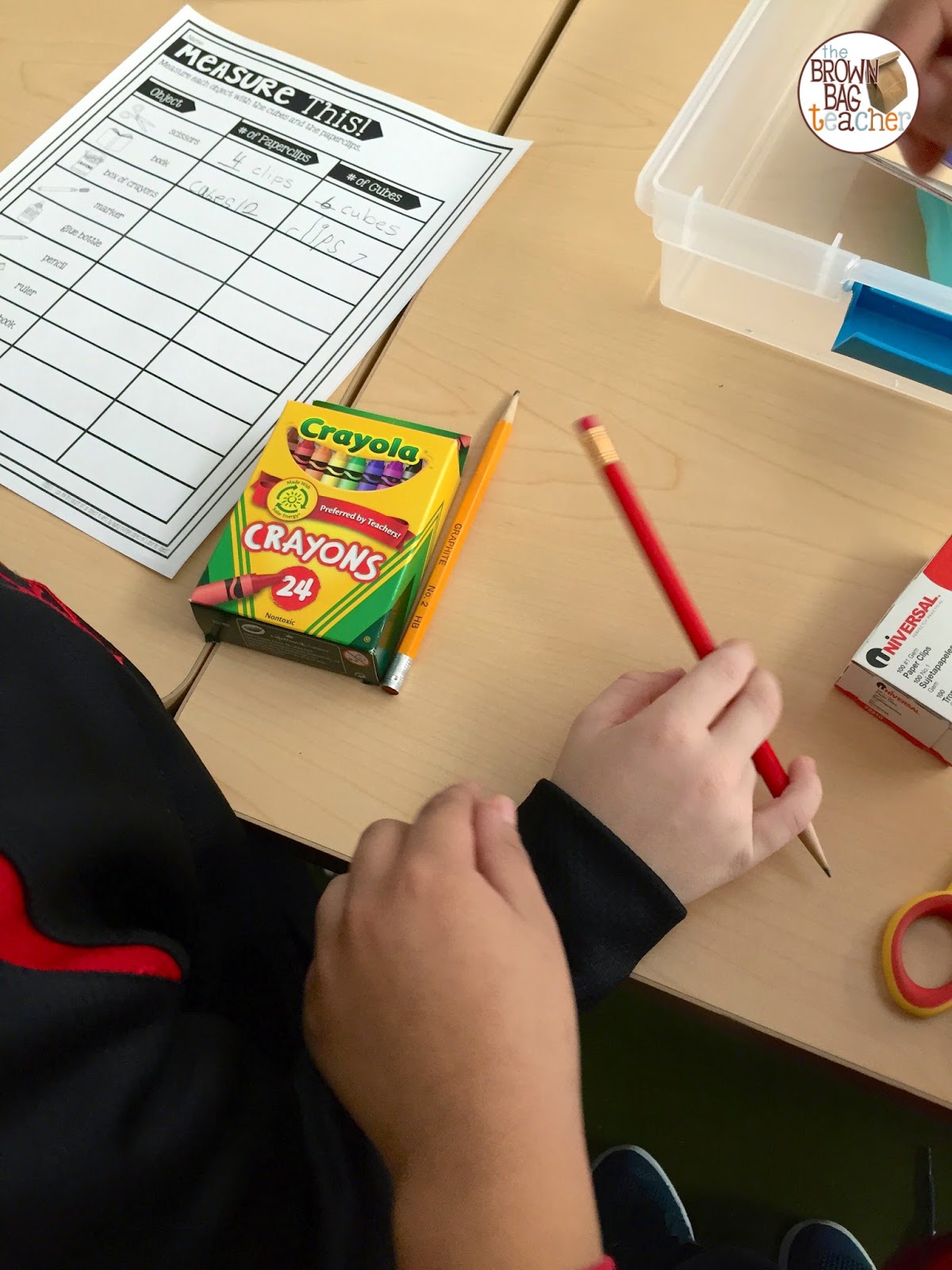
Starting 2 weeks ago, we’ve also started practicing with nonstandard measurement! It isn’t a skill we’ve explicitly taught, but it is a skill where students can get perfect, hands-on practice within centers. I use a recording sheet from my Math Centers pack to guide what objects students measure, and the last 2 objects are their choice!
Well friends, this is what our center choices look like when friends aren’t with me. I’ll be back in the next couple of weeks to talk about our technology choices, as well as, what my guided-math teacher-table looks like! In the mean time, what questions do you have? I’d love ideas for future blog posts. 🙂
I’ve complied many of our favorite centers, visual directions, and recording sheets into a 1st Grade Math Centers pack. If you’re looking to add to your math-center repertoire and just-starting to dabble in centers, this pack is for you. You can snag it here or by clicking below!
Catherine, I love these dice and definitely will be looking for them. I also love your games and will be putting them on my wish list. Thanks for sharing. I may have to try math groups in my room as my data also shows we are far more advanced in reading. Thanks for all the wonderful ideas.
I am dabbing into guided math this year. My biggest problem has been my concern for students to be independent during our no wry minute reading block and then we also have 75 minutes for math. Any thoughts?
Adriana Mrsadrianaberry.blogspot.com
Hi Adriana! Independence is always a HUGE issue in reading and math. Honestly, it is a lot of practice. We practice EVERYTHING from how to get a number line or who to go to ask a question (ask 3 before me) to how to clean-up a center. Initially, while we're still training, every time we mess up, we retry. Right now, we still meet on the carpet in between each round to review/reflect/practice. Eventually, we'll be ready to go from round to round without regrouping. So, my advice – just keep at it. Lots and lots of practice!
I just started doing math centers in my room two weeks ago. I love them so far but I keep tweaking them to make them better. Love all your centers!!
It sounds like we're in the same boat, April! Tweak, tweak we will. 😉
Hi- just discovered your blog and it is a gem! Thanks for sharing so much of what you do in great detail.
Question – what does the math notebooking look like in independent stations? Is this like writing to solve a problem? Or interactive notebook? If so do you use a specific resource for that? Interested to see if it was interactive what that would look like.
Thanks! Emily
Do you have a picture of your rotation board?
Hi Catherine! I love this post! What do you use for Math Notebook? My students have workbooks with our math program but at times they are very complex or just plain silly! I would love other options for them to use.
Hi Alyssa! I actually pull from all over for the math notebooks. Most of the math notebooks I purchase are WAY too easy…so I just pull the best from all over. The easiest way to get what I want is to make my own differentiated word problems!
I love the idea of math notebooks as a center choice! Do you keep them accountable in any way for doing the notebook entry each week? Do you find that some students always skip the notebook center and never do it? I’m moving to 1st for the first time, coming from 5th grade, so my older ones would never do this without some sort of accountability. I’m just wondering if it’s something you concern yourself with or not in first grade.
I read this article and its tell me first grade student how to solve math on paper thanks for share it best translation services .
I LOVE your blog and ideas!! I will be doing guided math (Daily 3) this year and am SO excited. I purchased your Math Centers for Second Grade and am working to get them organized. I noticed you provided 2 different center labels (labels for each center activity and math station 1,2,etc). Do you put each center into a sterility container or just a set of 6 centers? I'm trying to figure out how many containers to purchase. Thanks for sharing ALL your amazing ideas!!!
Hi Catherine! I just spent too many hours not cleaning/lesson planning on a Saturday, and instead on your amazing blog! I love all of your ideas you share! I love the idea of math groups, as I utilize them occasionally, but one question/concern I have about them is replacing whole-group teaching all together and still getting all the curriculum in. I struggle getting in the curriculum as it is and I have a hard time wrapping my head around getting that all in the 20 mins I would have with each group every day. How do you do it?! Thanks!
Hey Rachel! Our math centers have spiral review skills, so students see the skills many times over the course of the year. I also have a short mini-lesson at the very beginning of rotations. Then, during our talking numbers time we hit lots of mental math skills!
It’s the first official day of summer vacation and I’m already looking for ways to improve next year. Oh, the life of a teacher! lol Thanks for the ideas! You make guided math seem manageable. One question- are your groups fluid or are the usually the same and do you mix your leveled groups (such as high with medium or medium with low) or are they always all highs, mediums and lows together? Thanks!!
Hey Heather! My groups change every unit, so about 6 times a year. They can change more often if a specific student needs something different. During centers, students do work with students of other colors. Also, during number talks are done altogether, so students can hear the math thinking of lots of different people!
Get teaching tips and free resources
Practical K-2 math and upper-elementary morphology ideas, straight to your inbox. No spam, unsubscribe any time.



 on Amazon for $20, differentiating has been especially easy. Each colored set of dice


16 Responses
Catherine, I love these dice and definitely will be looking for them. I also love your games and will be putting them on my wish list. Thanks for sharing. I may have to try math groups in my room as my data also shows we are far more advanced in reading. Thanks for all the wonderful ideas.
I am dabbing into guided math this year. My biggest problem has been my concern for students to be independent during our no wry minute reading block and then we also have 75 minutes for math. Any thoughts?
Adriana
Mrsadrianaberry.blogspot.com
Hi Adriana! Independence is always a HUGE issue in reading and math. Honestly, it is a lot of practice. We practice EVERYTHING from how to get a number line or who to go to ask a question (ask 3 before me) to how to clean-up a center. Initially, while we're still training, every time we mess up, we retry. Right now, we still meet on the carpet in between each round to review/reflect/practice. Eventually, we'll be ready to go from round to round without regrouping. So, my advice – just keep at it. Lots and lots of practice!
I just started doing math centers in my room two weeks ago. I love them so far but I keep tweaking them to make them better. Love all your centers!!
April
Wolfelicious
It sounds like we're in the same boat, April! Tweak, tweak we will. 😉
Hi- just discovered your blog and it is a gem! Thanks for sharing so much of what you do in great detail.
Question – what does the math notebooking look like in independent stations? Is this like writing to solve a problem? Or interactive notebook? If so do you use a specific resource for that? Interested to see if it was interactive what that would look like.
Thanks! Emily
Do you have a picture of your rotation board?
Hi Catherine! I love this post! What do you use for Math Notebook? My students have workbooks with our math program but at times they are very complex or just plain silly! I would love other options for them to use.
Hi Alyssa! I actually pull from all over for the math notebooks. Most of the math notebooks I purchase are WAY too easy…so I just pull the best from all over. The easiest way to get what I want is to make my own differentiated word problems!
I love the idea of math notebooks as a center choice! Do you keep them accountable in any way for doing the notebook entry each week? Do you find that some students always skip the notebook center and never do it? I’m moving to 1st for the first time, coming from 5th grade, so my older ones would never do this without some sort of accountability. I’m just wondering if it’s something you concern yourself with or not in first grade.
I read this article and its tell me first grade student how to solve math on paper thanks for share it best translation services .
I LOVE your blog and ideas!! I will be doing guided math (Daily 3) this year and am SO excited. I purchased your Math Centers for Second Grade and am working to get them organized. I noticed you provided 2 different center labels (labels for each center activity and math station 1,2,etc). Do you put each center into a sterility container or just a set of 6 centers? I'm trying to figure out how many containers to purchase. Thanks for sharing ALL your amazing ideas!!!
Hi Catherine! I just spent too many hours not cleaning/lesson planning on a Saturday, and instead on your amazing blog! I love all of your ideas you share! I love the idea of math groups, as I utilize them occasionally, but one question/concern I have about them is replacing whole-group teaching all together and still getting all the curriculum in. I struggle getting in the curriculum as it is and I have a hard time wrapping my head around getting that all in the 20 mins I would have with each group every day. How do you do it?! Thanks!
Hey Rachel! Our math centers have spiral review skills, so students see the skills many times over the course of the year. I also have a short mini-lesson at the very beginning of rotations. Then, during our talking numbers time we hit lots of mental math skills!
It’s the first official day of summer vacation and I’m already looking for ways to improve next year. Oh, the life of a teacher! lol Thanks for the ideas! You make guided math seem manageable. One question- are your groups fluid or are the usually the same and do you mix your leveled groups (such as high with medium or medium with low) or are they always all highs, mediums and lows together? Thanks!!
Hey Heather! My groups change every unit, so about 6 times a year. They can change more often if a specific student needs something different. During centers, students do work with students of other colors. Also, during number talks are done altogether, so students can hear the math thinking of lots of different people!