Sight words play such an important part in building a foundation for reading…especially with my struggling first graders. Today I wanted to share with you a quick and simple game we use to practice our must-know words during guided reading!
What Do I Need?
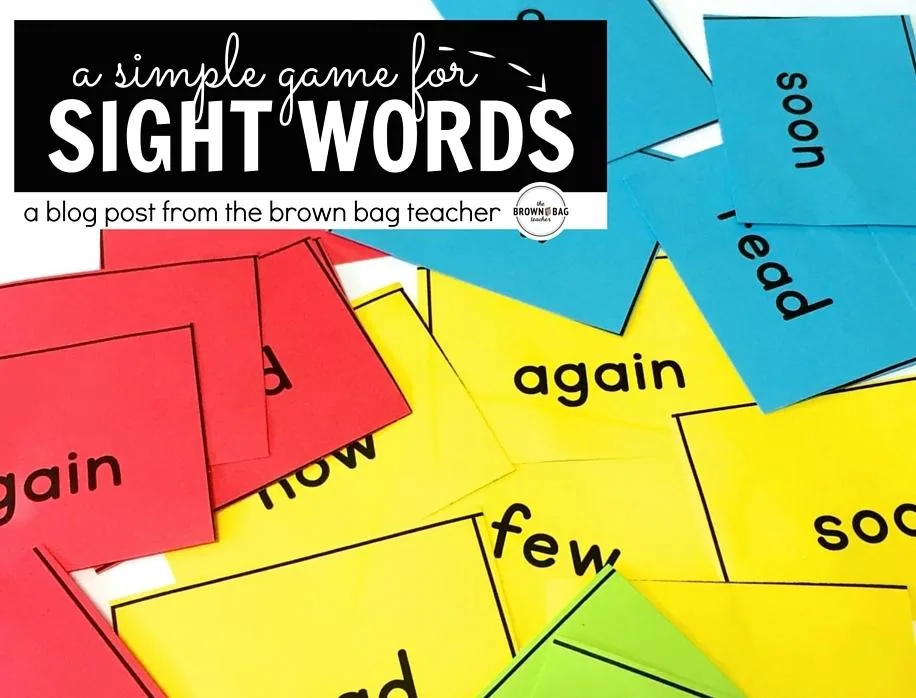
Know this is a VERY simple game, and it’s only a game because 1st graders are awesome and believe whatever you tell them. 🙂 I’ve included the templates and affiliate links for easy prep! To begin, I quickly type out our must-know words (or sight words) into a simple 3×2 table in PowerPoint. You can snag the template here. Then, I print enough sets of the words for each friend in my guided reading group. Each set is on a different color of Astrobrights Paper so they are easy to sort and collect. I paper clip each set together and they are ready to go all week! Plus, afterward, they are the perfect size to fit in card-collecting sleeve protectors!
Where Do You Get Your Words?
This year, our school is only using the basal for our phonics program and the sight-word sequence, and it’s working really well! (See more about how I use Reading Street here.) If you don’t have a reading program, you might use Fry Words, Dolch, or even vocabulary words from Flocabulary! This game is so simple and can be modified to work with any set of words (or even numbers and math problems).
How does it work?
When students come to my Guided Reading table (while other students are making Daily 5 choices) they find the cards in middle of my teacher table. Each students grabs a set of cards and lays them in front of them. I’ve taught my friends to make a 3×2 or a 2×3 arrangement, so we don’t sprawl everywhere!
When I arrive at the guided reading table, we do a quick review of all the words. I say a word and my friends point to the word or cover it with their paperclip. For this, I am only giving students a few seconds before moving on to the next word.
Next, I start using the words in sentences. Students have to listen to the words and then, put the must-know word or vocabulary word in the middle. Sometimes we’ll also hold the cards to our chests so wandering eyes can’t see them!
When using the cards for vocabulary words, I don’t actually say the word. I’ll say a synonym and students have to decide which word fits. For example, if our word was adapt, my sentence would be “Animals have to change to survive in their environments.” Students would be listening for the vocabulary word that should have been used in the sentence. Then, we will re-say the sentence with the vocabulary word or pull out our whiteboards and write the sentence!
Placing the Words in Context
Yes, I want my 1st grade friends to be able to identify the words (when they hear them and when they see them) BUT placing them in context is also a HUGE part of high-frequency words. Typically on Day 2 or 3, I pull out the whiteboards and we start pulling words to fit in sentences. I’ll have sentences pre-written on whiteboards. Students have to read the sentence and then, identify the word that fits in the blank. It seems simple enough, but it is tough for many of my friends – especially my friends who struggle and my ELLs.
We’ve learned how to use the process of elimination to “try-out” the words. “Read it will be my birthday again?” “Afraid it will be my birthday again.” “SOON it will be my birthday again.” My friends have gotten really great at asking themselves, “Does that make sense?” and I am seeing the transfer to their own reading and writing…which is AMAZING! (Bonus Points – this is a really important testing skills when students get into the upper grades and it’s such an easy one for primary teachers to assume the responsibility for teaching!)
Giving Up the Power
After a 2-3 days of teacher-led questions and sentences, it’s the perfect time to hand over the control. Give students the opportunity to be the teacher – asking friends to identify words, creating synonyms, writing sentences with missing words for their friends to “solve”. Students love being in charge (and having teacher permission to do so) and it really requires that they own the words they are quizzing their friends on!
How Long Does it Last?
Friends – guided reading is THE most important part of my day. I use Jan Richardson’s “The Next Step in Guided Reading” to structure my time, so Word Work is just one part of our time together. This game is intended to be simple and QUICK! So, we spend no more than 3 (4 max) minutes on it. It’s a warm-up and fast paced…then, it’s time to move on!
Other Ways to Use This Game
Numbers – Print a number or equation on the cards. As a math warm-up describe the numbers in different ways and have students identify the numbers you’re describing. “I’m thinking of a number that is 6 more than 5.” “I’m thinking of a number that adds with 7 to make a ten.” “I’m thinking of a number that you would count when counting by 2s starting at 5.”
Vocabulary – No matter the content (reading, science, social studies, math, etc.) students can get some quick in-action practice. From synonyms, antonyms, real-life examples, and definitions – there are TONS of opportunities for students to think about a word in different ways.
Pictures – For pre-readers or friends who need more support, you might have pictures (easily found on Google) that describe different concepts. You could use adjectives to describe a pictures and students have to identify it. You might also describe different settings or characters and have students identify them. Then, students can easily add their own details or use the pictures for a writing prompt in Work on Writing.
I told you friends, I super simple, fast-paced, and easy ‘game’ for getting students in the sight-word groove! Is this something you’ve used before or think your friends would like? Have you used this idea in a different way? I’d love to hear your ideas!
What great ways to help students practice sight words. I've been looking for ways to change up what I do with my students during our intervention time. I cannot wait to try out some of these ideas when we get back from vacation. Thank you!
Hello! I downloaded KG Primary Penmanship from TpT. It is really easy to read and one of my go-to fonts!
Thanks for sharing. I was wondering which font you had used?
Hello! I downloaded KG Primary Penmanship from TpT. It is really easy to read and one of my go-to fonts!
Can I just say I love everything you do?! You are such an inspiration to me. I love to think outside the box as well, and have fun learning in the classroom at the same time. Your ideas have saved me so much time! Thank you!
Get teaching tips and free resources
Practical K-2 math and upper-elementary morphology ideas, straight to your inbox. No spam, unsubscribe any time.



7 Responses
Thank you for sharing these wonderful ideas to help students learn the sight words! It's just what I need for my students!
Teaching Special Kids
What great ways to help students practice sight words. I've been looking for ways to change up what I do with my students during our intervention time. I cannot wait to try out some of these ideas when we get back from vacation. Thank you!
~ Sarah
One Modern Teacher
What font was used for the sight word cards?
Hello! I downloaded KG Primary Penmanship from TpT. It is really easy to read and one of my go-to fonts!
Thanks for sharing. I was wondering which font you had used?
Hello! I downloaded KG Primary Penmanship from TpT. It is really easy to read and one of my go-to fonts!
Can I just say I love everything you do?! You are such an inspiration to me. I love to think outside the box as well, and have fun learning in the classroom at the same time. Your ideas have saved me so much time! Thank you!