Happy Thursday, friends! Today marks the second week of our Reading in the Wild summer book study. If you are just joining us and missed the first week (Wild Readers Dedicate Time to Read), you may check it out here. Without further adieu, Our hosts for Chapter 1: Creating a Workshop Schedule that Works for You are Jivey from Ideas by Jivey and Chelsea from Flip-Floppin’ Through 3rd Grade.
Today I’m sharing with you the Reading Workshop schedule that worked for me and my group of 5th graders. This year I taught 3 reading classes, each with 30 students. The first class of the day I co-taught with an amazing Special Education Teacher. ohmygoodnessiwouldnthavesurvivedwithouther. My other two reading classes weren’t intentionally ability-grouped, but generally the second class was on-grade level, and my third class was above-grade level.
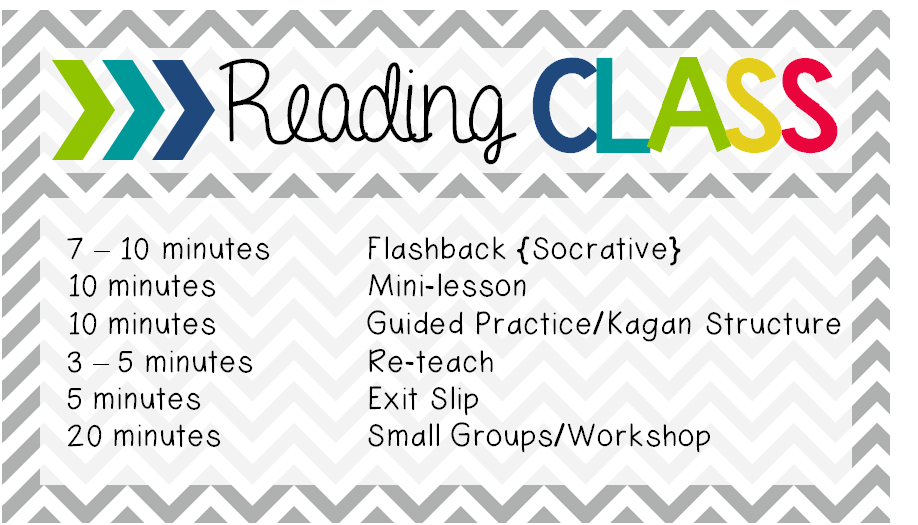
With that said, I had 55 minute class periods (including a transition time), so most days it turned into 52ish minutes. Our District has a veryspecific format or “blueprint” for classes that I was expected to follow daily. You’ll see the format below – flashback, mini-lesson, guided practice, exit slip, and then, small groups/reading workshop.
Every. Day. Friends. No. Wiggle. Room. So, we made it work! 🙂
What are flashbacks?
In our district, flashbacks are 3-5 multiple choice questions that open all of our classes. They are very intentional Common Core spiral reviews of skills. Flashbacks are not intended to review materials being taught right now or even content taught a week ago. Rather, we flashback to topics already assessed. Since I am 1:1 iPad classroom, we use the free Socrative app to take our flashbacks {and it’s AMAZING!}.
What’s a Kagan Structure?
Kagan is all about cooperative learning – not group work – with frequent modeling, celebrations, community building, and brain breaks…sounds fun, right? Kagan structures hold every student accountable and eliminate ‘hogs’ and ‘logs’ in the learning process. Every person in our district is Kagan trained and it has TOTALLY revamped my idea of my classroom. Hands down, it is the best training I’ve received. I have shared more about Kagan here!
What about read aloud?
We started every reading with a poem read orally, but in terms of novels read-aloud, each homeroom teacher read with her class before or after lunch for 10-15 minutes.
How Do You Run Workshop?
Fantastic question! I’m going to give you several answers. They show how much I’ve changed as a teacher and how my reading period changed throughout the year.
First, I am about to be really honest with you. I waited way too long before introducing reader’s workshop. Until October or so, my mini-lessons were not mini and my flashbacks were not flashes…With encouragement from my mentor and knowing the importance of the workshop time, I tamed my mini-lessons, flashbacks, and everything in the middle. At first, my “workshop” was very structured. I gave students no autonomy or control. I know, I know, I know. The thought of giving up control hurt my mind and I could fight the nagging question – “Will students really make the choice that they need most or just the one that is easiest for them?” With that said, my first workshop schedule (October – January) looked like this – 13 stations in a 2 week rotation. Students went to 9 stations in the two-week period {one a day, assuming that 1 day out of 10 we did not have time for workshop.} Students did not go to every center.
Students spent 17-19 minutes at each rotation and accomplished one task a day. Students worked in groups of 2 or 3 and were grouped with the closest person(s) academically at that time. I regrouped students every two weeks (if needed) based on Common Assessments (tests), flashbacks, exit slips, and teacher observation. During centers, I kept the below chart on the board so students knew where to go, and a timer going on the TV.
We’re friends now, so let’s be honest with each other…it really wasn’t workshop. In fact most of the actual work was being done by me – creating, printing, laminating, assembling, and checking. The students were LOVING the activities, and they loved working in groups, but it wasn’t sustainable. It was exhausting.
After a literacy coordinator visited during our Professional Learning Community time, my co-teacher and I decided to move more toward the workshop model giving students choice, responsibility, and autonomy using a monthly choice board. (Please note – this was never perfect, but it worked so much better!) Students chose which activity to complete based on the goal we had set for them. They were expected to visit one activity in each learning section (time spent reading, common core skills, word work) every two weeks. Many of the squares take several days to complete, so some students might only make it to 3 squares, while some students (often my students who struggle with building reading stamina) might make it to five or six squares in a two-week period.
If a station required more directions or explanation than I could fit in a box, I included an audio QR code to share my expectations with students, as well as, the “I Can” statement.
With the choice boards, the majority of our workshop time centered around our classroom library. Only in the Word Work column are students not actively engaged with reading material. This was the most important shift with our schedule and truly got to the heart of what reading class should be…reading! Students spent more time reading books of their choice, responding to their reading, and sharing their reader (informally by sitting next to a friend and sharing while reading) or in a more formal way as shown above.
Additionally, only the 2nd and 3rd Word Work choices changed every 2 weeks, so students knew what to expect, and I spent more time working with students rather than managing workshop!
With the choice boards, students still had access to some of our print-and-cut centers/materials, but would often trade an activity out if they needed more practice or if they were struggling with their stamina and needed to change courses. I upgraded from manila folders to more durable and organized Sterilite bins. You can read more about how I organize these materials by clicking below.
While students are at their chosen station, what are you doing?
During workshop, I am doing one of three things (1) conferring with a student (2) assessing students (3) meeting with a small group. When I am conferring with students one-on-one, I use a Google Doc (similar to the one Miller provides in her book) to take notes. In my small groups, we focus on target-intervention (Common Core skills that were not initially mastered). Typically, the same group of student visited me 2 or 3 days, before I take days off to confer or pull another group.
——————-
Well friends – confusing enough? My workshop style definitely changed throughout the year, and by the end of the year, it was glorious! My kids loved having choice and independence. One day we even ditched the lesson plan and workshop-ed the ENTIRE class period. IT WAS AWESOME.
Now, share with me, how do you run your workshop? What works for you and your students? What doesn’t work? If you’re a blogger, awesome! Link up your posts/ideas. If you’re not a blogger, that’s great, too! You can read/follow and comment. We want to hear your advice, thoughts, and ideas for the classroom, too. The more teachers we have joining, the more amazing our classrooms will be this fall! Next week, we will be reading Chapter 2: Wild Readers Self-Select Reading Material.
Mrs. Allen, I was able to hear Catherine speak at a conference last fall! She was phenomenal. We should request a day to go observe her teach!
I like the way you run your reader's workshop! Do you have one workshop menu for every month? I think the flashback portion would work really well for my students. Unfortunately, we don't have ipads but I think I could do something similar to exit slips. You definitely have me thinking after reading your post – thank you!!
This post is most definitely getting pinned! The tech piece is huge for me and I want to try that out as well as the choice menus. As a gifted cluster teacher, that's what I do for my students for enrichment…for both my mainstream and my gifted students. So, this could easily make its way into Reader's Workshop. Awesome! And I won't throw rotten veggies at you because once you read my post…well, you'll know why…and I'm going into my 10th year of teaching. The hardest thing for me is cutting down my lesson to what would be considered a mini-lesson. My district asks us to teach sooooo many standards in one week, that I don't even know how I could do it in 10-15 mini-lessons. This is the hardest part for me. Hardest.
Mini lessons that are actually mini are SO hard. I have an even harder time when we have to read an article/story to work through the standard!
You are doing an amazing job as a first year teacher! I'm moving into my 8th year and still struggle with workshop (in fact I'm hoping to learn a lot from all you on how to revamp…or should I say completely overhaul my workshop time). The timing is what always gets me, my mini lessons tend to turn into full lessons. I gotta work on that! Thank you once again for all the great ideas! I am definitely going to refer back to this post!
Isn't it so hard to run workshop the way all the books tell you when you have someone else telling you what you "have" to do? EEK! That is something I've had to get over, it's a rare thing that you will ever just get to close the door and teach. (I still love my job! It's just not what I ever expected from all the great books I read in college.) 😛 I love your menu!! Such great ideas! jivey
There are just so many great little tips in here ~ so appreciate your thoroughness! 🙂
-Lisa
Amazing! I am getting ready to start my first year and pray it will be as successful as yours. I love the idea of choice menus. I maybe back to ask more questions.
Oh my gosh, I love your monthly choice board!!! And the QR codes on it! I need to do that next year!! You have so many amazing ideas! I wish we could teach together!!!
Molly
I love your workshop menu! I previously used Daily 5, but my district switched to a reading program that requires we do centers instead. I think that with your menu, I could tweak things a little bit so that it's a little bit closer to the Daily 5 that I LOVED using before. I also link surfed and found so many great ideas as a result of this post!
Thank you so much for this post! I am returning to the classroom after stepping out for 4 years to be a stay at home mom. I saw a lot of posts about Readers and Writer's workshops, but I didn't know what it would look like (or if it was honestly possible) in a middle school classroom. So thank you so much for your perspective…I can't wait to apply the information you shared! – Candace
These had multiple great ideas! I would love to use some in a workshop I am planning. A lot of my students are struggling with basic math and reading skills. I think implementing them into something like this would be extremely beneficial for the children! http://www.learningencounters.com/workshops.php
Get teaching tips and free resources
Practical K-2 math and upper-elementary morphology ideas, straight to your inbox. No spam, unsubscribe any time.






14 Responses
Tons of great ideas Catherine! I will definitely be saving this post to add new and fresh things to implement my reading workshop!
Chelsea
Flip Floppin' Through…3rd Grade
Mrs. Allen,
I was able to hear Catherine speak at a conference last fall! She was phenomenal. We should request a day to go observe her teach!
I like the way you run your reader's workshop! Do you have one workshop menu for every month? I think the flashback portion would work really well for my students. Unfortunately, we don't have ipads but I think I could do something similar to exit slips. You definitely have me thinking after reading your post – thank you!!
Sara 🙂
The Colorful Apple
This post is most definitely getting pinned! The tech piece is huge for me and I want to try that out as well as the choice menus. As a gifted cluster teacher, that's what I do for my students for enrichment…for both my mainstream and my gifted students. So, this could easily make its way into Reader's Workshop. Awesome! And I won't throw rotten veggies at you because once you read my post…well, you'll know why…and I'm going into my 10th year of teaching. The hardest thing for me is cutting down my lesson to what would be considered a mini-lesson. My district asks us to teach sooooo many standards in one week, that I don't even know how I could do it in 10-15 mini-lessons. This is the hardest part for me. Hardest.
Mini lessons that are actually mini are SO hard. I have an even harder time when we have to read an article/story to work through the standard!
You are doing an amazing job as a first year teacher! I'm moving into my 8th year and still struggle with workshop (in fact I'm hoping to learn a lot from all you on how to revamp…or should I say completely overhaul my workshop time). The timing is what always gets me, my mini lessons tend to turn into full lessons. I gotta work on that! Thank you once again for all the great ideas! I am definitely going to refer back to this post!
Chelsea
Fifth Grade Wit and
Whimsy
Isn't it so hard to run workshop the way all the books tell you when you have someone else telling you what you "have" to do? EEK! That is something I've had to get over, it's a rare thing that you will ever just get to close the door and teach. (I still love my job! It's just not what I ever expected from all the great books I read in college.) 😛 I love your menu!! Such great ideas!
jivey
There are just so many great little tips in here ~ so appreciate your thoroughness! 🙂
-Lisa
Amazing! I am getting ready to start my first year and pray it will be as successful as yours. I love the idea of choice menus. I maybe back to ask more questions.
Misty
Think, Wonder, & Teach
Catherine!!
Oh my gosh, I love your monthly choice board!!! And the QR codes on it! I need to do that next year!! You have so many amazing ideas! I wish we could teach together!!!
Molly
I love your workshop menu! I previously used Daily 5, but my district switched to a reading program that requires we do centers instead. I think that with your menu, I could tweak things a little bit so that it's a little bit closer to the Daily 5 that I LOVED using before. I also link surfed and found so many great ideas as a result of this post!
Kristin
Teaching In A Nutshell
Thank you so much for this post! I am returning to the classroom after stepping out for 4 years to be a stay at home mom. I saw a lot of posts about Readers and Writer's workshops, but I didn't know what it would look like (or if it was honestly possible) in a middle school classroom. So thank you so much for your perspective…I can't wait to apply the information you shared!
– Candace
These had multiple great ideas! I would love to use some in a workshop I am planning. A lot of my students are struggling with basic math and reading skills. I think implementing them into something like this would be extremely beneficial for the children! http://www.learningencounters.com/workshops.php