
Phonics is a critical part of our primary lives. We sing phonetic songs, we chant them, we read phonetic poems, and then, we do it all again. Phonics matters. Students need to be able to differentiate between different sounds and then, apply them to their own reading. Phonics helps develop automaticity as students read these patterns, and continuous exposure allows students to make the connection to their own writing, reading, and spelling. With that said, basic sound sorts of single-syllable don’t offer ‘just-right’ practice for all our friends. So, today I want to share about how I differentiate sound sorts for all the friends in my class.
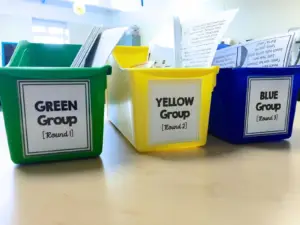
Just like my reading and math center, I differentiate our sound sorts using colors – green, yellow, and blue. (Read more about my system here.) The first level of our sound sort includes mostly CVC and CVCe words, perfect for students who are approaching grade-level. The second level includes words that often include multiple phonics patterns or include blends (ex. celebrate, nudged), and for patterns that sound identical I leave blanks (i.e. power/pound would be p__wer and p__nd). The third level includes several phonics patterns, inflected endings, and higher-level sight words. On this highest set, I always include blanks where the phonics patterns belong.

I print the card sets for my students (one on green Astrobrights card stock, one on yellow Astrobrights card stock, and one on blue Astrobrights card stock) and place them in a plastic bag above the Pocket Chart using a magnet. When students choose word sort, they know to grab their ‘just-right’ color and get to work!

Since the sorts are a just-right challenge for my students, I do ask students to work in pairs for this choice. Our Phonics Sort Center expectations are…
1. Greet my partner.
2. Pick my just-right word color.
3. Get to work right away.
4. Pull 1 card at a time. Have both partners read the card.
5. Sort the word under the correct heading.
6. Record the word.
7. Continue until all our words have been sorted.
8. Use my words in sentences.

To ensure that partners can be successful, I include these sorts in Word Work the week after they have been taught in small-groups. This provides the perfect spiral review, and allows me to pull skills I know we need to practice in alternating week. Typically, students see 2 ish sorts a month.

If you are a tech-based classroom, these digital sorts are perfect for you. Students have the opportunity to say the word, sort it, and use it in a sentence. You can snag them here.

To store our Sound Sorts, I keep them in a 2-inch binder with each individual sort in a plastic-sleeve protector. It’s simple and easy to flip through grabbing what I need.

Ultimately – phonics matters. Foundational skills instruction instruction helps ensure ALL students are able to decode and encode texts. It provides solid core instruction for all students and then, follows-up with small group and targeted instruction practice.
If you are interested in additional resources for your classroom check out:

6 Responses
Added to the wish list… along with the rest of your TPT store! =) I love how you differentiate learning! You make it seem so simple, yet I feel like I always 'work harder and not smarter' when it comes to differentiation. Any tips would be greatly appreciated!
Hi Tracy! Thanks so much for the note. My biggest tip would be to color-code your groups. It makes it simple for our students, and simple for me to organize materials. Also, you might try the same colors as your entire team. It's much easier when your all working together and on the same page. I've talked about about how I use color for DI here – http://thebrownbagteacher.blogspot.com/2014/10/differentiating-your-classroom-with.html
I love your blog! I had a question about your word cards. Do you have two sets of each? One for sorting (take out the pattern in the words) and one for the rest of the word work stations on the key rings?
I really like your approach to word sorts. I've never been comfortable having the students just sort the words since I know many of them look for the pattern (ai/ay) instead of actually reading! I've used pictures but this cuts down on the 'what's this?' picture questions. I look forward to using this next year! Thank you for sharing!
Interactive online math homework help ,Best site for math homework help solutions
Do you have a phonics program that you follow in addition to your activities. We are looking at programs now, and your sorts seem to be a great activity.