

“Why do biology and biography both start with bio?”
“Why is it impossible instead of inpossible?”
These are the kinds of questions that make word study worth our time! Students are noticing patterns. Our job is to help them investigate how those patterns connect to meaning.
Many English words contain parts derived from Greek and Latin. Learning these meaningful parts gives students something to draw on when they encounter unfamiliar vocabulary in reading, science, social studies, and math.
Word study was a huge focus in my fifth-grade classroom. Some of our most useful learning happened in short conversations about words we were already reading. We introduced a meaningful part, explored related words, and kept coming back to it throughout the week.
Here’s how we can help students understand Greek and Latin roots and give them meaningful opportunities to use what they learn.

Before asking students to analyze words independently, we need to show them what they’re looking for.
A root carries a word’s core meaning. Some roots can stand alone as English words, while others appear within larger words. Prefixes attach before a base, and suffixes attach after it.
For example, students can connect port, meaning carry, to words such as transport, portable, and export. Rather than stopping at the root’s definition, ask:
Each week, as I introduced words for our class word wall, we analyzed the words we were learning, focusing on particular prefixes, roots, or suffixes. This gave us a reason to study word parts and opportunities to use them again.
If you’re getting started, my Morphology Instruction post shares more about introducing meaningful word parts and building cumulative practice.
Students don’t need to memorize the origin of every word. However, knowing a little about where words come from can help us explain patterns in their structure and spelling.
Consider these four words:
biology • geography • magnify • uniform
The Greek-derived forms bio-, meaning life, and geo-, meaning earth, help us understand biology and geography. In these words, -logy relates to study, and -graphy relates to writing or description. Geography involves describing and studying Earth.
These Greek elements are often called combining forms. They carry meaning and combine with other word elements to build words. Students can connect biology to biography, then explain how the idea of life contributes to each word.
Now consider the Latin-derived words:
After explaining the parts, return to the four words. Ask students:
“How do these meaningful parts help us understand each whole word?”
Students can underline familiar parts, explain a connection to a partner, and use each word in a sentence. The explanation matters more than sorting the words by origin.
Teachers may notice the o in Greek combining forms such as bio- and geo-. In Greek-derived word construction, o often functions as a combining vowel.
For classroom instruction, we can introduce the conventional forms bio- and geo- together with their meanings. We don’t need to describe the o as a random “filler letter.”
Connecting vowels occur in particular word formations. Avoid turning them into a rule that Greek words always use o and Latin words always use i. In our examples, keep uni- together in uniform and -ify together in magnify.
The useful question is: Which parts carry meaning, and how do they work together?
Write these words on the board:
inactive • impossible • illegal • irregular
Ask students to identify the familiar base in each word. Then compare the meaning before and after adding the prefix:
| Word | Meaning |
|---|---|
| inactive | not active |
| impossible | not possible |
| illegal | not legal |
| irregular | not regular |
All four contain forms of the Latin negative prefix in-. In this family, im- occurs before b, m, or p; il- before l; and ir- before r. These established spellings reflect a process called assimilation, in which a sound becomes more like a neighboring sound.
Have students say impossible slowly and notice their lips. Both m and p are made with the lips together.
Then let students predict and explain:
Together, check incomplete, immature, illogical, and irresponsible. Ask students to explain both their spelling choice and the word’s meaning.
One caution: these beginning letters don’t always mean not. For example, inside doesn’t mean “not side”! Students need to consider meaning before deciding that they’ve found a negative prefix.
Each week, we also focused on one root using our Root of the Week resource.
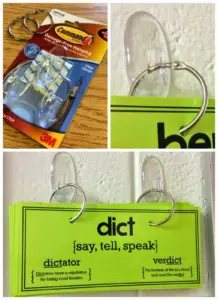
I posted our root word wheel outside my classroom door using root cards, Command Hooks, and binder rings. It became a “password” as students entered the classroom.

After plenty of modeling and practice, students led a short activity each morning: record it, list it, picture it, chant it, and teach it. These three- to five-minute routines helped us revisit the same meaningful part in different ways. You can see more of the routine in my Root of the Week post.
For a focused mini-lesson, try this sequence:

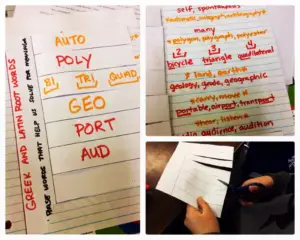
As we learned new roots, we also added them to our reading interactive notebooks. A useful entry includes the root, its meaning, related words, and an explanation of one connection. The blank templates in my Morphology Games resource can be adapted to the words students are studying.
Even with mini-lessons and a weekly focus, my students needed repeated opportunities to work with words.
I created Greek and Latin Root Puzzles for hands-on practice during literacy centers. Each puzzle connects a root, its meaning, and a word used in a sentence.
I often selected seven or eight puzzles for the week, drawing on roots we had already introduced. To extend the matching task, ask partners:
“How does the root’s meaning connect to the word in this sentence?”
Students can record that explanation using a word web, Frayer model, or learning log. Choose the format that helps you see their thinking. They don’t need to complete every recording option.
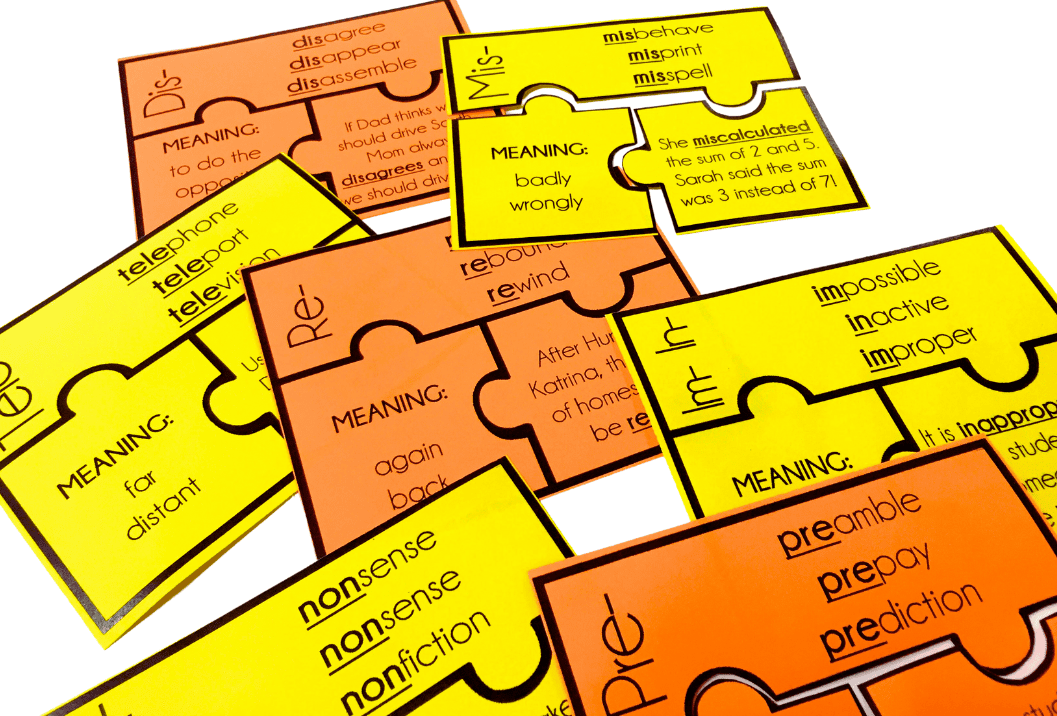
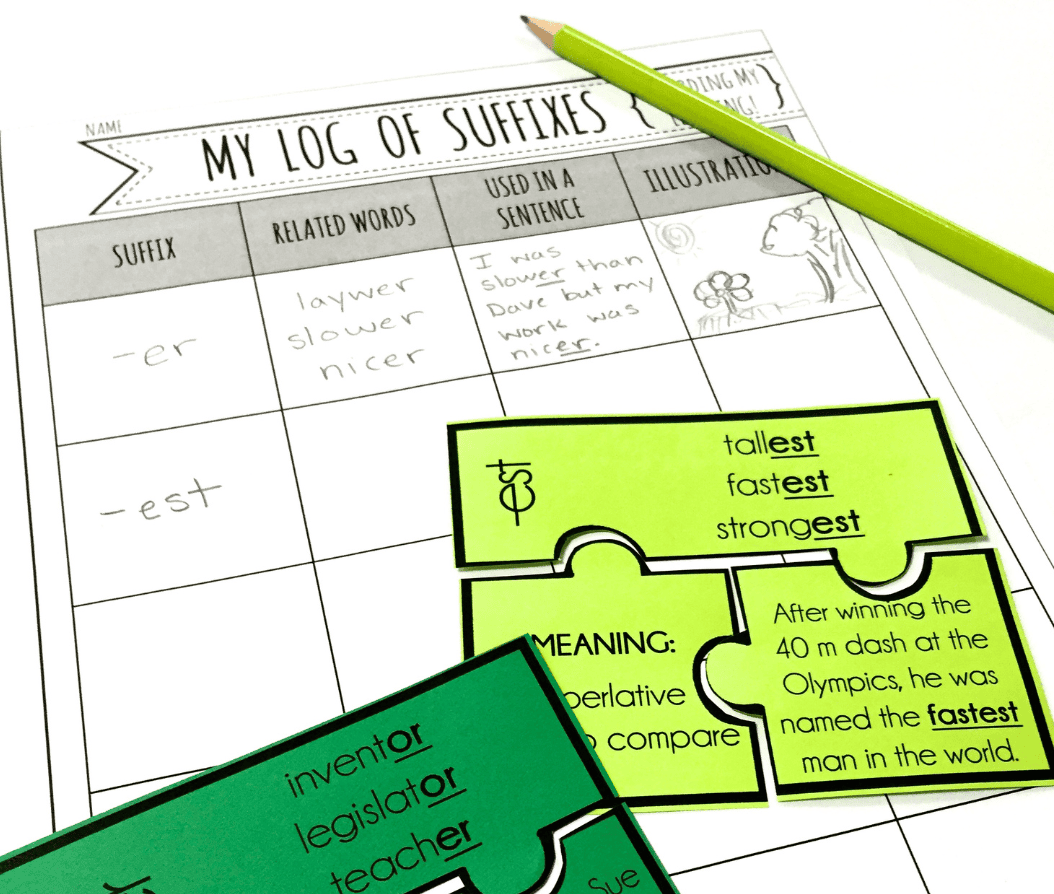
To hold my students accountable, I also included four different accountability options for students. The first is a log, where students record the roots they are learning throughout the year. I’ve also included Frayer models, webs for making connections among root words, and a general puzzle piece recording log. All of these resources aren’t meant to be busy work, but function to make sure students are staying on track…we all know how easily distracted our 10 year olds can be when partnered with a friend.

Check out how this 5th grade classroom (Stacey at Literacy for BIG Kids) sets-up her reading centers for easy access! No fuss or frill. The best.
One of our favorite practice games was Stacks!
I wrote a root on the bottom of each cup and its meaning inside. Students worked in pairs, taking turns selecting a cup.
Before adding it to the pyramid, a student:
Their partner checked the explanation using the answer inside the cup and a familiar example or reference sheet. If they were unsure, they checked together before adding the cup.
Students worked together to build their pyramid during our 12-minute center. Simple materials, repeated practice, and plenty of word talk!
For additional practice formats, visit my Root Word Games post.


Plus, Molly Malloy from Lessons with Laughter is using the Morphology Matching cards for a game of memory with her students.
The most useful word investigations often begin with something students are already reading.
During a science lesson, you might introduce geo-, meaning earth, and explain that geothermal relates to Earth’s heat. Then read:
“Some communities use geothermal energy to heat buildings. This energy comes from heat within Earth.”
Ask students:
“How do the word parts and the next sentence help us understand geothermal energy?”
This connects word analysis to understanding the text. Recognizing a meaningful part gives students a starting point; the surrounding sentences help them check and refine their interpretation.
With a classroom text, choose a small number of useful words to investigate. Model one, discuss another together, and revisit the meaningful parts when they appear again.
Before wrapping up, give students a new word containing a part you’ve already taught.
After studying port, meaning carry, try:
“We packed a portable stove because we needed to carry our cooking equipment to the campsite.”
Ask students to:
Listen for whether students can connect port to the idea that the stove can be carried. If they can name the root but can’t explain the whole word, model that connection again.
You can do this on a sticky note, a whiteboard, or in a quick partner conversation.
You don’t need a new activity for every root. Start with one meaningful part, a few carefully chosen words, and a routine you can return to.
Model how the parts contribute to meaning. Give students opportunities to explain their thinking. Then help them recognize those parts in their reading.
If you’d like ready-to-use support, these resources serve different purposes:
Keep coming back to the question: “How does knowing this part help us understand the word?”

6 Responses
I used Reading Olympians last year with success, but unfortunately I don't have time to implement it this year 🙁
We definitely have tight schedules! I am able to slip it in during the last 10 minutes of our class (during literacy centers), and kids really enjoy it. 🙂
Can I just say that I love your blog?! It's so often just packed FULL of great ideas and details! 🙂 I particularly love you idea of posting the root word poster outside your classroom door and using it as a password for entry. How smart!
~Deb
Crafting Connections
Haha – thank you so much, Deb! I have really enjoyed keeping a record of what's going on in my classroom. 🙂 I am so grateful for the blogging community and resources (yours are some of my favorites!).
Happy day,
Catherine
These are GREAT ideas! I've been neglecting word parts in our vocab activities this year, and I really need to spend some time focusing on them. I love the idea of using a root word as the password to get in, and Reading Olympians looks great too! Thanks for sharing!
~Kristen
Chalk & Apples
I absolutely LOVE these ideas! Thanks so much for sharing.
Terry
Terry's Teaching Tidbits