Outside of “What do I write about?” (see that post here) teaching students to zoom into a small moment is one of the first skills I teach during narrative writing. Without this concept, we have grocery-list stories that involve lots of conjunctions, commas, and actually tell you nothing! So, here are a series of mini-lessons that we loved over the past week all about digging into small moments.
Watermelon vs. Seed Moments
At the beginning of the week, we started with the hands-on. So often in writing we forget to start with the concrete and move to the representational. It’s best practice in math (and we totally do that) but for writing we somehow always jump to the pencil.
So, I brought in a mini-watermelon and we took a minute to pass it around. We talked about how big it was, what it looked like, and we even tried telling EVERYTHING about it. We decide it would be *really* hard to eat a watermelon like this.
So, we cut into the watermelon to make it more manageable. (Then, #teacherfail – I BOUGHT A SEEDLESS WATERMELON. <insert every face palm emoji here> Thankfully there were still white seed, so our metaphor continued. Students decided that the cut watermelon was definitely more manageable to eat and talk about.
We then made the connection that the HUGE watermelon was just like our “List Stories”. I went to the park, then I played on the slide. Then I went on the swim. Finally it was dark. I went home. We talked that knowing what happened is very different than knowing all the details.
Relating it to Ourselves
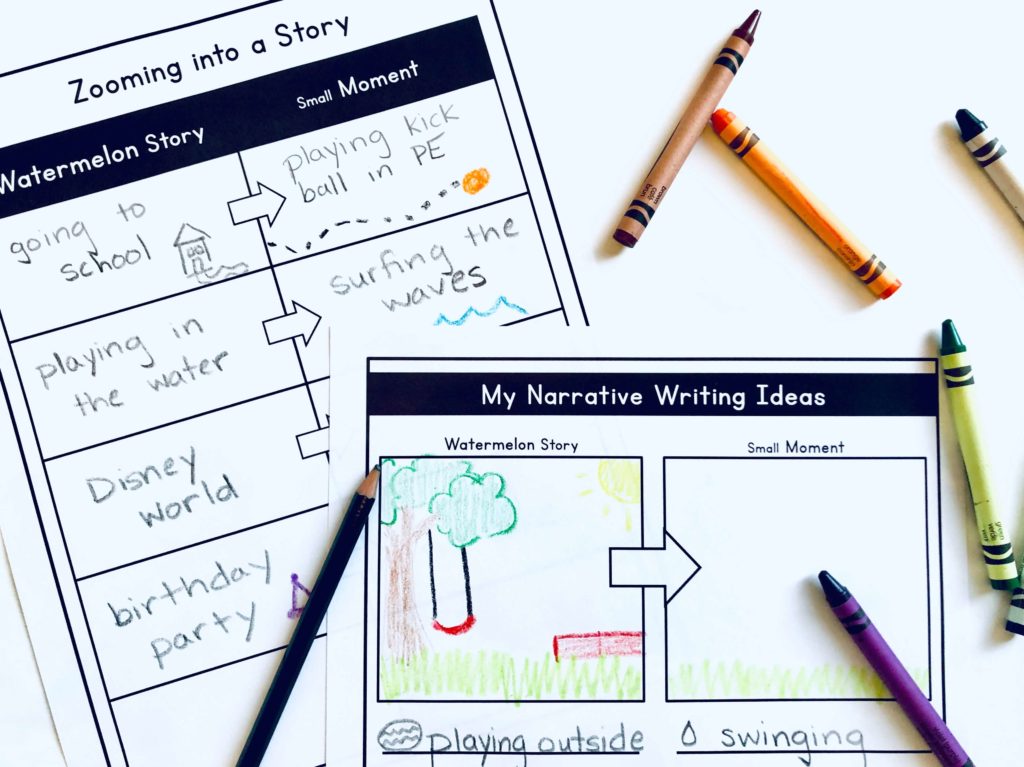
We went back to our writing journals and brought them back to the carpet. Students shared “Watermelon Stories” in their journals that they may need to revisit. (Note – this totally wasn’t a shaming lesson and totally voluntary. I love pulling examples from our own writing because it makes it much more real. (Snag this organizer for your classroom here.)
As students shared one of their watermelon stories, I asked – “So ___________, instead of writing about the WHOLE __________, what part can you go back and describe?” When students picked specific parts (hitting the piñata, riding the roller coaster), we called these ‘Seed Moments’.
Finally, it was writing time! As students worked, I delivered plates of watermelon as a motivator and reminder to think small. Then, I started conferencing with my habitual list-story writers. 😉
The next day we continued practicing zooming into moments. I brought in my Dad’s binoculars (eeeek – how exciting!) and talked “What happens when you zoom in?” After looking at our class plants from across the room, we decided we could see SO much more with binoculars. We could see all the details!
We made the connection that our readers weren’t with us when our event happened, so we need to include all the details important to the story. Readers should be able to create a mental picture as they read your story.
Using Mentor Texts
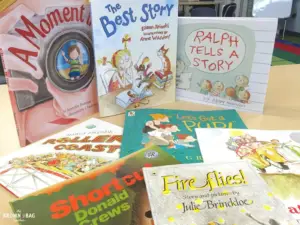
After a few minutes of hands-on zooming-in practice, we used the Mentor Text Roller Coaster to see how a famous author zooms into a story. This is a *PERFECT* text for small moments. Marla Frazee takes the reader all through the roller-coaster process (waiting in line, seeing the carts arrive, getting nervous and wanting to leave, being buckled in, etc.). Plus, she uses some great text/writing features that students love to emulate – using dashes to stretch out words, using CAPITAL letters to place emphasis on words, using sound words.
As a teacher, these are all features I pointed out as we read. I would write examples on the board and as a class, we practiced reading these phrases with and without those special features. What a difference they make!
Putting it Into Action
After reading together, it was time to put this mentor text into action! Students went back to write about a seed moment (or revise an old story) adding stretched-out words, sounds words, and punctuation that adds meaning.
Below is a narrative from one of my on-level friends – “This weekend my cousins came over. It was so fun. We play outside and we played walkie-talkies – WEEE! We hid around the room. We tried to find each other. But we could not. It was a fun time.”
For Day 2 of zooming into small moments, I am THRILLED! Plus, he begged to share it with the class because he included a sound word (WEEE) just like Marla Frazee did. (Which is fabulous and makes my teacher-heart so happy! It’s also a great motivator to keep using mentor texts.)
Fireflies
On Day 3ish (possibly 4…I don’t remember), we read another Mentor Text together – Fireflies by Julie Brincklow. This is a totally different type of book from Roller Coaster. It is more serious, definitely more detailed, and is truly a beautiful narrative about a little boy catching fireflies with his friends and releasing them.
Fireflies is the perfect text to talk about why zooming in matters. After reading the book, our class wrote what the story would sound like if we didn’t zoom-in. “I was eating dinner. Then, I got a jar and went outside. We all caught fireflies. Then, it was time for bed. Before they died, I opened the jar and let the fireflies go.” <insert 1st Grade GASP> My friends all agreed that this was not nearly as wonderful of a story as the one Ms. Brincklow wrote. We read it again, this time with our eyes closes, so we could make a picture in our mind.
Shared Writing
This day, we actually spent our writing time together. Shared Writing is a perfect way to high features of many different mentor texts focusing on the strengths of lots of different students. We decided to zoom into building a sandcastle. Although not perfect, we have a great start to a narrative. Plus, we include some of those great features from Roller Coaster (VERY, wee, A-L-L) and Fireflies (small details about the day).
Since writing it at the end of the day, and we ran out of the time – the next morning during ‘Morning Work’ students came in and started working on their narratives. It’s a perfect way to sneak a few more moments for writing!
This friend is sharing about his recent trip to the zoo, seeing tigers. My favorite line – “One did not look fun. He was lame.” Hahahaha – classic and perfect 1st grade writing. (Note – he does go on to explain the lame tiger behavior.)
This week we are continuing to write about small moments but are transitioning into beginning/middle/end of our small moments, as well as, how to use our 5 senses to describe our small moments. The following week, we are going to begin exploring dialogue – eek. 🙂 I’ll be back to share soon! (Snag these resources for your classroom here.)
Until then, how do you stop grocery-list stories and encourage students to zoom into small moments? Do you have any favorite mentor texts? I’d love to hear your ideas!
Such wonderful lessons! I am wondering what type of writing journals you use. I really like the wider lines and the area to put a picture at the top of the page. Thank you for sharing more inspirational ideas!
Hi Mandy! I actually picked up some Primary Writing journals from Dollar Tree (just for my struggle . I haven't seen them since. I know you can order them on Amazon and Lakeshore, too…but they are really expensive. I actually prefer real composition notebooks but know that my struggling writers need the extra support!
Order from Dollar Tree online:)
Unforuntaley, this is one product they aren't selling online. So, you have to luck out that your store is selling them!
Such wonderful lessons! I am wondering what type of writing journals you use. I really like the wider lines and the area to put a picture at the top of the page. Thank you for sharing more inspirational ideas!
I LOVE the anchor chart!!!
I absolutely love your posts about Writing Workshop! I am definitely going to try this lesson, watermelon, binoculars, and all with my kinders later in the year! Thanks so much for sharing, Catherine!
Another amazing post about Writing Workshop! Thank you so much for sharing. We are working on small moments this week. Thank you!
What a fantastic post! I love that you point out how many times in writing we just quickly jump to the pencil and don't take time to "build up." These are fantastic mini lessons. Thank you so much for sharing!
A really useful post. Thank you. I would be interested to know which mentor texts you use for other skills – both reading and writing.
It did this "seed moments" lesson with my kiddos this week. My husband and I had a long discussion about whether or not you can still buy watermelons with seeds!!?? I should have just gone for it like you did…I'm sure your kids will remember it for a long time :0) Great post! I'm trying hard to incorporate more writing. Keep the ideas coming!!
Night of the veggie monster is a great mentor text!
Thank you so much! This helps me explain what a small moment is to my son in 2nd grade with out having to email his teacher!
Get teaching tips and free resources
Practical K-2 math and upper-elementary morphology ideas, straight to your inbox. No spam, unsubscribe any time.






13 Responses
Such wonderful lessons! I am wondering what type of writing journals you use. I really like the wider lines and the area to put a picture at the top of the page. Thank you for sharing more inspirational ideas!
Hi Mandy! I actually picked up some Primary Writing journals from Dollar Tree (just for my struggle . I haven't seen them since. I know you can order them on Amazon and Lakeshore, too…but they are really expensive. I actually prefer real composition notebooks but know that my struggling writers need the extra support!
Order from Dollar Tree online:)
Unforuntaley, this is one product they aren't selling online. So, you have to luck out that your store is selling them!
Such wonderful lessons! I am wondering what type of writing journals you use. I really like the wider lines and the area to put a picture at the top of the page. Thank you for sharing more inspirational ideas!
I LOVE the anchor chart!!!
I absolutely love your posts about Writing Workshop! I am definitely going to try this lesson, watermelon, binoculars, and all with my kinders later in the year! Thanks so much for sharing, Catherine!
Another amazing post about Writing Workshop! Thank you so much for sharing. We are working on small moments this week. Thank you!
What a fantastic post! I love that you point out how many times in writing we just quickly jump to the pencil and don't take time to "build up." These are fantastic mini lessons. Thank you so much for sharing!
Kelly
Lattes and Lunchrooms
A really useful post. Thank you.
I would be interested to know which mentor texts you use for other skills – both reading and writing.
It did this "seed moments" lesson with my kiddos this week. My husband and I had a long discussion about whether or not you can still buy watermelons with seeds!!?? I should have just gone for it like you did…I'm sure your kids will remember it for a long time :0) Great post! I'm trying hard to incorporate more writing. Keep the ideas coming!!
Night of the veggie monster is a great mentor text!
Thank you so much! This helps me explain what a small moment is to my son in 2nd grade with out having to email his teacher!