One of my favorite things about teaching 1st grade was watching students grow as writers. They arrived writing single sentences (sometimes single words!) and, over the course of the year, began writing paragraphs with details, organization, and their own wonderful personalities.
But that growth didn’t happen just because we handed students a journal and told them to write.
Beginning writers need explicit writing instruction, meaningful experiences to write about, and opportunities to write every single day. They also need scaffolds that make writing feel possible while they’re still figuring out how to get their ideas onto paper.
And I learned that lesson the hard way.
During my first year teaching 1st grade, I didn’t realize I needed to explicitly teach students how to use a writing journal. I passed them out, and we jumped right in.
FRIENDS. Our journals were a hot mess.
Letters everywhere. Pages of writing mixed together. Illustrations without the writing to match. And I spent the rest of the year wishing I’d slowed down and taught those routines from the beginning.
The following year, I did things differently.
I intentionally taught the little routines and writing strategies that helped students become more independent. From organizing their journals to stretching out words, adding details, and sharing their work, we practiced the things experienced writers often take for granted.
Here are six ways I scaffolded beginning writers in my 1st-grade classroom, with practical ideas you can use with your own students.

Teaching 1st grade taught me something I hadn’t expected: students need to be taught how to use a writing journal. It seems so obvious now, but after a year of disorganized journals, I knew I needed to start differently!
So, on the second day of school, we started with a simple How to Write in a Journal mini-lesson.
We practiced five basic expectations:
Nothing fancy. But we modeled each step, practiced together, and revisited the expectations as students became more independent.
And were our journals perfect? Absolutely not!
But they were lightyears ahead of where we’d been the previous year. More importantly, students spent less time figuring out how to organize their pages and more time actually writing.
That’s something I wish I’d understood sooner. Sometimes the smallest routines make the biggest difference in helping beginning writers work independently.

“How do you spell this?”
“What letter comes next?”
“Can you help me write this word?”
If you’ve taught beginning writers, you know how quickly these questions can take over your writing block!
Early in the school year, one of our writing mini-lessons focused on what to do when you don’t know how to spell a word.
During shared writing, I modeled how to say a word slowly, listen for the sounds, and use the phonics patterns we’d already learned. Then, if I still wasn’t sure about a spelling, I simply underlined the word and kept writing.
We practiced doing the same thing in our journals.
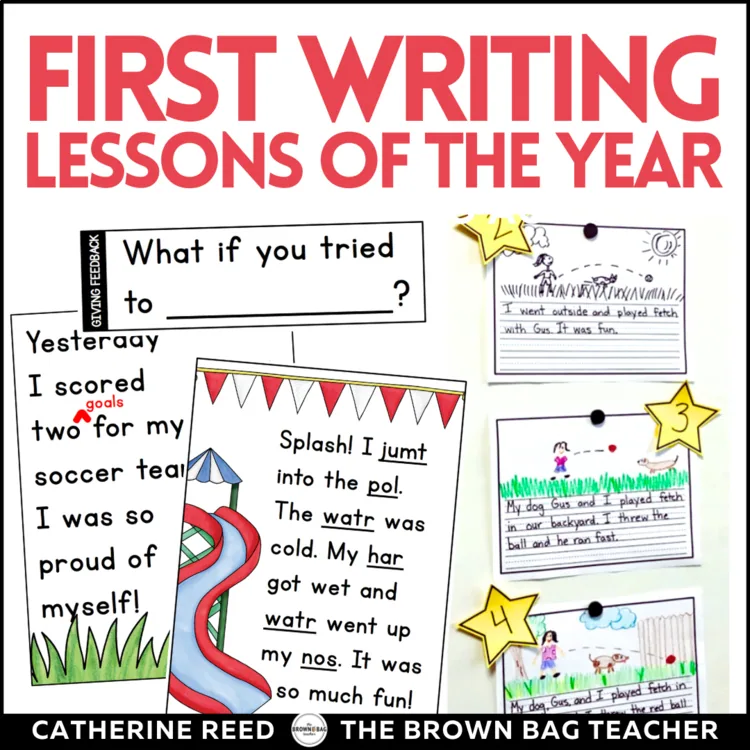
That little underline became a signal: “I tried to spell this word, but I might need some help.”
It also gave me useful information during writing conferences. If a student was missing a sound or struggling with a phonics pattern we’d explicitly taught, we could stop and work through it together. For more advanced spelling patterns they hadn’t learned yet, I could offer support without expecting them to figure everything out independently.
And sometimes? We left the underline and kept going.
The goal wasn’t perfect spelling in every first draft. It was helping students use what they knew while keeping their ideas moving onto the page.

We also practiced what to do when we forgot a word or wanted to add something to a sentence.
Instead of erasing everything and starting over, students learned to use a caret (^) to show where a missing word belonged. For longer additions, we practiced using an asterisk (*) and writing the extra information at the bottom of the page.
One of my students even added a little extra flair to their arrow!
These were such small routines, but they helped students understand that writers reread, make changes, and keep going. Writing doesn’t have to be perfect the first time.

Here’s something I believe strongly about teaching beginning writers: students need real experiences to write about.
Think about how we teach math. We give students manipulatives, let them explore, and help them connect concrete experiences to mathematical ideas.
Writing is no different!
When students have something they’ve actually seen, touched, explored, or experienced, they have a starting point for their writing. They have ideas to share, vocabulary to draw on, and a reason to put their thinking onto paper.
During our second week of school, I put my first-grade scientists to work exploring our three classroom plants: Plantuska (bamboo), Phil (a vine), and Rocket (a hydrangea).
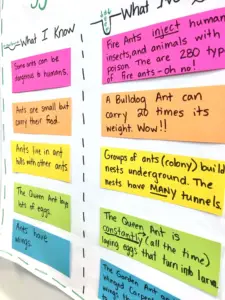
Students worked with partners and magnifying glasses, making observations and talking about what they noticed. We spent 15–20 minutes looking closely at the plants before returning to our seats to write about one of them.
I turned on Yo-Yo Ma, and friends, it was AMAZING.
Suddenly, students weren’t staring at a blank page wondering what to write. They had something to say!

They’d spent time observing, asking questions, and talking with their classmates. They were practically plant experts. (I mean, 15 minutes of scientific observation will do that for you!)
And while they still needed support with spelling, sentences, and organizing their ideas, they weren’t starting from nothing.

That’s why I love building shared experiences into writing instruction. A science observation, a classroom experiment, a read-aloud, or even a walk around the school can give beginning writers meaningful content to work with.
Real experiences give students something to say. Explicit writing instruction helps them figure out how to say it on paper.

Sometimes beginning writers have plenty of ideas, but they aren’t quite sure how to turn those ideas into a sentence.
That’s where sentence stems can make a huge difference!
During the first few weeks of school, I used sentence stems regularly to help students organize their thinking and get started with writing.
After observing our classroom plants, for example, a simple sentence starter gave students a way to begin sharing what they’d noticed. Instead of spending all their energy figuring out how to start, they could focus on the details they wanted to include.

But here’s the important part: students were always welcome to move beyond the sentence stem.
Some students needed that structure. Others were ready to write their own sentences independently. Both were perfectly fine!
As we transitioned into Writer’s Workshop, I gradually removed the stems so students had more opportunities to organize and express their ideas independently.
And that didn’t mean sentence stems disappeared forever. We brought them back when students needed additional support, especially as we began writing paragraphs and responding to reading.
The goal of scaffolding isn’t to keep students using the support. It’s to help them become confident enough that they no longer need it.
Sentence stems are one tool in that process. We introduce them when they’re helpful, model how to use them, and gradually release responsibility as students grow.

One of the trickiest parts of teaching beginning writers is helping students understand what it means to add more details.
We can say, “Tell me more!” or “Add some details!” a hundred times, but what does that actually look like to a six-year-old?
During our first few weeks of school, I introduced a simple four-star writing mini-lesson to help students begin noticing what makes writing more interesting and informative.
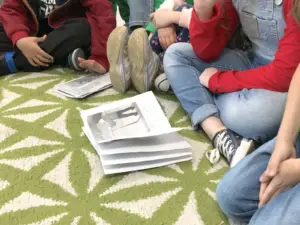
I prepared four versions of the same story, each with different amounts of detail in the writing and illustrations.
As a class, we read the examples and worked together to give each one a rating from one to four stars.
But the important part wasn’t the number of stars. It was the conversation about why one piece of writing communicated more than another.
We talked about questions we still had after reading, details that were missing from the illustrations, and which version helped us understand the story best.

Then, students returned to writing they’d completed during our first two weeks of school.
Instead of starting something new, they reread their work and looked for opportunities to make it stronger. Some added details to their sentences. Others returned to their illustrations to show more of what they wanted readers to understand.
And suddenly, revising wasn’t just something I was asking them to do. They had examples of what adding meaningful details could look like.
We returned to this mini-lesson throughout the year because beginning writers need repeated opportunities to see, discuss, and practice revision.
If you’d like to try this lesson, you can grab the free writing examples and paper here. The lesson is also included in my Beginning of the Year Writing Mini-Lessons.
One of my favorite parts of our writing block was sharing time. My first graders LOVED having the opportunity to share their writing with their classmates!
From the very beginning of the year, I explicitly taught students how to share their work, listen to other writers, and give specific, encouraging feedback.
We saved the last 7–8 minutes of our writing block for sharing. Typically, four or five students shared each afternoon, which meant every student had an opportunity to share during the week.
And friends, this was such a powerful motivator! Students weren’t just writing because their teacher asked them to. They were writing for an audience.
Our sharing routine had four simple steps:
Of course, these routines didn’t happen automatically. We modeled what sharing looked and sounded like, practiced giving meaningful compliments, and worked intentionally to create a classroom where students felt comfortable taking risks.
Building those positive classroom relationships made such a difference.
And while the cheers and microphone were fun, the real value was helping students see themselves as writers whose words were worth sharing.
Writing wasn’t just something students completed in their journals. It became something we celebrated together.

One of the greatest joys of teaching 1st grade was watching students discover that they really were writers.
And that growth didn’t happen overnight!
It happened through the little things we practiced every day. Learning how to use a writing journal. Stretching out words. Having real experiences to write about. Using sentence stems when needed. Rereading to add details. And sharing our writing with friends who were excited to listen.
Scaffolding beginning writers isn’t about making writing easier. It’s about giving students the tools and support they need to become more independent.
We don’t have to introduce every routine at once. Start with the support your students need most, model it explicitly, and give them opportunities to practice. As their confidence and skills grow, gradually step back and let them take more ownership of their writing.
And please remember, students need opportunities to write every single day. Those small, consistent moments of writing, revising, and sharing add up over time.
If you’re looking for a little structure as you get started, my Beginning of the Year Writing Mini-Lessons include the routines and activities I used to help my first graders build a strong writing foundation.
Here’s to growing confident, capable writers, one mini-lesson and one writing experience at a time!

21 Responses
I would love to use a student microphone. I can only imagine how much they must love speaking into it. What kind do you use?
Mona
First Grade Schoolhouse
I am a first year first grade teacher. I have struggled with writer’s workshop. Out of the 12 students I have, only 4 of them can write independently. The rest struggle with Spelling words which translates to having a hard time with making sentences. I have been working really hard with them on sight words and sounding out words, but they are still struggling, I am trying to figure out what to do. I really like this blog post. You have so many great ideas on how to help them and you! I will definitely try some of these and see what happens.
I have a tiny karaoke machine I bought off Facebook marketplace!
I use the document camera as well but would love to add the microphone. Can you share what kind and where you found it?
I would love to see how you launch writer's workshop.
I really enjoyed this clear and concise post. Thanks.
I really enjoyed this clear and concise post. Thanks.
I really enjoyed this clear and concise post. Thanks.
I would love to hear how you launch writer's workshop….this is great!!
Great post, great ideas. Thank-you for sharing!
I love your blog! I began using Writer's Workshop last year and what a difference it made in my kids' writing! I used the book No More I'm Done by Jennifer Jacobson to help develop my lessons. Good luck with your writing workshop this year and I'm looking forward to hearing more about it!
Loved reading this, and you share so many great ideas and strategies. Love Writing Workshop. Thank you!
Love this.
I am first grade student and many time i can't write beautiful and this article give me good idea how to improve your writing thanks for share it writing cover letters .
I love your ideas for Writer's Workshop. Hopefully I can cram in a lot of them at the beginning of the year next year before we're required to use our Series.
I love all of your ideas for writer’s workshop!
Today, Emblix as one of the best and top most service-oriented Digital Marketing Agency in Hyderabad and India , Which provides high-quality result-oriented Digital Services ranging from SEO to Web Design, Social Media Marketing and more, to a broad spectrum of clients from diverse industry segments. Through a well-oiled combination of Quality Solutions, Transparent Pricing, helping brands connect with customers, Flexible Delivery & Contract Model with a firm commitment to deliver on time and to budget, Emblix has successfully built a strong relationship with clients based on mutual trust and respect. Further, Emblix’s extensive market experience and expertise in Digital Marketing helps clients in successfully managing data as a strategic asset.
Website: https://www.emblixsolutions.com
Any suggestions for kiddos who are brand new to the country? I am struggling for way to support the 3 kiddos who and 2nd language speakers during writing time.