



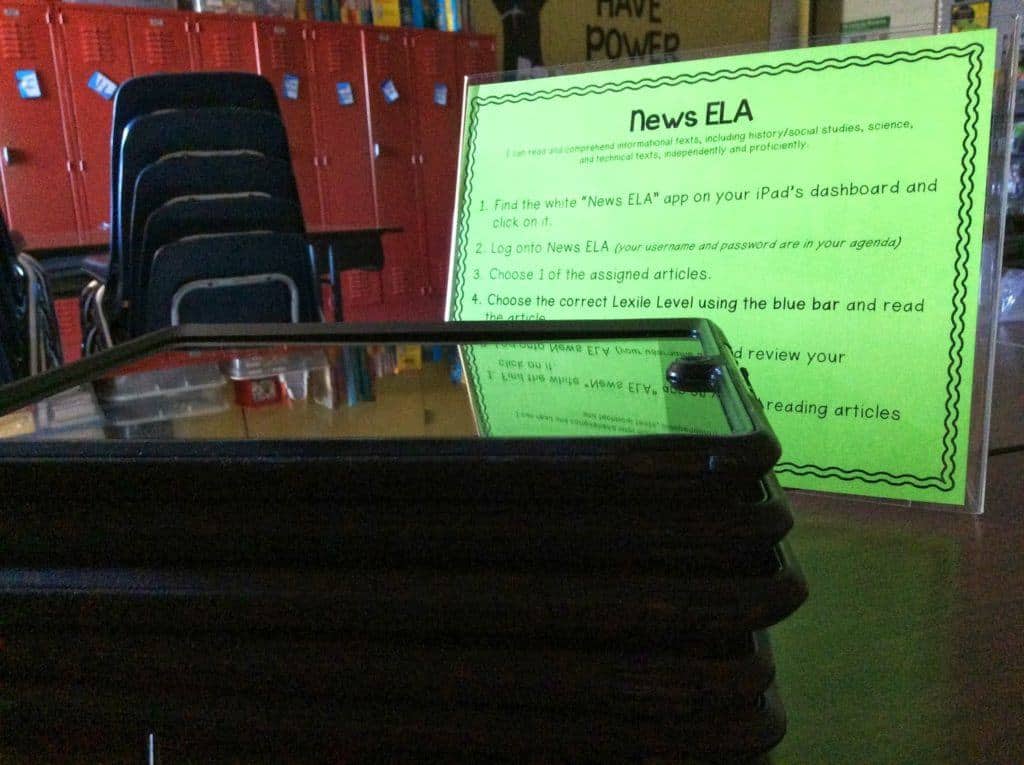
Using our iPads, students will be
reading different nonfiction articles from News ELA. Students are expected to
read and test over 1 article during the station {from the 5-6 I have assigned},
and then, they have free-choice for the rest of the time {as long as they are
in News ELA}. FANTASTIC practice.
I am really excited to introduce my figurative language puzzles. If you haven’t downloaded them yet, you can grab
them here for free! Students will read the story, “Grandma’s Garden” and circle
any figurative devices they find. Then, they’ll lay out the
figurative language puzzle pieces and make the 8 puzzles! Fun, interactive, and
wonderful for my kinesthetic learners.


We also use Lakeshore’s Daily Comprehension
notebooks as a center. Students complete one week’s reading during a 12-15
minute center. Each ‘week’ contains a 2-3 paragraph article {alternating
between fiction and nonfiction} with five sections of questions – vocabulary,
comprehension, short answer, a Common Core skill, and a connection to the text.
These wouldn’t work for my grade-level
students, but they are a solid resource for my below-grade level kiddos who can
work independently.

One of our staple centers {that is easy
to put together and requires NO printing} is STACKS. This week, we are playing prefix stacks. I write a prefix on the bottom of each cup and its meaning on
the inside of the cup. I place the cups in a large Ziploc bag and students
works in pairs. One partner grabs a cup. He/she defines the prefix and then,
gives an example of a word that uses the prefix. The partner checks their work
(mentally or using the answer I have written on the inside of the cup). If the
partner answers correctly, they can add it to their cup pyramid. If incorrect,
the cup goes back into the bag. Students work together to build the tallest
possible pyramid in our 12 minute work period! Super fun, low maintenance, and
great practice!


Every week, I add our vocabulary words
to Spelling City {for free}, and students practice spelling and using the words
with our iPads.


18 Responses
Hi! I just discovered your blog and I am in LOVE! I also teach fifth grade and have struggled trying to find a system that works for ELA stations and your blog has been a God send! I look forward to implementing your ideas! Thank you!
Thank you so much for your comment. It has taken me SO long to get centers tarted (almost until December…eekkk!), so I completely understand. I talk more about how I organize my centers here – http://thebrownbagteacher.blogspot.com/2013/12/hey-friends-well-10-days-away-from.html. If you have more questions, feel free to email me at [email protected]. 🙂
Sounds like your students will be busy with a lot of great learning! I definitely feel your pain on the DRA. It is a VERY time consuming process, isn't it?!
Amy
Eclectic Educating
DRAs are ridiculously time consuming. I believe I am definitely overestimating how quickly I can get them done. 40 in 4 days…we'll see! 🙂 Have a great week, friend.
Hello. I love your Prefix Stacks game. Would you be willing to share the direction sheets and work sheets that you used? Thanks for all the great ideas. 🙂
Ursula
[email protected]
Hi Ursula, I would be happy to share! I have the game on a different computer, so I'll send them your way tomorrow. 🙂 Happy Sunday!
Your prefix stack game is terrific! I'd love to know if you'd be willing to share the directions.
I completely understand the loss of instructional time for testing…I have to start mine this week. 🙁 Looks like your kids won't mind so much as you have a lot of great learning activities planned for them.
♬Kay
On the Trail of Learning
Hi Kay! Thanks so much. I would be happy to share. 🙂 I'm on a different computer right now, so I'll send them you way tomorrow evening. Have a great week!
I love all your great ideas! The stack game is a great idea. Would you be willing to share your directions sheet with me also? I would love to try it for vocabulary review too! 🙂
Thanks,
[email protected]
Could I snag those worksheets as well? Thanks!
Full of great suggestions, as always! I especially like those Main Idea mittens and how they are linked to a photo…I'm off to check them out now!
~Deb
Crafting Connections
This makes me wish I had become a teacher 🙂
I love the prefix stacks idea, anyway you would be willing to share instructions?
You are a force to be reckoned with! Hope those DRAs go well. I hate having to give up teaching time for testing too, one of those necessary evils of teaching. I am sure you will feel proud of their growth. Have a great week.
Please share the prefix stack game directions 🙂 I love the idea!
Looking at this years later…. I would LOVE the prefix info and the figurative language puzzles!
If you do not mind I would appreciate the stacks instructions please. Thanks for all the awesome ideas.
If you do not mind I would appreciate the stacks instructions please. Thanks for all the awesome ideas.