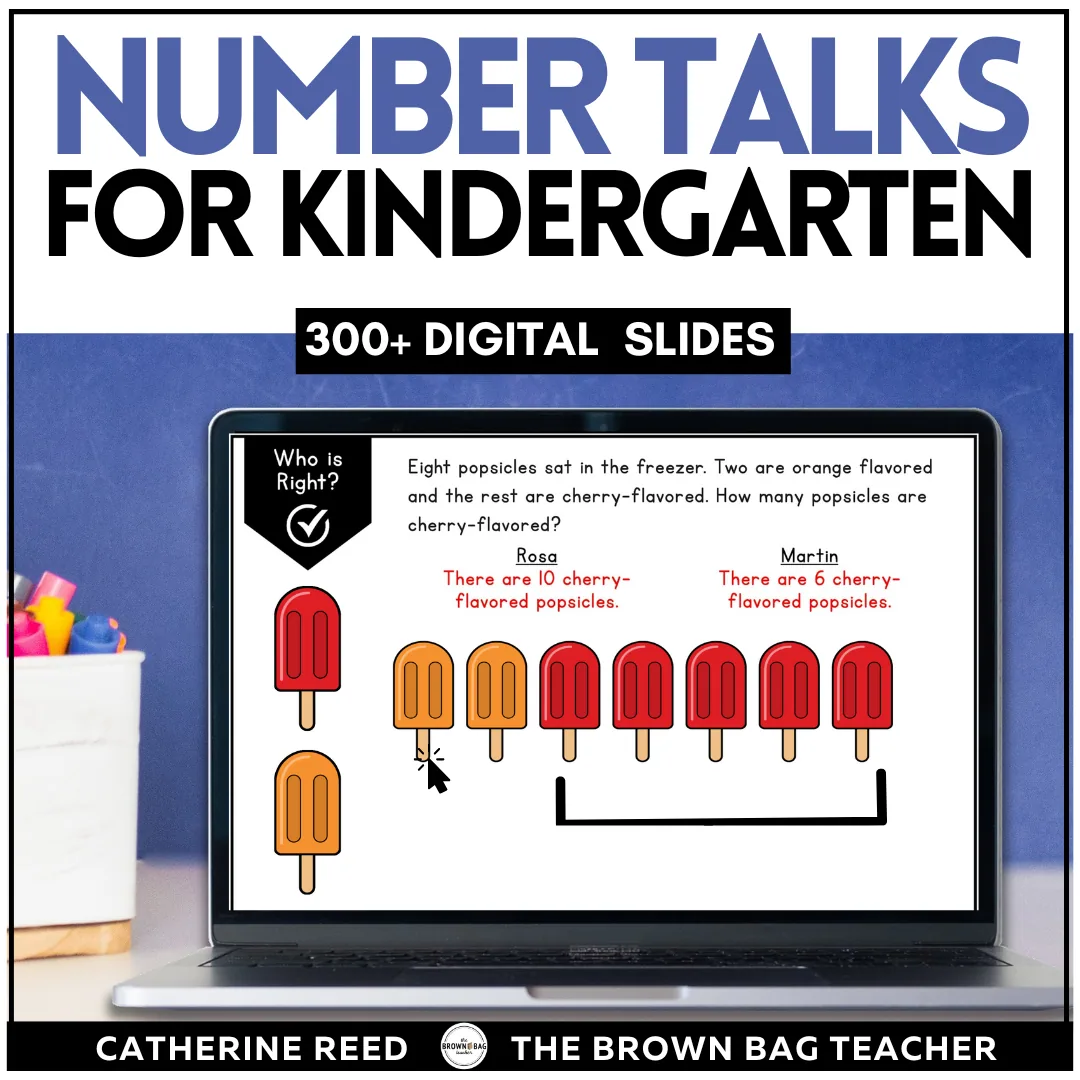
Number talks (Kindergarten, 1st Grade & 2nd Grade) offer a bridge between conceptual understanding and mental math. During mini-lessons and Guided Math, I am ALL about manipulatives. Base 10 pieces, unifix cubes, cuisenaire rods – give me all the math things. Especially in 1st grade, manipulatives offer a concrete way to represent a number and their thinking. At some point, this concrete thinking has to begin to transition into abstract and mental math processes. Number Talks offer a daily, short, structured way for students to talk about math with their peers.
Number Talks are short (10ish minutes), daily exercises aimed at building number sense. Number sense is the ability to play with numbers meaning students can visualize problem solving, perform calculations quickly, and are flexible in their mathematical strategy. Students who have strong number sense solve problems in more than one way and check that their answers make sense. As a part of this routine, students are thinking, asking their peers questions, and explaining their own thinking all while the teacher records the thinking.
Sherry Parish has written the book Number Talks (Amazon affiliate link) and it offers awesome ideas for Kindergarten to 6th grade. It is definitely an expensive (up to $60 if bought new) but offers great ideas and real-life examples of Number Talks.
What Do Number Talks Look Like?
When possible, I love slipping a number talk (Kindergarten, 1st Grade & 2nd Grade) in at the beginning of our Guided Math block. If we’re running late, I’ll slip a Number Talk in during an awkward transition or at the very end of the day. A traditional talk follows this routine –
Present the class with a problem. Students are seated in a common area with no math tools. Number Talks are mental exercises. I store my number talks (Kindergarten, 1st Grade & 2nd Grade) on binder rings next to my Document Camera for easy access.
Give think time. (When a student raises their hand, it tells other students they were not fast or good enough in their thinking. To account for this, students give me a sly thumbs-up on their chest to signal that they have thinking they want to share. Then, they put up multiple fingers (on the same hand) to indicate they have multiple ways to answer/solve the problem.
3. Call on a student – “_______, what are you thinking?” Have the student explain their thinking and then give their answer. My focus is always on the process not the answer.
4. Offer the strategy to the class. Student will elaborate (if correct) or ask questions (if misguided). If students aren’t sure they understand a friend, they will say “I’m a little confused. Could you tell me in a different way?” If students agree with the student sharing they will do sign-language for ‘me too’ (thumb near chest and pinky pointing at friend). This builds the student’s confidence and also offers the student sharing positive affirmations.
5. Invite other students to share their strategies.
Getting started with Number Talks in any K–2 classroom begins with creating a safe and predictable environment for math conversations. This means teaching clear routines—like how to gather on the carpet, when to use silent signals, and how to share or respond to others’ ideas. Even in these short, daily conversations, the goal is to help students see math as something they talk about—not just something they do. By modeling how to explain and justify thinking, teachers build a classroom culture that values curiosity, flexibility, and the idea that everyone’s thinking matters.
Scaffolding Students
If students have never been expected to explain their mathematical thinking, students may be very resistant to share their own strategies. So, how do I encourage students to share their own thinking/strategies?
Model, Model, Model – The first 2 days of Number Talks, I do a lot of modeling. After this, I completely release the Number Talks to the students.
Sentence Stems – “In my head I saw…” “My first step was…” “At first, I decided to try…” “I needed to…” “Since I wasn’t sure what to do, but I noticed…”
Force It – Awkward silence is your friend. Sometimes I will wait (for extended periods of time) for students to share their thinking. Even if a friend is STRUGGLING with a problem or sharing their thinking, I do not come to the rescue. Growth comes when friends are able to sort out their own thinking and my 1st grade friends are able to do this…even if it is a little painful for me.
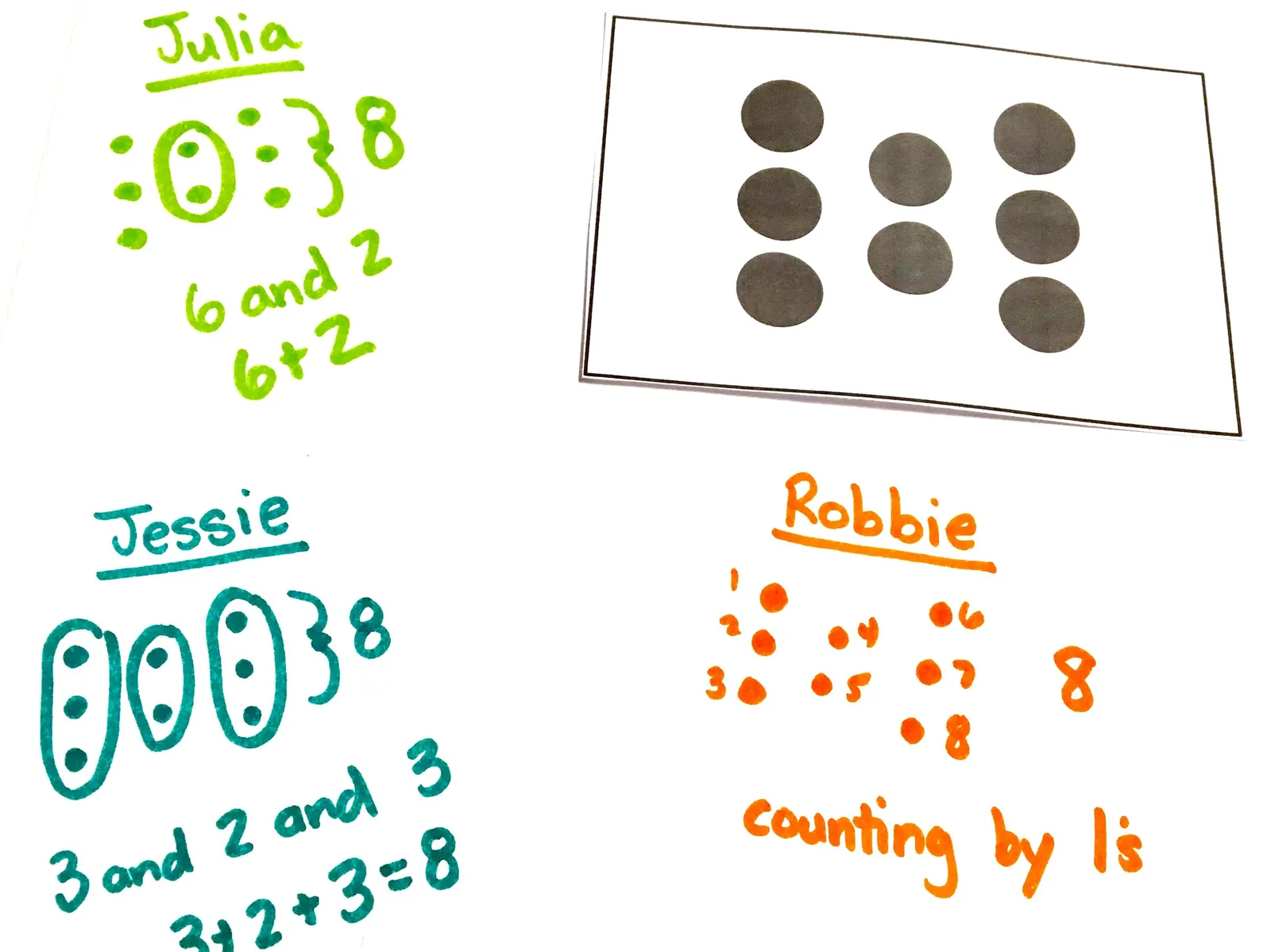
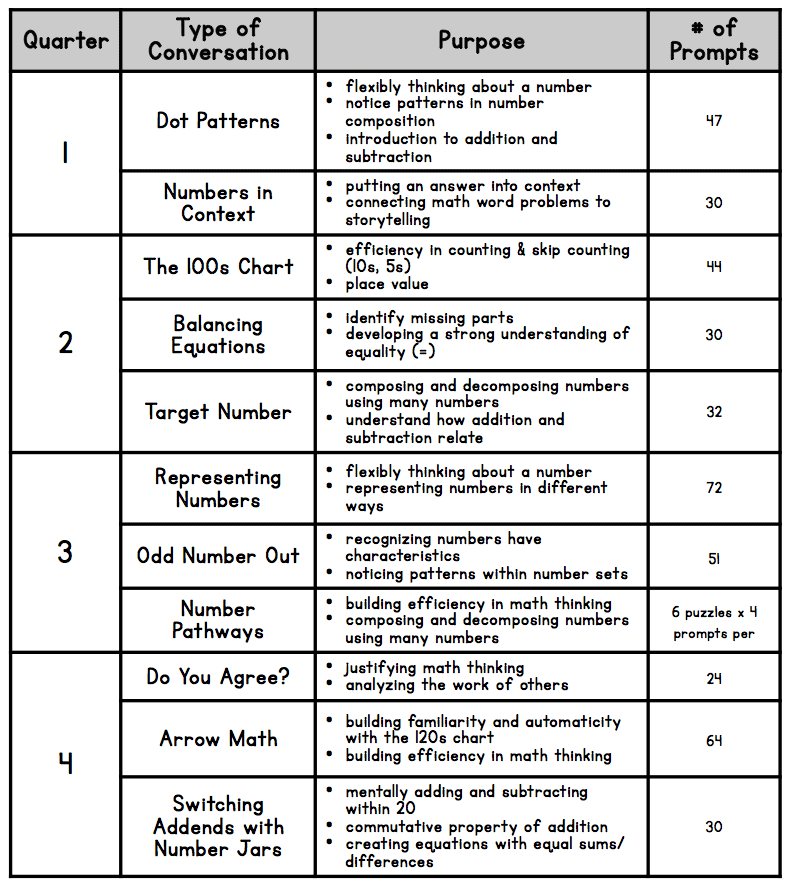
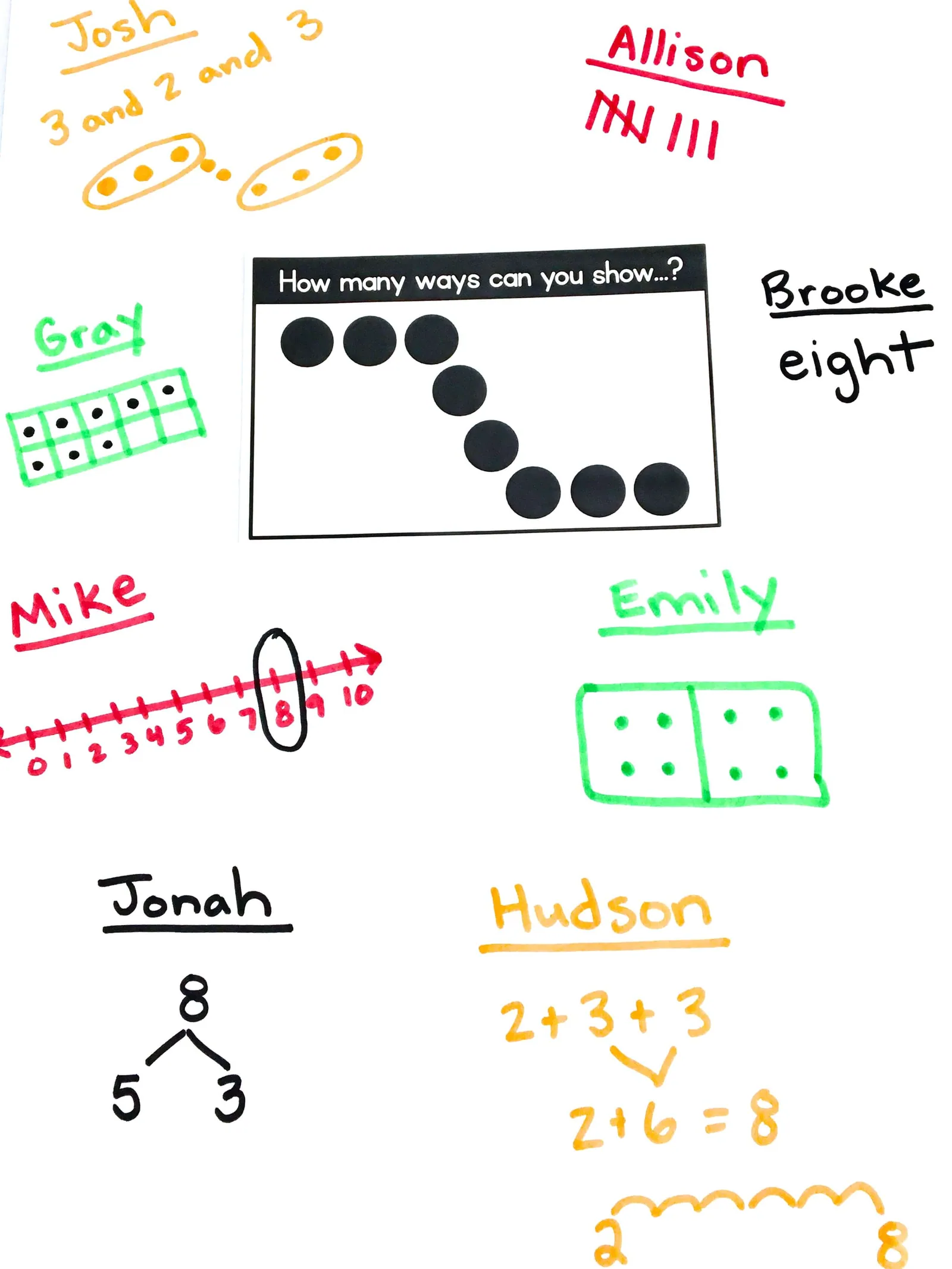
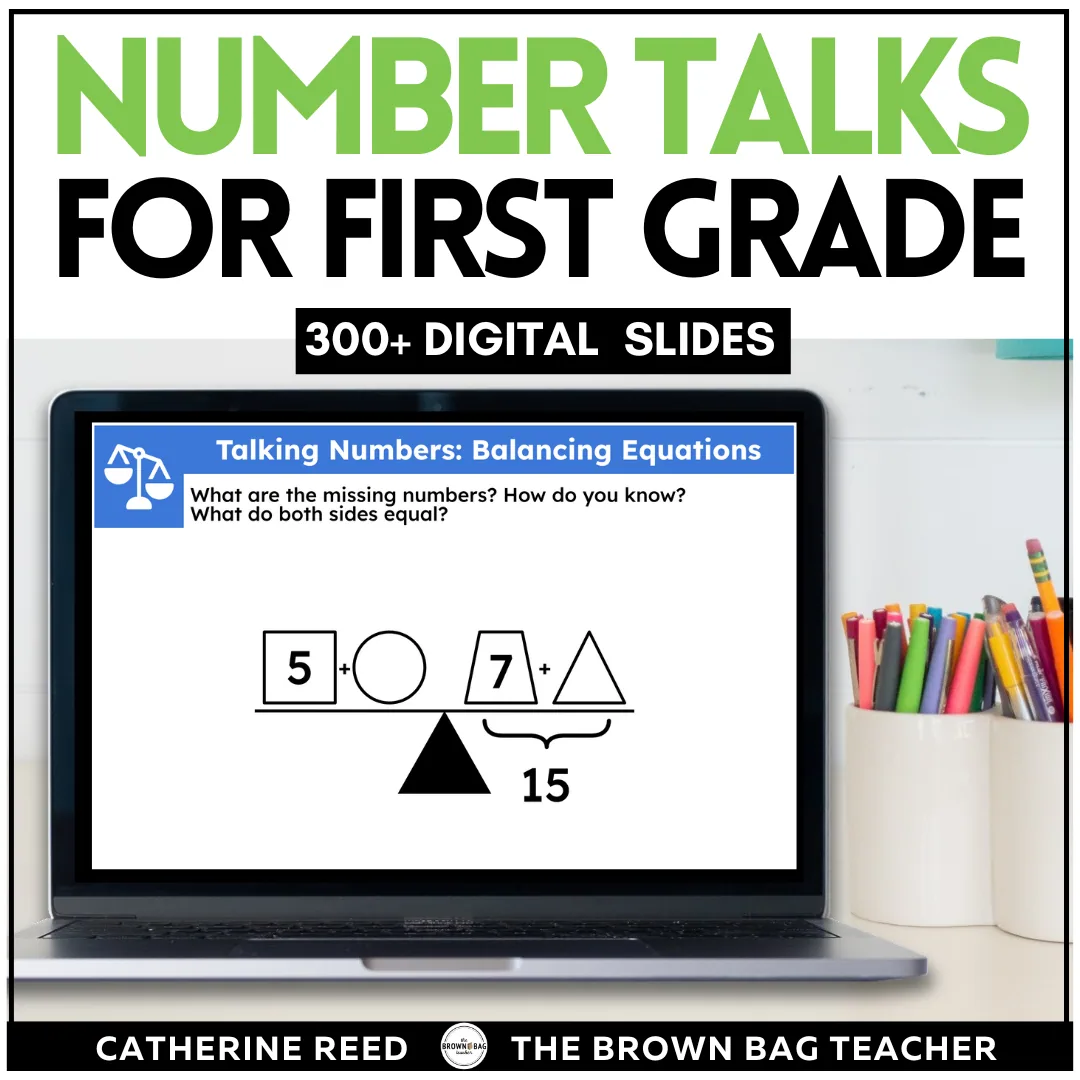
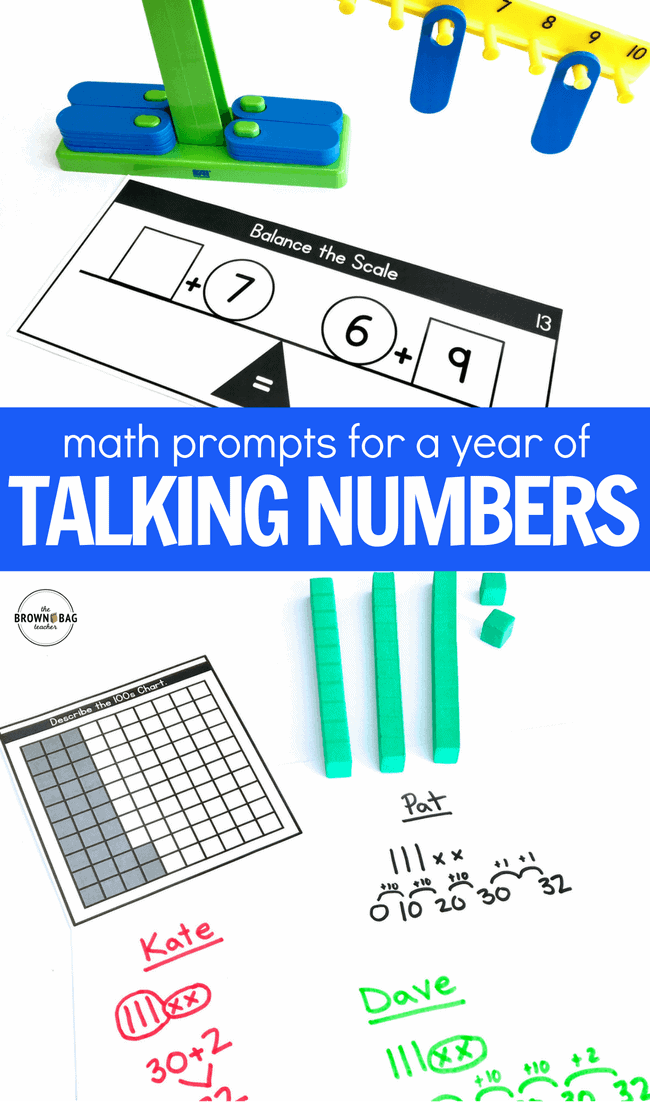
So, it all sounds great, right?? But what do number talks actually look like? My first talks (Kindergarten, 1st Grade & 2nd Grade) each year are always subitizing patterns (dot patterns). They are the perfect introduction into composing and decomposing numbers. Slowly that transitions into the 100s chart and eventually into word problems and balancing scales.
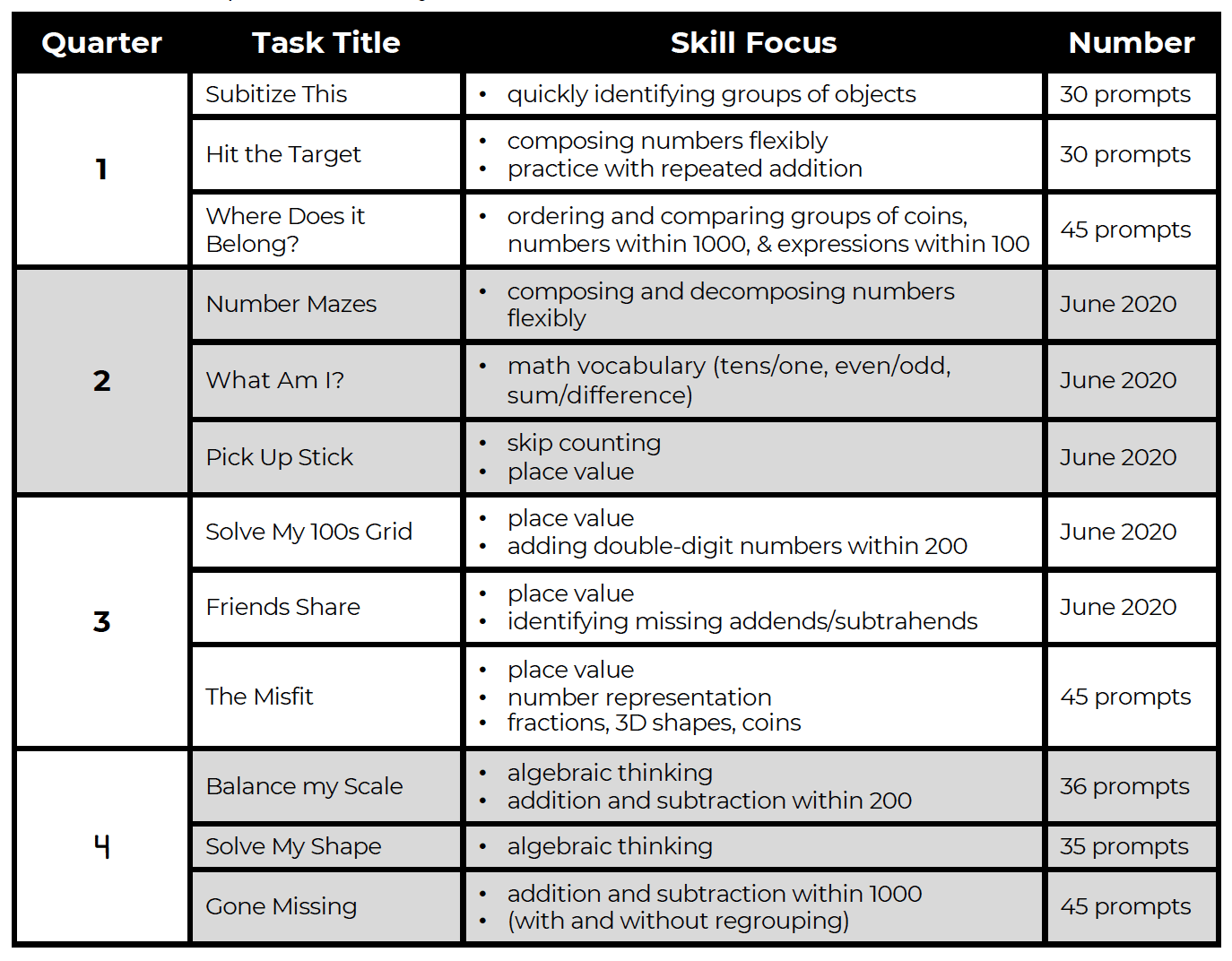
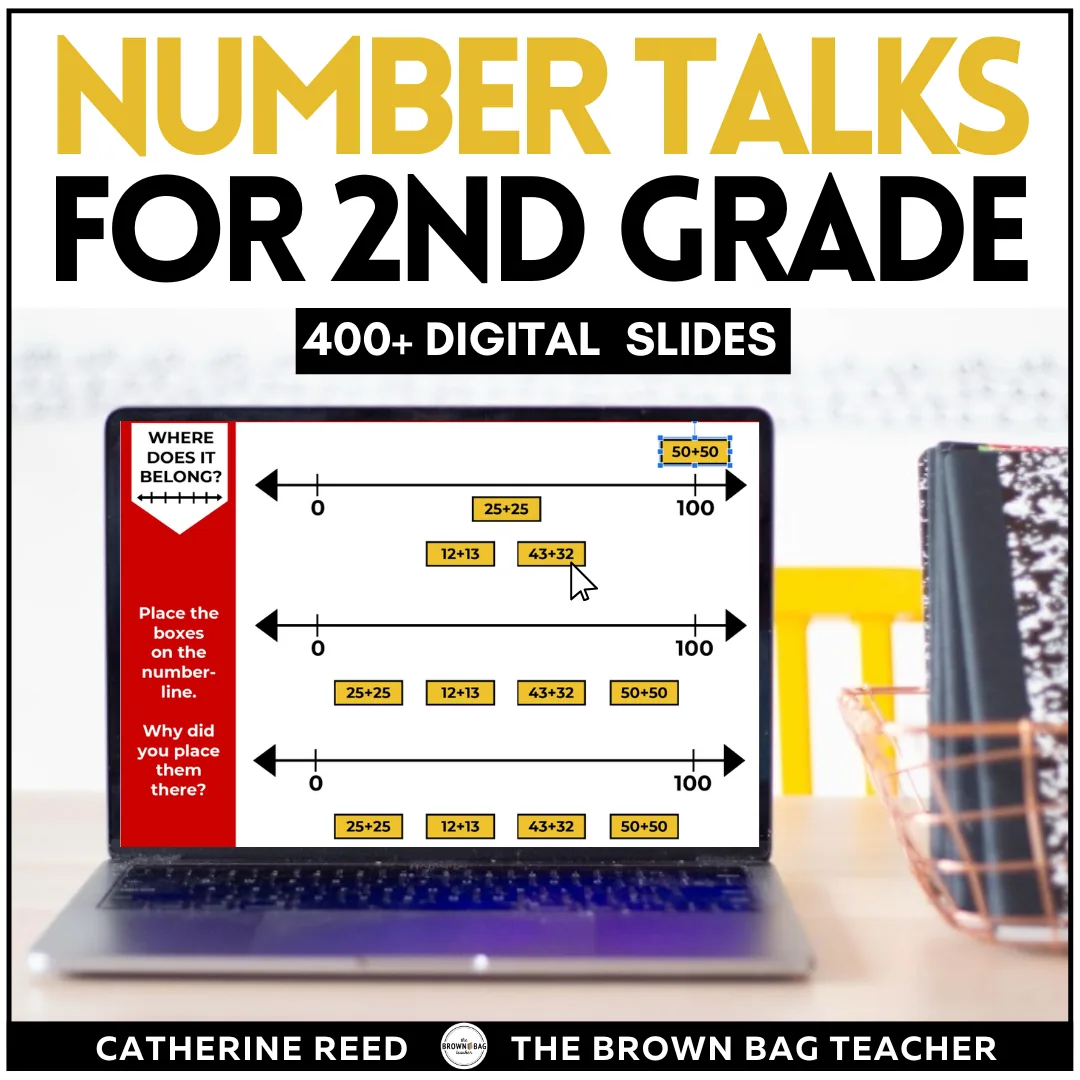
In the 2nd grade number talks, the focus is on building fluency within 20 and 100, as well as, layering skills in different ways. From missing addends, to algebraic thinking, over 400 prompts offer students dozens of chances to spiral review math skills each month.
Subitizing Quick Images
Subitizing (Kindergarten, 1st Grade & 2nd Grade) is the ability to quickly identify the number in a group of objects without individually counting the objects. It is a concrete way to explore composing and decomposing numbers. Students will see dot patterns in different ways, and that is a great thing. When showing students 6, made from a pyramid students might see 3 and 3, 5 and 1, or 3 and 2 and 1. These are all ways to build 6 and lead students to understand that numbers can be composed and decomposed in many different ways.
Composing Numbers
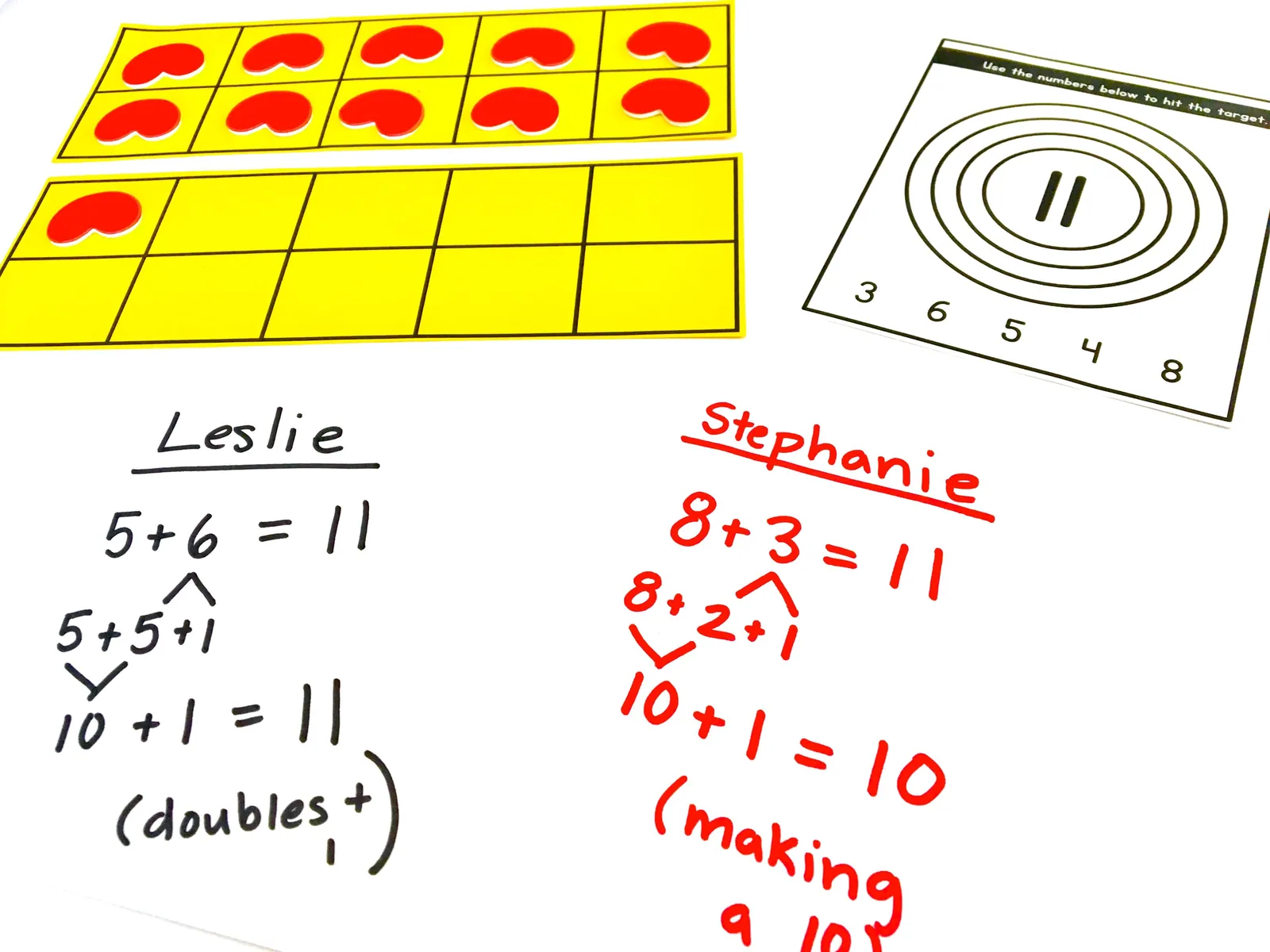
Flexibility in number thinking is a critical skills in beginning mathematicians. Students must understand that 7 can be made from 4 and 3, 2 and 5, 6 and 1, or 7 and 0. Below students are provided with a “Target Number” and ask students to use some of the provided numbers to hit the target. Students then have to decide how many numbers to use, which operation to use (addition or subtraction), and then, decide if number order matters. (1st Grade Prompts, 2nd Grade Prompts)
Flexibly Composing AND Decomposing Numbers
An important part of teaching primary students is to build number fluency and flexibility. Students should be able to encounter numbers in a variety of formats and engage with them in a variety of ways. During our Representing Numbers conversations (1st Grade & 2nd Grade), I encourage students to branch outside of the typical ten frame, plus one, etc. These are great strategies when we first start, but after the first few days students can build on these basic representations to develop different relationships and understanding.
If you’re interested in me emailing you some of my favorite ways to talk about numbers, sign-up here and confirm your email. Some sample number talks will appear in your inbox.
Live Talking Numbers Prompt
To see a LIVE Talking Numbers Prompt in action, click on the video below!
So friends, have you used number talks before? If so, how has your students’ number sense changed since using them? Do you have any go-to number talks? I’d love to hear your ideas!
In the meantime, to learn more about talking numbers in my K-2 classroom, click the links below:
I teach 2nd and find all of your wonderful ideas so very helpful!! Thank you for sharing 🙂 Is there a book you pull these number talks from?? I have been toying with this for a bit now. I will be starting up Guided Math in January when we get back.
Hi Karen! Thank you so much. Sherry Parrish has a fabulous book called Number Talks (link above) that offers examples of Number Talks and real math conversations from students. It's an investment, but I highly suggest it!
Shared a modified version of one of your number talks with my class during our number talks this week! My kiddos are loving it! Thanks so much for your willingness to share!
This is so awesome! I also teach second and I can see that some of these number talks would be great for my struggling mathematicians in a small group. I'd love to have the set and try it with my little ones!
On days that I'm short on time (usually Mondays)….I'm guilty of using a human continuum and just walking in and out of the line as I listen to the kids share/justify their thinking…and then we come back together to wrap up. 🙂 Great post!
This says Number Talks are for the primary classroom. How much of it is "useful" for K-1 level? Debating because of the cost and wanting to make sure most of it will be useful for us. Thanks.
Hi Caroline! My blog post is about how I run math talks in my primary (1st) grade classroom. As a 1st grade teacher, I LOVE the math talk book (it's intended for K-5) and would definitely recommend buying it. In terms of the freebie file at the bottom of the post, they work best for 1st-2nd, but the subtilizing dots and 100s charts could work in K, too.
Caroline, I currently teach 1st (looped up w/my kinder class) and Number Talks have been a HUGE success for my kiddos. I know the ultimate goal is to build number sense, but for me…I just love seeing ALL my kids have more confidence in the way they connect with their thinking and express their ideas about Math. I have not read the Parish book, but was trained on Number Talks through Math Perspectives and it was such a resource to help me to create my own number talks (w/help my my team & other teachers). That's one of the great things about finding freebie number talks…it helps give you ideas that you can adapt for your own kiddos.
Google number talks + math perspectives and there are several documents that give quite a bit of info. 🙂 Good luck!
I'm swooning over those number talk cards. Please tell me there's a full set coming to your TPT shop soon! – Katy First Grade Kate
H Katy! Right now, I just have the free 5 weeks and will need to get the others I use TpT ready. Maybe in the coming weeks. Thanks so much for asking! 🙂
Love your posts. I learn something every single time I read one.
I have been working on incorporating Number Talks into my Math lessons, but lack the confidence 🙂 These are great and I really appreciate you sharing! 2nd grade Sheri
Love this post! I have heard of number talks before, and have thought it would be great to implement. After reading this post, I think I could actually do it! I'd love to receive the cards. My email is [email protected]. Thanks for sharing! 🙂
Hello onjonet@yahoo. If you follow the link above, you can sign-up and the Number Talk cards will be emailed to you! 🙂
I love so many things about this post Catherine! You are so correct about wait time and hand signals…it has mad a huge difference in my student's motivation to figure out the answer because they are not feeling/knowing that they are needing more time than others to problem solve. Im looking forward to trying out your math talks cards. Happy New Year! ~Christina
I would also love to purchase more cards like this from you in the future!
I have really enjoyed using Number Talks this year in my second grade classroom and have noticed great changes in students ability to mentally solve problems! I would love a set of the cards but am already signed up to your email list. Is there a way I could still receive them? Thank you for sharing your great ideas!
Hi Caitlin! Email me at [email protected] and I can help troubleshoot the email problem. 🙂
Hi! I have been wanting to do Number Talks in my classroom for some time, but didn't quite know where to begin. Thank you for explaining it in detail! I also would love a copy of your set of cards, and am signed up on your email list. Thank you for sharing all of your hard work and ideas with us!
Hi Celia! Email me at [email protected] and I can help troubleshoot the email problem. 🙂
I have been reading all of your guided math/ math related post tonight and LOVE everything I have read! I am a fourth year, first grade teacher and currently "kind of" do a guided math set up but definitely have a lot to improve on. I have gotten so many good ideas, thank you!! I have already signed up for your emails but would love to see the number talks. I didn't know if they would be sent since this is an older post. Thank you for sharing your awesome ideas!
Hello! Email me at [email protected] and I can help troubleshoot the email problem. 🙂
Sherry Parrish just did a PD training for us, and she was fabulous! I would love a set of these number talk ideas to get started in my classroom. I love your blog, and even though I teach 2nd grade I'm able to incorporate your ideas into my classroom. Thanks for sharing!
Thank you so much for sharing your learning and ideas with me! I am super excited to start number talks, because you have done a great job of teaching me how, and what. THANKS!!! Alyce
This is my fifth year teaching but my first year in 1st grade. My district doesn't have much for guided math curriculum so I've been struggling to find things to make it more fun and entertaining for students (I have a wide variety of needs – as I know you all do too) aS well as managable for me. I just signed up for your emails and can't wait to receive the five weeks of number talks as well as other great resources. Thank you for all you do! I look forward to reading more of your blog too! Xo
Hi Kayleigh! Email me at [email protected] and I can help troubleshoot the email problem. 🙂
Get teaching tips and free resources
Practical K-2 math and upper-elementary morphology ideas, straight to your inbox. No spam, unsubscribe any time.




30 Responses
I teach 2nd and find all of your wonderful ideas so very helpful!! Thank you for sharing 🙂 Is there a book you pull these number talks from?? I have been toying with this for a bit now. I will be starting up Guided Math in January when we get back.
Thanks
Karen
[email protected]
Hi Karen! Thank you so much. Sherry Parrish has a fabulous book called Number Talks (link above) that offers examples of Number Talks and real math conversations from students. It's an investment, but I highly suggest it!
Shared a modified version of one of your number talks with my class during our number talks this week! My kiddos are loving it! Thanks so much for your willingness to share!
This is so awesome! I also teach second and I can see that some of these number talks would be great for my struggling mathematicians in a small group. I'd love to have the set and try it with my little ones!
On days that I'm short on time (usually Mondays)….I'm guilty of using a human continuum and just walking in and out of the line as I listen to the kids share/justify their thinking…and then we come back together to wrap up. 🙂 Great post!
This says Number Talks are for the primary classroom. How much of it is "useful" for K-1 level? Debating because of the cost and wanting to make sure most of it will be useful for us. Thanks.
Hi Caroline! My blog post is about how I run math talks in my primary (1st) grade classroom. As a 1st grade teacher, I LOVE the math talk book (it's intended for K-5) and would definitely recommend buying it. In terms of the freebie file at the bottom of the post, they work best for 1st-2nd, but the subtilizing dots and 100s charts could work in K, too.
Caroline, I currently teach 1st (looped up w/my kinder class) and Number Talks have been a HUGE success for my kiddos. I know the ultimate goal is to build number sense, but for me…I just love seeing ALL my kids have more confidence in the way they connect with their thinking and express their ideas about Math. I have not read the Parish book, but was trained on Number Talks through Math Perspectives and it was such a resource to help me to create my own number talks (w/help my my team & other teachers). That's one of the great things about finding freebie number talks…it helps give you ideas that you can adapt for your own kiddos.
Google number talks + math perspectives and there are several documents that give quite a bit of info. 🙂 Good luck!
I'm swooning over those number talk cards. Please tell me there's a full set coming to your TPT shop soon!
– Katy
First Grade Kate
H Katy! Right now, I just have the free 5 weeks and will need to get the others I use TpT ready. Maybe in the coming weeks. Thanks so much for asking! 🙂
Love your posts. I learn something every single time I read one.
I have been working on incorporating Number Talks into my Math lessons, but lack the confidence 🙂 These are great and I really appreciate you sharing! 2nd grade
Sheri
Love this post! I have heard of number talks before, and have thought it would be great to implement. After reading this post, I think I could actually do it! I'd love to receive the cards.
My email is [email protected].
Thanks for sharing! 🙂
Hello onjonet@yahoo. If you follow the link above, you can sign-up and the Number Talk cards will be emailed to you! 🙂
I love so many things about this post Catherine! You are so correct about wait time and hand signals…it has mad a huge difference in my student's motivation to figure out the answer because they are not feeling/knowing that they are needing more time than others to problem solve. Im looking forward to trying out your math talks cards. Happy New Year! ~Christina
I would also love to purchase more cards like this from you in the future!
I have really enjoyed using Number Talks this year in my second grade classroom and have noticed great changes in students ability to mentally solve problems! I would love a set of the cards but am already signed up to your email list. Is there a way I could still receive them? Thank you for sharing your great ideas!
Hi Caitlin! Email me at [email protected] and I can help troubleshoot the email problem. 🙂
Hi! I have been wanting to do Number Talks in my classroom for some time, but didn't quite know where to begin. Thank you for explaining it in detail! I also would love a copy of your set of cards, and am signed up on your email list. Thank you for sharing all of your hard work and ideas with us!
Hi Celia! Email me at [email protected] and I can help troubleshoot the email problem. 🙂
I have been reading all of your guided math/ math related post tonight and LOVE everything I have read! I am a fourth year, first grade teacher and currently "kind of" do a guided math set up but definitely have a lot to improve on. I have gotten so many good ideas, thank you!! I have already signed up for your emails but would love to see the number talks. I didn't know if they would be sent since this is an older post. Thank you for sharing your awesome ideas!
Hello! Email me at [email protected] and I can help troubleshoot the email problem. 🙂
Sherry Parrish just did a PD training for us, and she was fabulous! I would love a set of these number talk ideas to get started in my classroom. I love your blog, and even though I teach 2nd grade I'm able to incorporate your ideas into my classroom. Thanks for sharing!
Thank you so much for sharing your learning and ideas with me! I am super excited to start number talks, because you have done a great job of teaching me how, and what. THANKS!!!
Alyce
This is my fifth year teaching but my first year in 1st grade. My district doesn't have much for guided math curriculum so I've been struggling to find things to make it more fun and entertaining for students (I have a wide variety of needs – as I know you all do too) aS well as managable for me. I just signed up for your emails and can't wait to receive the five weeks of number talks as well as other great resources. Thank you for all you do! I look forward to reading more of your blog too! Xo
Hi Kayleigh! Email me at [email protected] and I can help troubleshoot the email problem. 🙂