
4 square writing completely changed how I taught on-demand writing in 5th grade.
Here is the moment many teachers recognize.
Students can talk about their ideas.
They understand what they read.
They have opinions and thoughts they want to share.
But when it is time to write on demand, their writing becomes scattered, unfocused, or unclear.
The problem usually is not motivation.
It is organization under pressure. 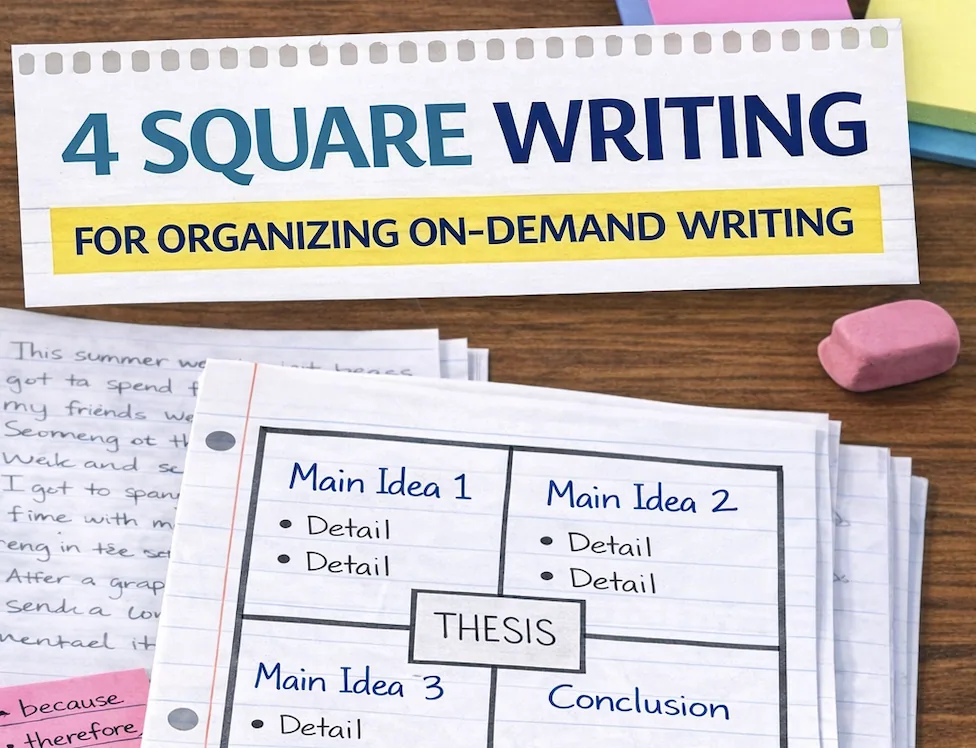
Teaching on-demand writing was my most dreaded 50 minutes of the day.
It was frustrating and exhausting. There were tears, crumpled papers, mangled erasers, and a lot of very weak writing. We could not write a single strong paragraph.
We spent the first nine weeks of school learning how to write paragraphs. Nine weeks. And even then, our writing was shaky at best.
The pressure made it worse.
By spring, my students were expected to take a 90-minute state writing test that required a five-paragraph essay with a thesis statement, three main ideas, supporting details, and a conclusion.
My students knew what they wanted to say.
They just could not organize it clearly or quickly enough when it mattered. 
Like many teachers, I tried everything.
Pyramid planners.
Traditional main idea organizers.
Genre-specific writing planners.
None of them worked consistently.
They either overwhelmed students or felt disconnected from real on-demand writing conditions. My lowest writers struggled the most. Not because they lacked ideas, but because they could not see how their ideas fit together.
After visiting a neighboring school with strong growth in on-demand writing scores, I asked a simple question.
How do you teach students to plan?
Their answer was clear.
Schoolwide, kindergarten through fifth grade, they used 4 square writing.
I brought the idea back to my classroom, and everything changed.
4 square writing works because it provides just enough structure without doing the thinking for students.
Instead of handing students a pre-printed planner to fill in, I had them create the planner themselves. One vertical line. One horizontal line. A small box in the center of the page. 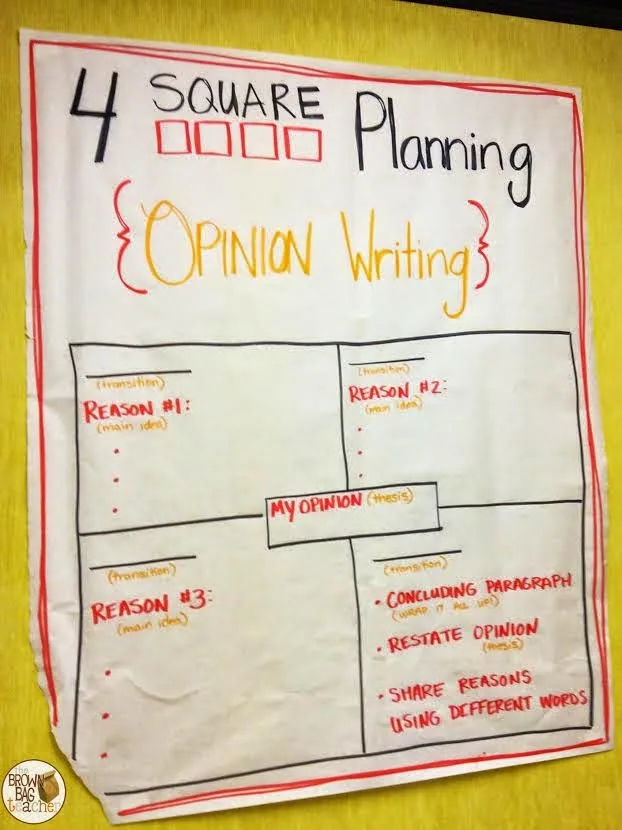
This mattered.
During state testing, students would not be given a graphic organizer. They needed to practice organizing ideas the same way they would on test day.
The 4 square format helped students organize ideas quickly, see the relationship between thesis statements and supporting details, and plan efficiently under time constraints.
One of the best parts of 4 square writing is that it is not genre-specific.
We used the same planner for opinion writing, narrative writing, and informational writing. Through one consistent structure, we were able to address all components of the Common Core Writing Standards.
When students completed a full piece, I expected to see:
Some students planned in great detail and wrote nearly full sentences in each box. Others recorded only key ideas or words. Both approaches were acceptable, as long as the structure was there.
Many students preferred to leave the conclusion box empty until after drafting.
Once their writing had substance, they returned to the planner to refine and anchor their ideas. This was an important shift.
The planner was no longer something I controlled.
It became a tool students used intentionally.
Over time, students learned how much planning they needed, how long to plan versus write, and what organizational strategies worked best for them.
At that point, I had to step back and trust the process.
Before students can organize ideas under pressure, they need regular practice explaining their thinking in writing.
That is why I pair 4 square writing with routines like reading response letters, which help students move from oral discussion to written explanation in a low-stakes way.
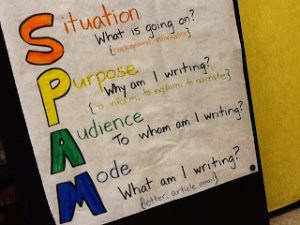
Once students understand how to explain their thinking, routines like SPAM help them break apart prompts so they know exactly what the question is asking.
Together, these routines create a system:
When students freeze during on-demand writing, it is rarely because they do not know what to say.
It is because they do not have a reliable structure to fall back on.
4 square writing gives students that structure. Calmly. Consistently. Without overcomplicating the process.
Structure first.
Confidence follows.