So, this post is going to have A LOT going on but it’s going to work a little like this – (1) The order in which I introduce choices (2) When are we ready to make our own choices (3) How students make choices (4) Accountability. So, here we go!
Note – I introduce my choices in a different way than suggested by the Sisters….and that’s okay! We have to do what works for our students. Still, I always, always introduce
Read to Self first in Week 1. Students need to know that reading is the most important and there is no better way to do this than
building stamina on the very first day of school. When we’ve built our reading stamina to 15 minutes, I know it’s time to launch our next Daily 5 choice – Word Work.

At the end of Week 2ish (depending on how Read to Self goes), I introduce
Word Work second because of the importance of phonics. My 1st grad friends NEED to be hearing and interacting with phonics patterns right away. Plus, since Word Work is SO interactive, it is a really easy one to introduce. I keep my materials in individual bins, so students know to grab one bin and return all the materials. Additionally, I keep
Visual Directions on the top of each bin, so students know exactly what this choice looks like….So, there is little wasted time. Now, Word Work is a *tad* tricky because it is a choice that may not last the entire time. At the beginning of the year, we are doing shorter choices (12ish minutes), so it’s not a big deal, but towards October/November our choices might be 20 minutes or longer. I train my students to know that after they finish one choice to immediately clean-up and make another one. I do not want students just ‘killing time’ at a choice, I want them actively learning. In the beginning, students only know 2 choices – Read to Self and Word Work, so they clean up and go to Read to Self.

Since it does not take us long to become independent with Word Work, at the Beginning of Week 3ish I introduce
Listen to Reading. This is an easy, easy one for students to pick up because we do a TON of read-alouds the first few weeks of school. Students are used to listening to me read and love it. I use 3 iPods we received from Donors Choose and a
Belkin Headphone splitter. I only allow 4 friends at Listen to Reading at a time, so I do teach students to use the HeadPhone splitter and how to choose a book. We use QR Codes, Books on CD, the Booksy App, and iTunes. When training, I actually pull ALL our classroom devices (8 devices + 3 iPods + 3 headphone splitters), so all our friends can practice at the same time. Throughout the 2-3 days of training, we trade devices so everyone has experience using them and we can iron out any of the wrinkles.

After Listen to Reading, I introduce
Read to a Friend at the end of Week 3. I like to separate this choice from Read to Self training because sometimes Read to Friend habits transfer to Read to Self. This choice requires a lot of modeling and practice because it quickly becomes WAY TOO loud. That said, it’s also a simple choice to introduce because students already love reading to self, they want to be with their friends, and they have already built stamina.
At this point (before I introduce Work on Writing) around Week 4, I start our Daily 5
rotations. Before this, we have been doing pockets of mini-lessons and practice sessions. During many of these times, I pull one student quickly for an assessment or spend time watching and helping. For organization, I use a
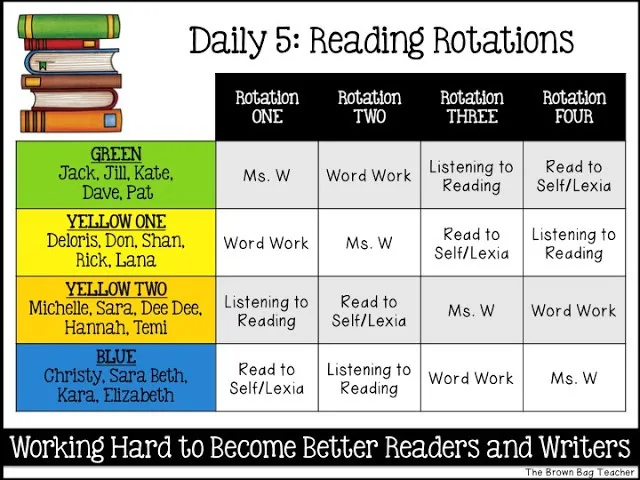
traditional reading centers rotation board. Everyone visits all 5 choices (Ms. W, Word Work, Listening to Reading, Read to Self, and Read to Friend) every day for 15 minutes.
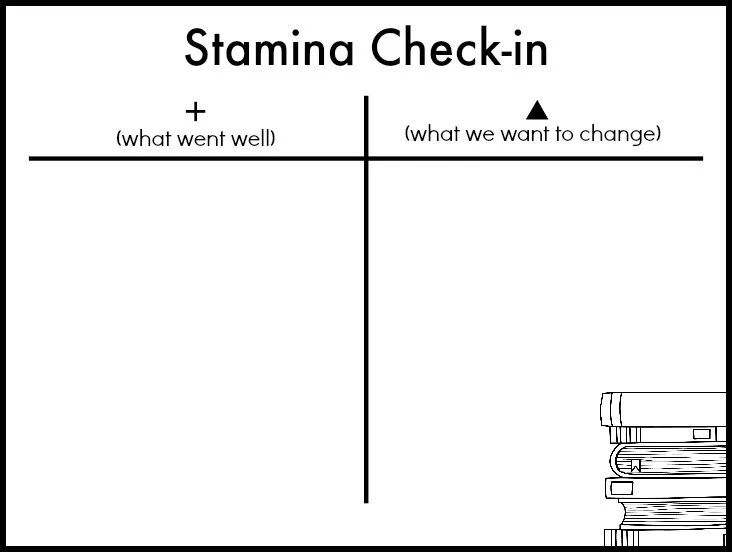
In between each round, students come back to the carpet and we talk about what went well and what we need to fix for the following rotation.
After we’ve comfortably practiced rotations (approximately week 5-6 ish), know what is going on, and have made progress in Writing Workshop, I introduce
Work on Writing. I do wait on this choice because I want students to have several different writing experiences and I want our writing journals to already have ideas and writing in them.
So, by Week 6, all our choices have been introduced and we’re practicing them through a rotation schedule. We keep using this rotation schedule until that moment when I look up from my teacher table and I know they’ve got it. For me this means, the kids groan when the bell rings to meet on the carpet, friends are showing other friends their work, and rotations are now 20ish minutes. Last year, it took until Week 9-10 for this to happen. This year might be similar, or it might be a totally different game. We shall see!
What I do know is that is SCARY to release my friends for the first time, but it is incredibly motivating. They are so excited to hear that they get to choose and they take the responsibility very seriously. It’s an amazing feeling to know that I am trusting my students and my training at this point in the year. Now, should something go wrong – DON’T PANIC! Just call friends back to the carpet and reteach/practice. It’s not that our friends don’t want to become readers/writers, it just means we didn’t practice and model enough.
When we make choices, we use our SMARTBoard to drag our names to a certain choice. I am a little particular about the number of friends at each choice (although towards the middle and end of the year, students know I can be convinced to add friends). Since I color-code my reading groups, my friends know if they see their ‘color’ on the SMART Board that they will not be making a choice that round. Without being told, they know to meet me at my teacher table. Then, friends take turns making choices (sometimes by reading groups, sometimes boys/girls, sometimes randomly). If students finish a choice early, they can come back to the board and move their name. (Note – I don’t have this SMART file available for download, sorry!)
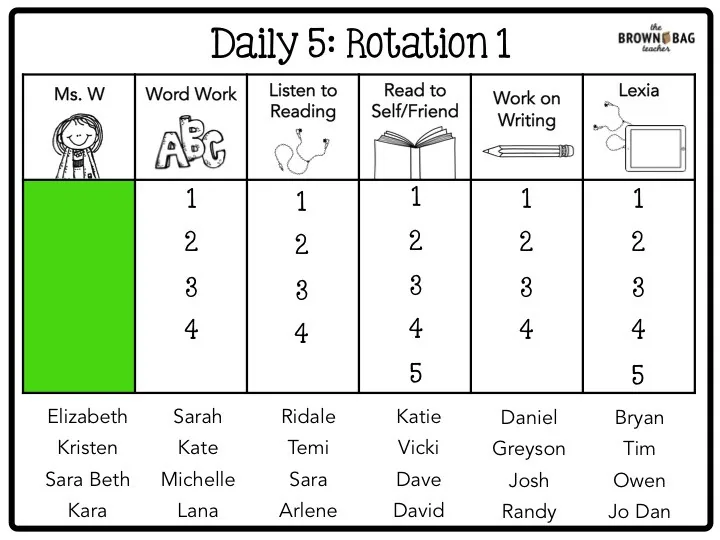
After moving their name to their choice, students then take their Work on Writing folder (where they also store Daily 5 materials) and color their Daily 5 schedule with the choice they made. This makes it easy for me to check-in with students and provides accountability.
At the end of our reading block, students use the Learning Reflection sheet to write about what they learned/practiced that day during Daily 5. Then, they write a positive (plus) and something they want to do differently tomorrow or a goal for tomorrow (delta). Initially, I give students the sentence-starters for these reflections.
- Today I learned/worked on…
- I did a great job of…
- Tomorrow I need to…
As students finish their reflection sheets, they put their heads down and I come by to check their reflection sheet, writing comments as needed. We store our Reading and Math reflection sheets in our math/reading folders. At the end of the week, students staple their work for the week beneath the reflection sheet and take it home for their families to see. When we are doing reflection, our classroom is at Level 0 with Hans Zimmer playing in the background. Our reading and math reflections each take 5 minutes once the routine has been mastered.

So, this is what release to choice looks like for us. It’s a full 9ish weeks of practice that pays dividends the entire school year. Students are independent in their choices and work. They feel a sense of pride in what they are doing, and it gives me – as the teacher – the freedom to pull small groups or assess students. I don’t strictly follow the schedule provided by the Sisters, but this is what worked for my friends last year. Could this year be different? Absolutely, but we’ll have to wait and see!
So, tell me friends, what order of choices works in your class? Is there always something you introduced second or do you play it by ear? How do your students check-in? With only 3 weeks until the school year starts, I’d love to hear your ideas! In the meantime, make sure to visit
All Things Apple and
Mrs. Price’s Kindergarten (who are hosting Chapter 7), as well as, the other awesome teacher-bloggers who are joining us. Even if you’re not a blogger, please join-in on the conversation below! 🙂






15 Responses
Thanks for this post! I want to give my first grade students more independence this year. What do you start your year off with at the word work station?
HI Laura! For the beginning of the year, we do the most basic Word Work centers – pyramid writing, roll and write, letter it, and stamp it! 🙂
I loved reading your post! Thanks so much for your ideas on how you run daily 5 in your classroom. It is so helpful to see how this works in other classrooms. Do you assign which container the students get (such as the work on writing tubs) or do they just grab whichever one they want to worl on?
Helllo! Thanks so much for your kind words. Most of the time, I let students have complete control over their Word Work choices. I honestly don't care if they want to stamp the words or just letter them…the practice is what matters to me! 🙂 The only time I make requests is when I have a sentence scramble, a super sentence, or a grammar hunt in there. Then, I do ask that students visit it sometime throughout the week, but let them choose when. 🙂
I am learning so much from you! It's one thing to read the book, but it's another to actually see it in action! Thank you!:)
I agree with Inspired Owl! Love to see how it is in action. Question (or this might get addressed in future chapters?) Once they have a choice, is your reading block time still about 90 minutes? I'm curious how it runs from week 9 and on.
Thanks!
Kelli
Hi Kelli! My reading block runs anywhere from 90 – 120 ish minutes. After we have choice, I typically run 4 rounds (20ish minutes) with a 10 minute mini-lesson in-between each round. The first mini-lesson is phonics, 2nd = writing, 3rd = reading comprehension, and 4th = sharing our writing. Sometimes I only pull 3 reading groups and do individual assessments/conferences during the 4th round. 🙂
Awesome! That answers so much! Thanks you! Just two more quick questions: 1. Do you typically run D5 M-F? 2. For Word Word I've read it might just be a 10 min or so working block for those kids. Do they finish the remaining 10 mins in another area or stay there? You're the best! I appreciate you leading all of us newbies through this! Thanks!
Hi Kelli! Yes, I used D5 M-F. My 1st graders love it, and I want that continuity. Many times Word Work is shorter, so when friends finish they make another choice on the SMART Board. If I start noticing a particular student struggling with a particular phonics pattern, I will suggest he/she make another choice within Word Work, or revisit it later the same day. 🙂
I love your reflection sheet and how you organize everything!
I came across this post while researching Daily 5 this evening – love the SMART Board/Choice Board idea! What a great visual! Right now, my kiddos and I are using a timed Powerpoint and rotating. I'm glad to see the transition from rotating to choice IS doable! P.S. – LOVE that you had a Sarah Beth in your class, even if she spelled her name without the "h" haha! 😉
Sarah Beth
Miss White's Classroom
HELP!!! Week 3. We are at 9 min stamina, and intro word work. I am required to use a basal series so I have group in that, but we rotate to the other stations. NOISE level has been a problem. I guess I just need to bring them back and we practice /model more. They are talking/discussing and mainly on task with the activities in Word work and game center, but it is difficult for my reading groups to focus, and for me to hear them. 🙁 Any suggestions?
Hi Michelle! I think you’re right – it’s time to practice some more! If noise becomes a problem, I will sometimes use the Noise Bubbles website. If it gets REALLY bad, we’ll do a round in silence (other than teacher table) and it really helps. 🙂
Hello! I have purchased your writing bundle and first week of writing unit and believe it is to be used for Writers Workshop. However I notice in the picture you have the organization sheets for all these units in the trays for the launch of your work on writing. I love this idea but I need some more clarification how you get to this stage by week 6. Do you just teach the basics of each unit and then go into detail when the unit is to be taught later in the year? Or is the picture in this blog not accurate and you introduce other forms of writing like letters, postcards, list, etc?