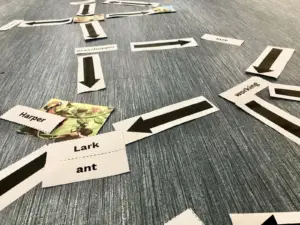

Today I wanted to share about about using 7-Up to introduce new vocabulary. This is a quick and material-free way to engage students with words they are learning!

We just wasted over a minute of classtime thinking and sharing about the word obstinate, and I have no idea if students actually understand what the word means. Here enters the game of 7-up.
So, you repeat the above Steps 1-4, but when asking students to use the word in a sentence you tell them they’re going to play 7-up. They get all excited because it’s a “game” and then, you say their sentence has to have at least 7 words. Then, someone shouts out “That’s going to be hard!” To which, you respond, “I challenge you to play my game.” My kids are ALL about games and challenges, so they immediately want to ‘beat’ me for the BEST sentence. After students have shared with a shoulder partner, they nominate 3 peers to read their sentence for the class and we vote for the most phenomenal example of the word.
Ha – simple right?!? In 1-2 minutes, students have heard, written, connected with, used, and listened to the word in action. Plus, they had fun because they thought it was a game! I always use 7-up as a whole-class, but also pull it our during small groups. When I use it in small groups, I pull out colored index cards (oooohhhh) and have students write their sentence, as well.
 Well, friends, that’s it. Quick and easy vocabulary instruction that helps students have 8-10 exposures to a word in just 2ish minutes! Thank you SO much for stopping by. If you’re interested in other FREE classroom resources and freebies, sign-up here for teaching ideas to land in your inbox each month.


13 Responses
Oh those short vocab sentences drive me crazy too! My students love a challenge so we are definitely going to try this!
Sara 🙂
The Colorful Apple
Isn't it just terrible?! Thanks so much for stopping by, Sarah. I absolutely love your visual lesson plans! We have to have our plans 'checked' every week by our Principal, and I am sure she would love it, too. 🙂
Very cute idea!! Love it! :O)
Thanks for sharing!
Amanda
Collaboration Cuties
Thank you so much, Amanda! I am absolutely loving your new blog design – so cute! 🙂
Love your idea!! Vocab is so hard to teach!! I am a new follower!!
Kathy O
Third Grade Doodles
You're right, Kathy, but it is SO important. Thanks so much for stopping by. 🙂
This game would be a good addition to our current vocab activities. Thanks for sharing!
Coming up with the non-examples is the MOST fun of the whole lesson !!!
Haha – so true, Katie! Our kids can come up with some ridiculously hilarious non-examples. 🙂
Thanks for sharing! I'm always trying to figure out more engaging ways to get my kids involved with vocabulary. I have the same problem with them using their new vocabulary words in sentences.
Chelsea
Fifth Grade Wit and
Whimsy
We use spoken and written words every single day to communicate ideas, thoughts, and emotions to those around us. Sometimes we communicate successfully, and sometimes we’re not quite so successful. To be successful in proper communication of thoughts we need adequate words i.e. good vocabulary skill set. To improve click https://vocabmonk.com.
We talk about 7Up sentences when we write sentences but I never thought of using it in as game. GREAT idea. I also like to show a picture of the vocabulary word in action thanks to my SIOP training. It really helps my ELD kids connect with the word.
I also have a Thesaurus on the walls of my classroom. My kids reference it continuously to help add more interesting and precise words to their sentences. Check out my post here for more info. http://www.inspirationforeducation.net/2014/09/word-choice-and-compliments.html
Great idea! Games are so smart and this one rocks!