Building independence is the most critical part of setting-up Daily 5 in our classrooms. Without independence, we would never be able to pull small groups, confer with students, or assess growth. There would be off-task children, there would talking and off-task behavior, and most importantly, there would be no reading and writing taking place. As we’re building independence, my 1st graders hear me ask (over and over) – “If we do __________, will that make us better readers and writers?” This is our driving question.
In Chapter 3, the Sisters give us a 10 Step Plan for helping students build independence. (You can check out Chapter 1 – Daily 5 Edition 1 vs. Edition 2
here and Chapter 2 – Our Core Beliefs
here.) We being by identifying what it to be taught, we often do this through an I-Chart. There is a teacher side and a student side. Then, we model, model, model. We choose students to model how to read, how not to read, and then, how to read again. From reading upside down to zooming through books, we model EVERYTHING!
After we’ve modeled the correct and incorrect behaviors and reviewed our I-Chart, we’re ready to begin. For the first few times, students aren’t ready to grab their book bins and go. So, this is how we roll –
(1) I assign book bins and students grab them in groups of 3-4. (At the beginning of the year, I’ve placed 6-7 books of different levels and interest areas for students to enjoy. After I’ve assessed their reading level, students start choosing their own books.)
(2) Students place their book bins on their desks and then, sit on the carpet.
(3) Continue until all students have their bins.
(4) Talk about just-right places to read in the room. Most of the time, my 1st graders prefer small corners or places. There is safety in these places, so I tend to choose these places for them – corners, chairs facing the wall, behind doors, cubbies.
(5) I pick spots for our first day only. I found this process is way overwhelming (and takes a TON of time), and my group this year could handle picking their own spots. My group this year may need to be placed for a while…we’ll see.
(6) Once students know their spots, I bring them back to the carpet.
(7) I call girls/boys to grab their book bins off their desks and then, go to their spots. We begin building stamina!
I start the time on the board. Initially, I thought this would be distracting, but most of the time, no one pays attention to it. For my few who care, they will take quick glances and get back to reading.

In Step 7, where I struggle – “The Teacher Stays Out of the Way” because you have to trust your students and most importantly, your training! The first 2 weeks of stamina building the teacher does not provide any prompting during stamina building. Students need to be able to do this independently (i.e without teacher prompting), so when teachers start pulling small groups later in the year, student behavior is not contingent on the ‘teacher look’. So, when students are building stamina, I grab a book and read at my teacher table. I am not walking around or giving the teacher eye. I am watching for barometer students (the first students to break stamina and who measure the ‘weather’ in our room…the ones we’ll later intervene with – notice the sand timer below), but not so much that the students feel monitored.

After students have broken stamina, it’s time to play a quiet signal. I use a traditional teacher’s bell and ring it 2-3 times. As soon as it is rung, students quickly grab their book bin, put their bin on their desk, and sit on the carpet (SILENTLY)! During this time, I give no affirmations or teacher looks. Students need to do this independently without hints from me…even if we didn’t meet out stamina goal. Reflection will come next…NOT during this transition.
When we are all on the carpet, friends are given the chance to reflect on their own Stamina Building. The Sisters suggest students use a 1-4 scale to rate their reading. When I introduce this scale, it looks like this –
(4) Wow! I am ready to do __________ by myself and can teach others how to do it.
(3) I can do __________ by myself but sometimes need a few reminders.
(2) I tried my best. I need more practice.
(1) Help! I need to check-in with Ms. W.
This is a quick check-in and I visually scan the room. It is a great chance to see if students are actually understanding how they are doing…especially our barometer friends.
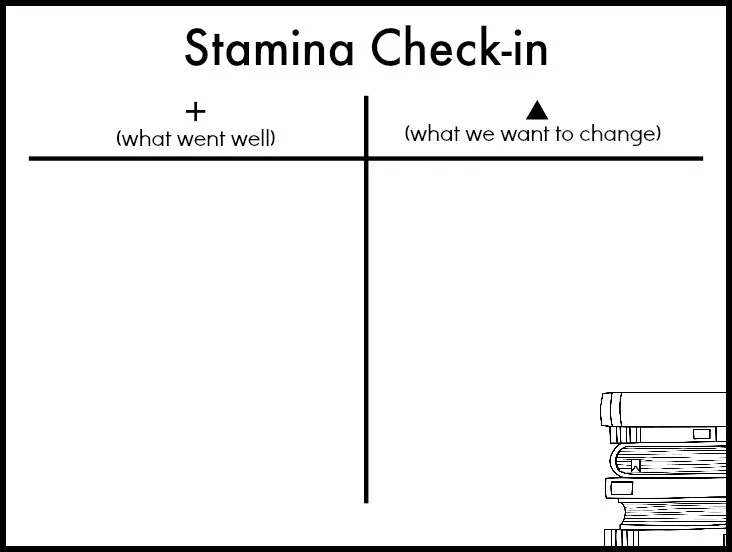
After an individual check-in, we do a whole-class check in. We make a Plus/Delta chart on our SMART Board talking about our celebrations and what we want to do differently. If we’re in the right ‘mood’ we’ll practice building stamina right away. If I can see we need a break, we’ll take one and practice later in the day. The Sisters suggest practicing 3 times a day, initially…but I found 2 times a day was plenty for us.
Finally, we graph our practice session. I
graph EVERY single session…not just by the day. It’s important for students to see how a weekend or a break can affect our stamina. Plus, for my competitive friends, they love setting meeting the next minute-goal! 😉 (Snag this graph
here.)
So, there they are: step-by-step ideas for building stamina and independence. When we follow these steps we give students the tools to read independently and the blessing of books. When our students become wild readers, they love reading…even the kids who wouldn’t traditionally be “readers”. It is with training, that EVERY student becomes a reader. So, what did you think about Chapter 3? Do you follow the steps explicitly? Do you find that you have to add any additional steps?
Read along with us and join the conversation here:
Also, make sure to visit The Crazy Schoolteacher (who is hosting Chapter 3), as well as, the other awesome teacher-bloggers who are joining us. Even if you’re not a blogger, please join-in on the conversation below! 🙂







4 Responses
Love all of your pictures! Reading outside??? Amazing!!
I'm so glad there are so many Daily 5 pros in this group! I am getting so many great ideas from all of you! Thank you for sharing! 🙂
Catherine, You did another FABULOUS post on Daily 5! I think the new way of thinking on the Stamina Chart is TOP NOTCH! Thanks so much for the download! I will be back next week!
Mrs. DiBenedetto's First Grade Critter Cafe
I do it as the 2 sisters laid out. I find that it works well. I like the changes of just telling the students the expectations – not having a long conversation about each one. Most of my kids have Daily 5 experience so, it goes quickly. I also get through placing kids around the room quickly because it takes a long time. I usually only do it only once or twice depending on the group.