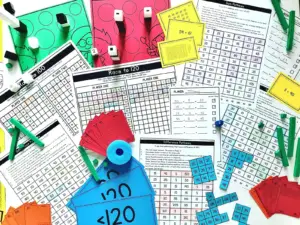

Our whole-group math lessons happen every day for 8-12 minutes after we talk numbers and before small-groups and math centers. These short, intentional lessons help anchor our learning, set the foundation for teacher-table, and establish common vocabulary among my math groups. So often I’m asked – “What is the difference between a whole group mini-lesson and a small-group lesson?” Here is a peek into whole-group math lesson in my 1st grade Guided Math classroom!
Whole-group mini-lessons are 8-12 minute base lessons that lay the foundation for our small group time. In these lessons, we meet on the carpet as a class and I, as the teacher, am leading the lesson and showing my thinking. Unlike small-group lessons, my whole-group times are teacher-led. Students are not using hands-on materials or making meaning of their learning. During our whole group lessons, I am modeling, showcasing, highlighting, explaining, and reinforcing. Then, during small groups students receive differentiated opportunities to engage with the content using hands-on materials. In these guided math times, we pull our the rekenreks, practice making 10 to add, apply our understanding of numbers to balance equations, etc.
To keep planning for our guided math block more manageable, I create a routine for planning. Typically on Mondays, we will introduce an Online Manipulative or use a familiar manipulative in a different way. On Tuesdays, we’ll introduce a Math Read Aloud that stems into our Teacher Table time. Then, on Wednesdays, we learn any specific vocabulary terms for the week and learn whole-brain motions/chants for them. On Thursdays, we pull out a video or song and on Fridays, we typically do a more interactive Partner Up activity! Of course, not every standard or learning target lends itself to this routine, but it’s nice to have a go-to format that I can tweak as I need to.
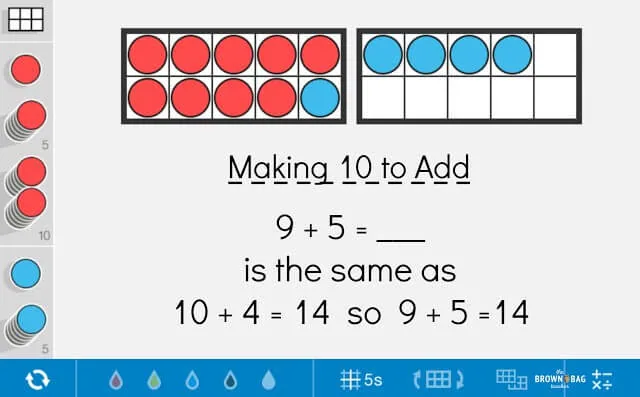
Online manipulatives are internet-based math tools that allow for whole-class modeling (led by students or teachers) moving students from the concrete to the representational mode of thinking. These math tools are often free resources sponsored by textbook companies and other organizations to generate alternative ways to represent math content. Online manipulatives allow students to show their thinking in a whole-group mini-lesson before guided math small groups begin (a great scaffold for students who struggle but still want to share their math thinking)
Books and read alouds are a perfect way to make math real-world for students and make a perfect whole group lesson. Seeing math in context – at a birthday party, catching fireflies, taking a walk in nature – is motivating for students and provides a perfect ‘why’ behind our learning. When using Math Mentor Texts I will share the read-aloud during our whole group mini-lesson. We’ll do a think-pair-share or pull out the sticky notes to talk about what math we see in the book. Then, we’ll use manipulatives during small-group to illustrate and work out the math.
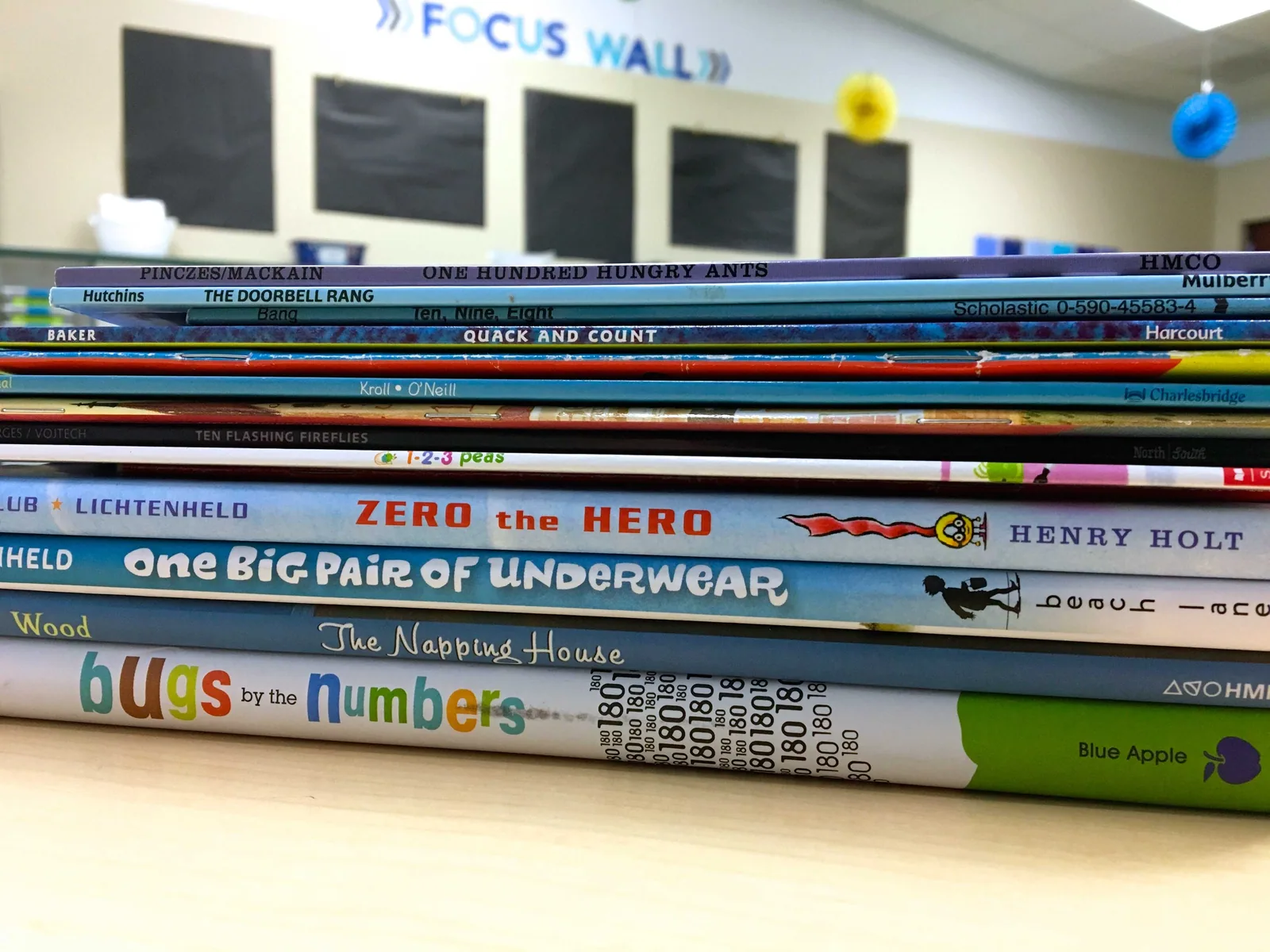
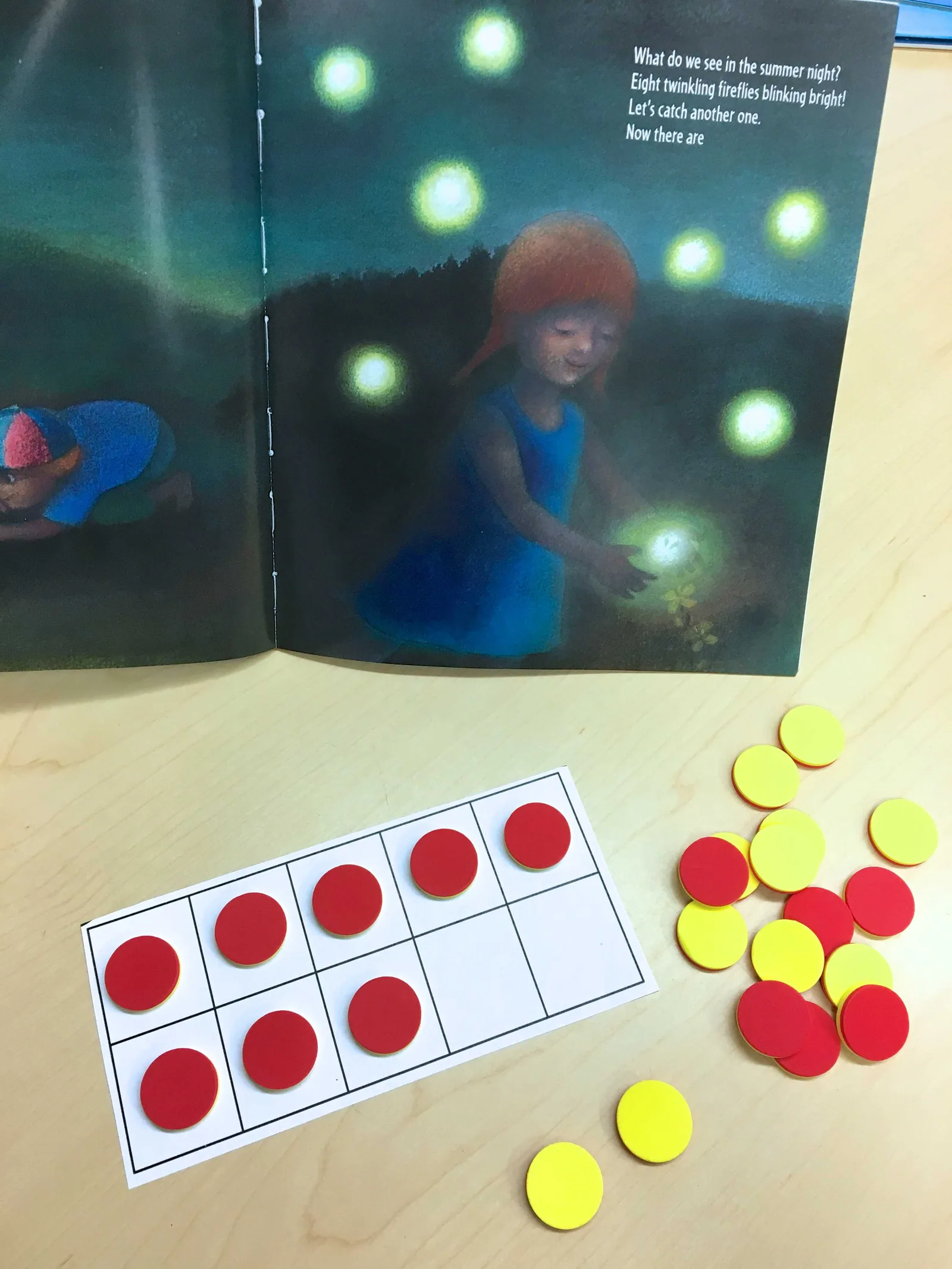
My go-to mentor text for making 10 is Ten Flashing Fireflies. A beautifully illustrated story in which there are 10 fireflies at night and two friends are collecting them. Every time one firefly is collected in their jar (shown on the left side of each page), there is one less in the sky (shown on the right side of the book, see below). It’s the perfect book for talking about commutative property (i.e. flip-flip facts) within the 10 facts (1 and 9 & 9 and 1). Then, in small groups, it is the perfect text to have students model what is happening with ten frames!
Building oral language into math is incredibly important. Just as much as students need to be able to solve problems and think flexibly about numbers, they also need to use precise language when talking about their thinking. One of our mini-lessons each week is devoted to learning new math vocabulary, learning definitions, and applying the vocabulary to our small-group learning. We typically we use Whole Brain call-and-response to learn new vocabulary. “Equal means the same as.” (students hold out hands palms up moving them up-and-down like a balance).
During whole-group lessons, songs and videos are a weekly occurrence. After a topic has been explored in small group, we love the opportunity to reinforce the idea, learn new vocabulary, or build fluency through songs and videos. From BrainPop Jr to the Learning Station, videos offer a hook into our small-group learning. Some of our favorite songs come from Ron Brown iTelli-Tunes or we make our own, like our Making 10 song!
Probably our most interactive whole group lesson is Partner Up. Every student is given a card and then they find their partner. Once students find their partner, they meet on the carpet and apply a context to their numbers. (i.e. If the two partners each had a number 68, then students might create a word problem like….Today it was 60 degrees out. Yesterday was 8 degrees warmer. How warm was it yesterday?) We use partner up for all kinds of skills – sums, place value, shapes and their names, expanded form, etc! Addend bonus? Partner Up is a great time to practice those important 1st grade social skills – greeting a friend, giving a kind high-five, making eye contact, listening, and taking turns.

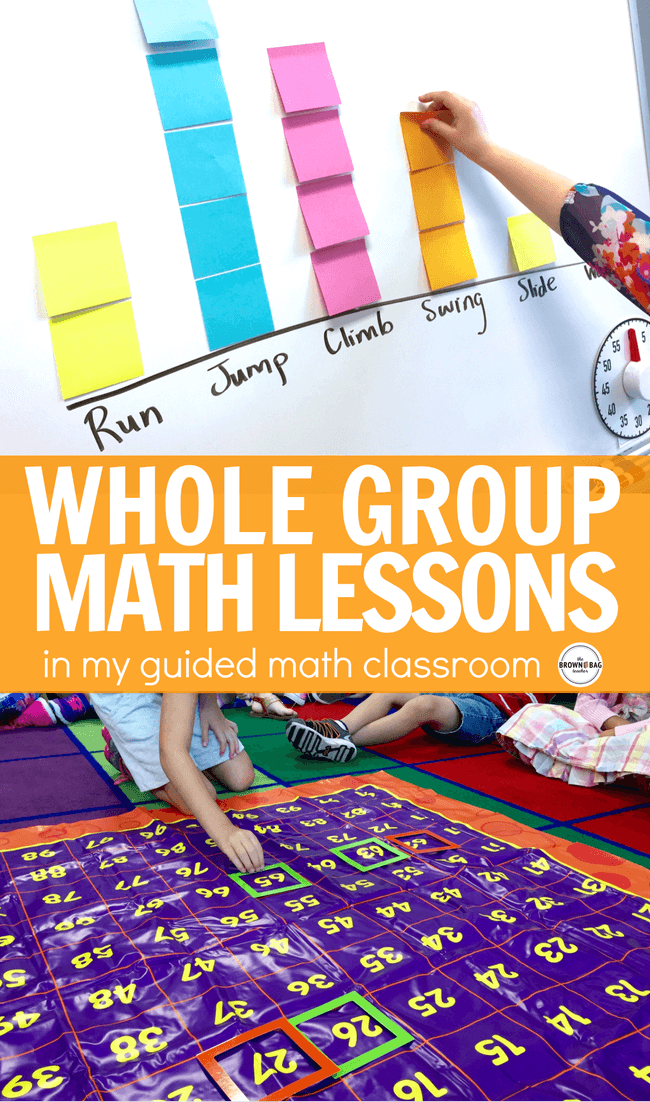
If we aren’t up for a round of Partner Up or the content doesn’t ‘fit’ I love pulling out activities that lend themselves to lots of people. Place Value Bootcamp, sticky-note graphs, shower curtain 120s chart are all perfect ways for students to showcase their thinking and modeling our learning target in larger-than-life terms.
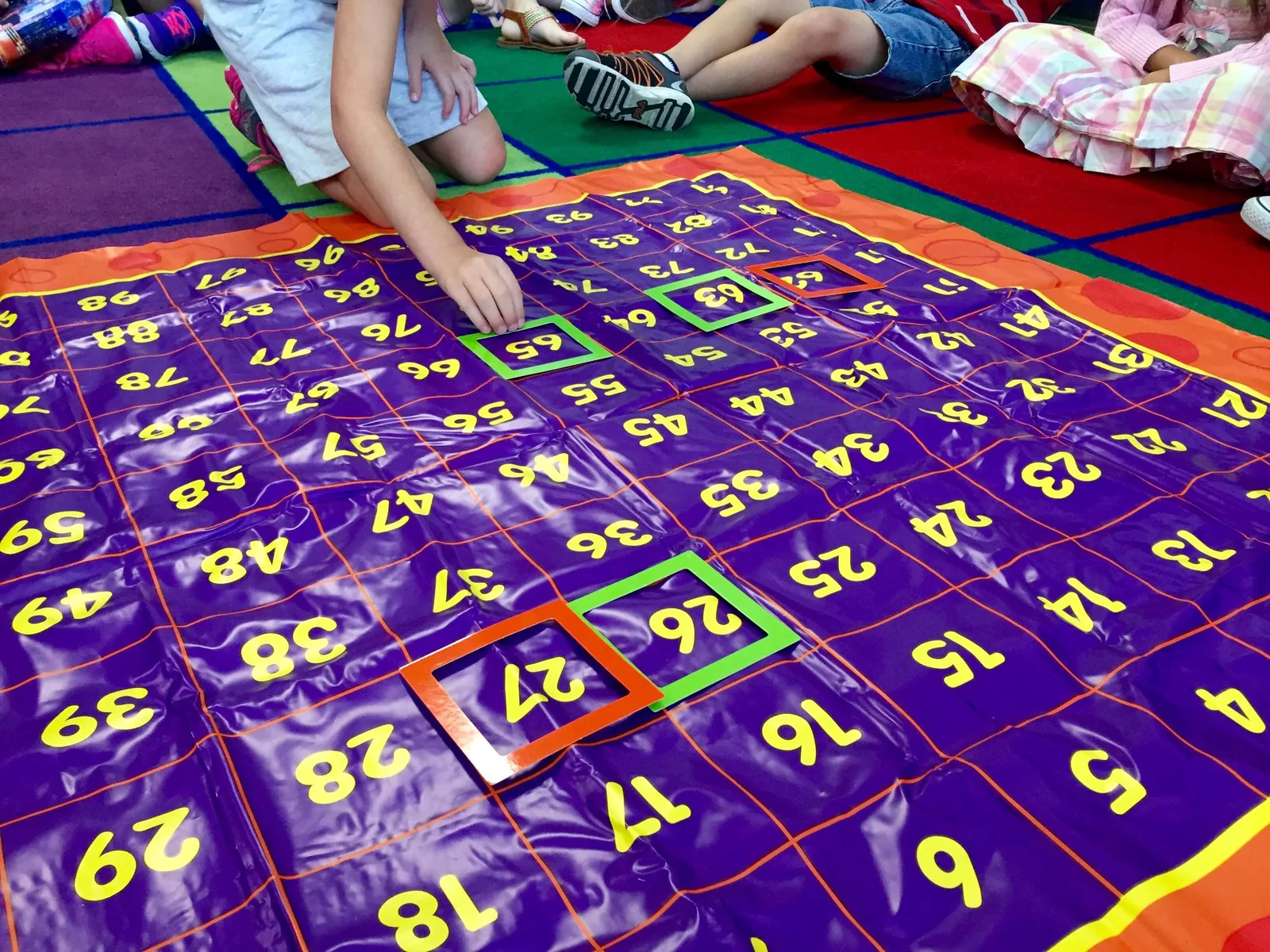
While we definitely branch-out some weeks, I’ve found having a routine for whole-group lessons really helps keep Guided Math manageable. What are your whole-group go-to lessons?

5 Responses
Hi –Could you share a good source to find a class carpet to seat 24? Where did you get yours? Thanks–Marion
Hey Marion! I have one from KidCArpet and LOVE it. I would highly recommend them.
Do you have any videos of you teaching math? I’m a visual learner myself and would love to see some of your awesome methods in action!
Hey Lauren! Thank you so much for your kind words. Here are some video for you – https://www.facebook.com/pg/brownbagteacher/videos/?ref=page_internal
Are you required (or do you use) a math textbook? If not, do you make up your own math problems for the whole group lessons, or even small group lessons? Thanks!