Research. A word that drives fear into many primary teachers’ hearts. How? When? With what? Researching in primary grades is so often students sharing random facts (or things they believe are facts). It frequently includes copying from an information source and/or the most unorganized combination of information. How do we move beyond surface-level recitation of information to deeper learning and research about a topic?
Just as we can ask questions to drive our research, students can also build on their knowledge about a topic to extend their understanding. When we teach students to build on their knowledge, we move from cursory facts to deep details that include specific information and new learning.
Researching in Primary – Why?
Research is a part of our standards from Kindergarten to 12th grade. Researching in primary does include the phrase “with adult support”. Outside of “the standards say so” researching in primary is a valuable tool in applying our reading and writing skills flexibly. As a coach and teacher, when I think of research here are my “Big 3” whys:
- Access & experience with diverse media: Books and print resources compose only a part of the information that is available to us as humans. Videos, podcasts, radio segments, tables and graphics, infographics, audiobooks, websites – are all a very real parts of our students’ worlds. Therefore, research allows us to explore and support students in applying reading skills to a variety of new literacies.
- Synthesize Information from Multiple Sources: Anchor Standards (Guiding Principles in Kentucky) 7, 8, and 9 are all about integrating learning and ideas within a single text and between multiple texts. Having multiple sources of data or information allows us to discern similarities and differences in how the author presented information and what information is presented, how text features support learning, which details support different ideas. Synthesizing is a high-order skill and students need scaffolded practice before they can do it independently in later grades!
- Leverage Content Knowledge: When we leverage content-learning, it allows student writing to be an authentic and natural extension of what is already happening in the classroom. Additionally, content knowledge gives all students an access point to the writing and research process. It is not dependent on students randomly developing a topic or having life experience (and or interest) with a teacher-chosen topic.
Collecting What We Already Know
So, what might this look like in the classroom?
Individually students brainstormed facts or information they knew about ants. This was in the middle of our animal adaptations unit, so later we would be exploring these industrious creatures and their way-cool adaptations. Students took 2-3 sticky-notes and could write or illustrate their knowledge.
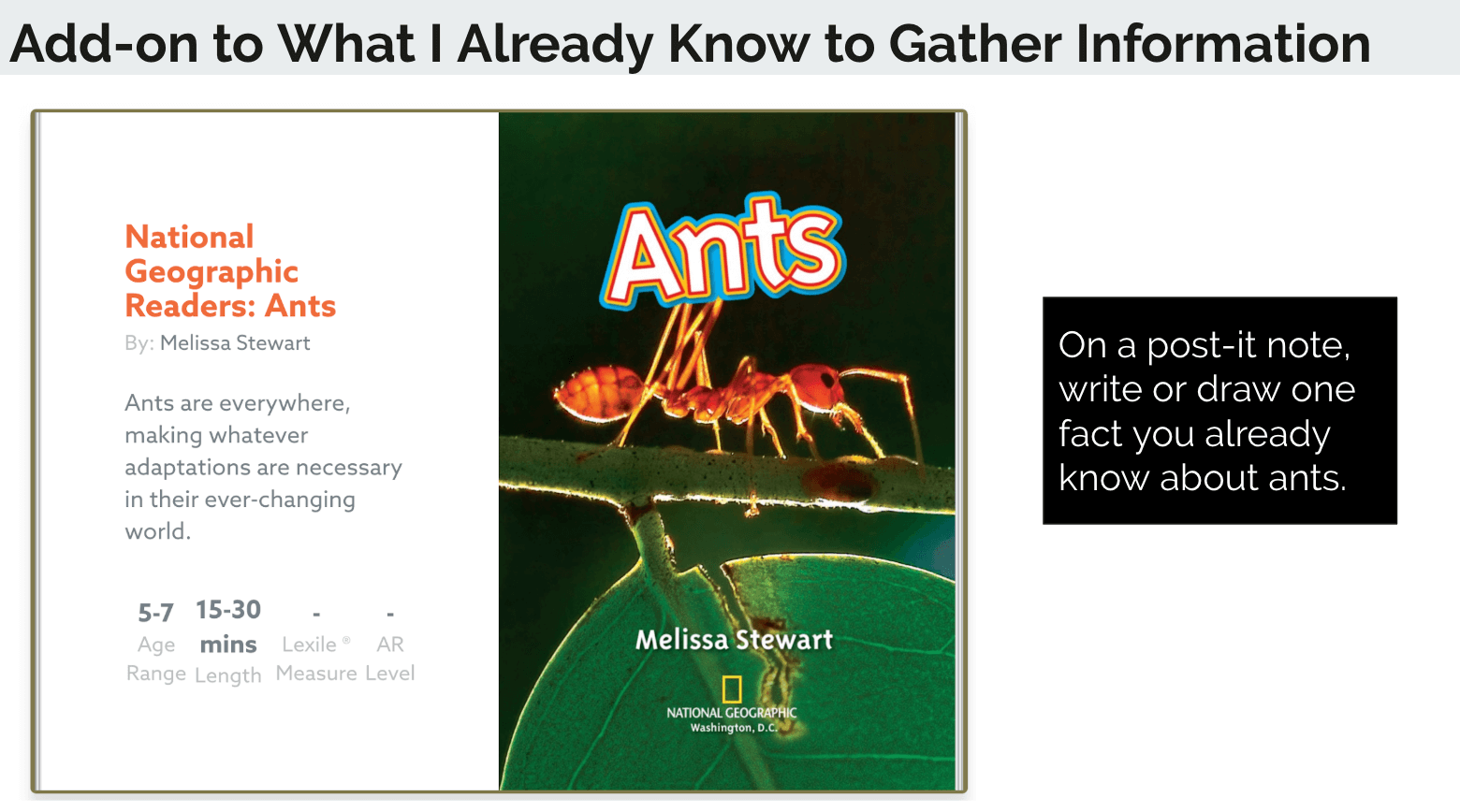
(Note – Sometimes things we “know” we know aren’t actually true. That’s okay! As we begin researching, we can shift our thinking. Even if we weren’t initially correct, we can use that information to spearhead our research!)
We grouped our current knowledge by subtopic (a skill we had previously learned) – habitat, how ants move, body parts, types of ants, characteristics. Then, picked one bit of information from each category to learn more about. At this point, we hadn’t narrowed our research question (ant adaptations leading to survival) and were collecting general information. We could have very easily chosen to explore one subtopic for our research.
Noting New Learning
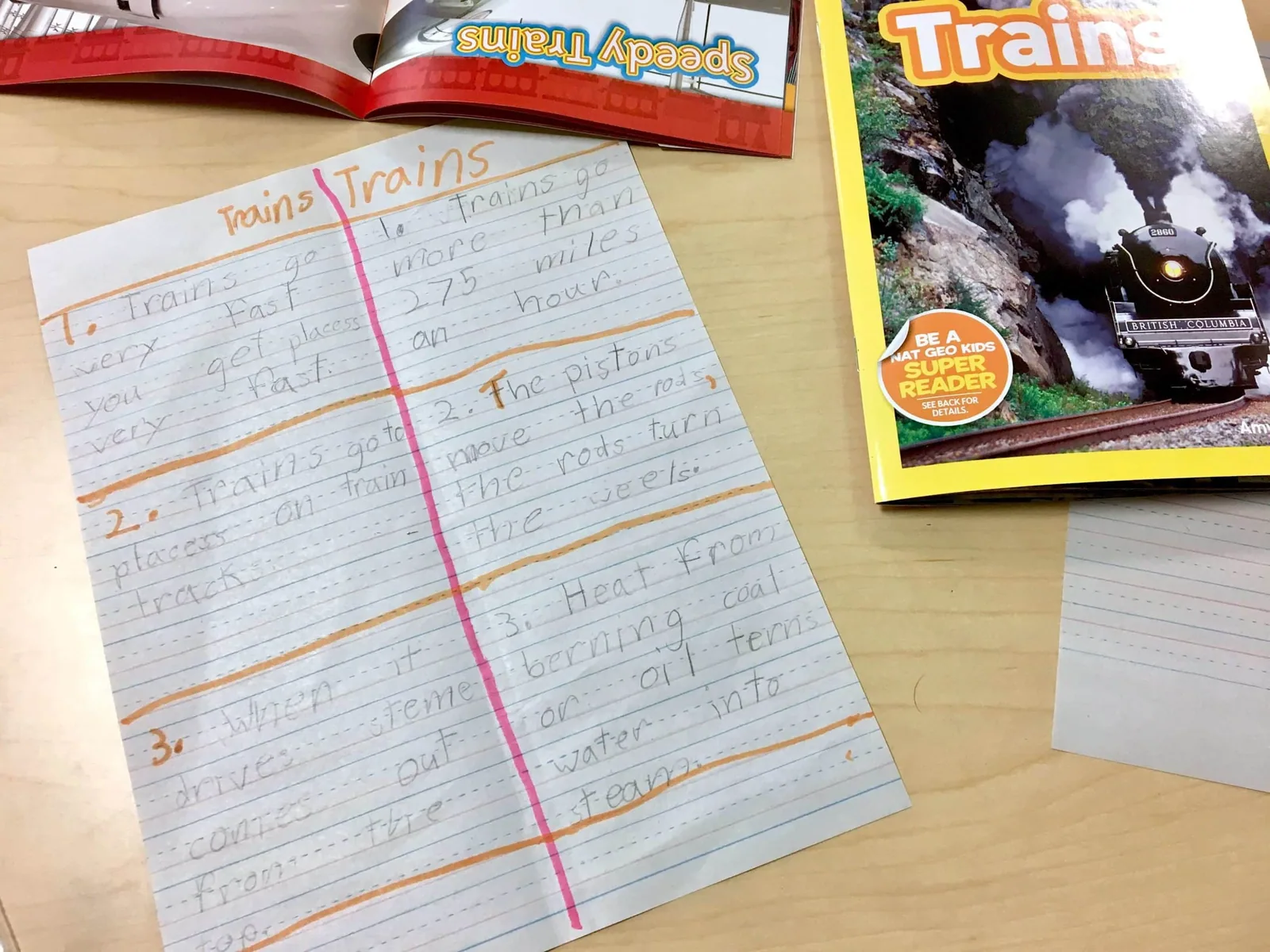
Now, it’s time to research. From EPIC to National Geographic Kids to Captsone Publishing, one way we can scaffold research in primary is choosing the texts or sources that will be used. As we research a specific topic, we are keeping in mind the 3-4 pieces of information we want to build on. Anything that doesn’t relate to these would be a “Fun Fact” that we have the opportunity to revisit later. As we encounter new-to-us information that expands on what we knew/what we thought we knew, we read that section and then retell it to a friend. From there, we write our new, extended learning. (We write based on our retelling, not the text….because #plagiarism).
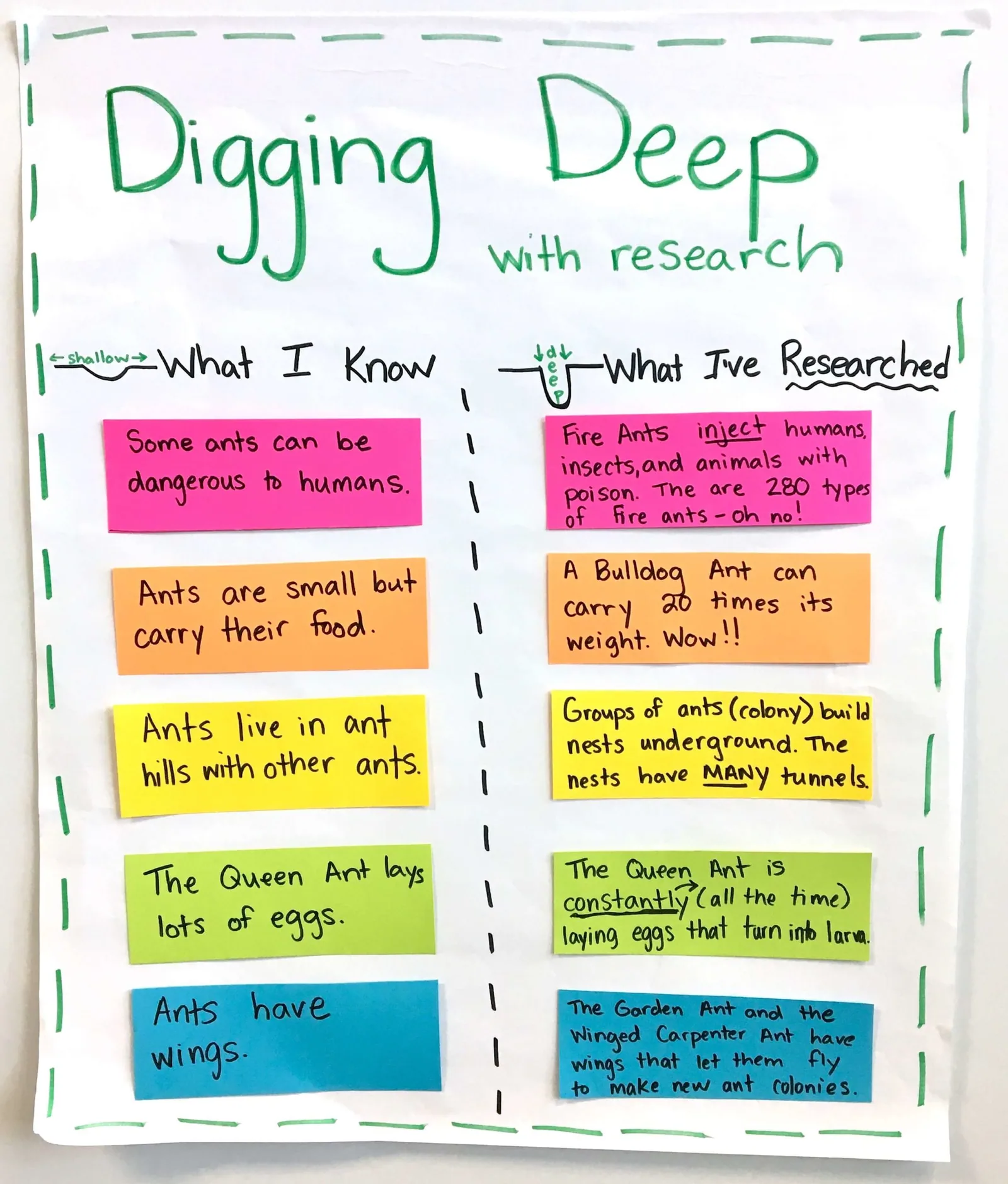
Below is a completed (typed by teacher) student sample of a “Digging Deep” exercise modeled and practiced in reading small groups. (Download this graphic organizer for FREE here.)
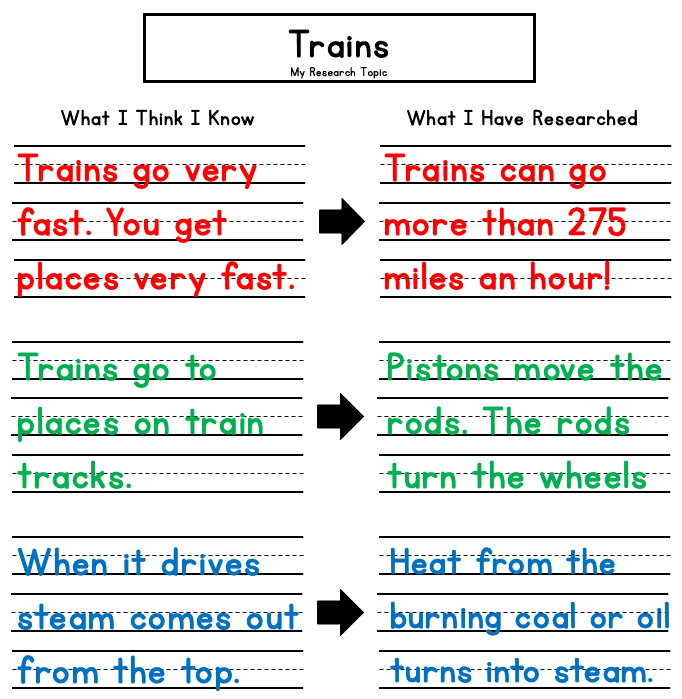
Researching in Primary: Branching Out
From here, any of our new learnings can be expanded upon. We might continue in this format (learning —> new learning from research) or try out another method for research collection. From our new learning we might be ready to ask questions or even divide the new learning into subtopics. (i.e. The blue fact could be further explored by creating a Topic: Types of Ants, Subtopic: Winged Carpenter Ants, Garden Ants, Bull Dog Ants, etc).
Students might turn their research into an article, a paragraph, a letter to an expert, a Google Slide Show, etc. The opportunities we offer students have to match the prompt or structure we initially set up!
Friends – researching in primary matters. If we are going to invest the time and energy to research, let’s do it well. Let’s provide specific strategies students can apply across subjects and skills. Strategies and skills that match what they will need and use in the real world.
For more information about how we gather and organize notes, check out this blog post. To see how we structure and organize paragraphs, click here. See what our animal adaptations unit look like here.
Join me for weekly classroom updates and free resources that are just-right for your writing classroom!
hii
very useful topic for students. Students have the opportunity to revisit here.
Thank you so much
Tnanks for sharing useful infomation
Having spent a couple of weeks at WS Casino, I’m thoroughly impressed. The variety of games, including the live casino section, provides endless entertainment. AU’s live chat service is incredibly efficient, which made resolving a minor issue super quick. The deposit and withdrawal processes are straightforward and secure. Plus, the promotional offers are fantastic. I’ll definitely be coming back for more gaming sessions!
In essence, this article presents research as an ongoing, dynamic process that is not just about gathering information but also about learning how to interact with various media, synthesize information, and connect new knowledge with what students already understand.
Leverage your knowledge to ask specific, relevant, and insightful questions that guide your research.
Sure,When conducting research, using prior knowledge is a powerful strategy for making connections and deepening understanding.Actually,I’m currently working on a coursework assignment and I’m struggling to apply this concept. Can anyone offer suggestions on how to effectively use prior knowledge to research a topic? Specifically, I’m looking for tips on how to get started and make meaningful connections between old and new information.
When writing an article, it is important to start by clearly defining the main idea and then researching information to support it. Use your prior knowledge as a starting point, but don’t rely on it alone; look for reliable sources to strengthen your arguments. Keep your style smooth and engaging, and avoid unnecessary filler—clarity is the key to a successful article
Using prior knowledge in research is a highly effective way to build connections and deepen understanding. To get started, begin by writing down everything you already know about the topic, even if it seems basic. Then, analyze how this existing knowledge can serve as a foundation for further research. Try categorizing your knowledge into key concepts and identifying areas where more information is needed. By recognizing gaps in your understanding, you can focus on searching for relevant sources that bridge these gaps. Additionally, reviewing related case studies, examples, or historical events can help strengthen the connection between what you already know and what you are trying to learn.
Using what you already know can make research easier and more meaningful. As you research, compare new information with what you already know . You can also use simple tools like https://writepapers.com/write-my-coursework to organize your thoughts.
This also helps you make better connections and remember things later.
Here’s a fun idea: try the “reverse research” method! Instead of starting with what you know, start by imagining you’re totally wrong about the topic. List your wildest misconceptions, then research to prove yourself wrong. It’s weirdly effective — plus, you’ll stumble upon fresh insights you wouldn’t have found otherwise. Bonus: it’s oddly entertaining!
Encourage Synthesis Over Recitation: Instead of listing facts, ask students to combine information in meaningful ways. For example, have them compare two animals or sprunki retake explain how an animal’s traits help it survive. This fosters critical thinking and deeper understanding.
A very creative and practical approach to helping primary school students learn to research in depth – not just gathering information but building understanding based on existing knowledge.
DR. ODUNGA IS THE BEST SPIRITUALIST ONLINE WHO RESTORED MY BROKEN RELATIONSHIP AND I HIGHLY RECOMMENDS DR. ODUNGA TO ANYONE IN NEED OF HELP! My husband left me for another woman 3 months ago and ever since then my life has been filled with pain, sorrow and heart break because he was my first love whom I have spent my entire life with. A friend of mine told me he saw some testimonies of a spiritualist called Dr Odunga that he can bring back lover within some few days, i laugh it out and said i am not interested but because of the love my friend had for me, she consulted this great man on my behalf and to my greatest surprise after 11hours my husband called me for the very first time after three months that he is missing me and that he is so sorry for every thing he made me went through. He came back to me and now we are happy together. I still can’t believe it, because it’s highly unbelievable. Thank you Dr.Odunga for bringing back my lover and also to my lovely friend who interceded on my behalf, for any one who might need the help of this great spiritualist here is the email address: [email protected], you can also add him on Whats’app: +2348167159012
Here’s a quirky trick I love: explain the topic to an alien who has zero context. Seriously — pretend they just landed and ask questions like, “Why would humans dry goo to save it for bread?” It forces you to simplify, challenge assumptions, and sometimes even laugh at how bizarre our routines can be. Unexpectedly fun, and super clarifying! https://essutumishigotz.com
Individually students brainstormed facts or information they knew about ants.
ok thansk
Great insights on guiding young learners through meaningful research! Just like structured research helps students move from surface facts to more profound understanding, making a bank reconciliation statement in FFARS ensures accuracy and depth in financial reporting. Both emphasize organization, verification, and accountability, skills essential for both education and financial management.
Wonderful post! Wordless picture books truly open doors for imagination and creativity.
It’s easy to forget the importance of activating prior knowledge. I love the sticky note idea – it’s super practical for my class.
Hi Everyone
By the way, for anyone who works a lot with design or fine-tuning layouts, I sometimes use a small tool I made to check pointer accuracy. It’s nothing fancy, but really helps with precise adjustments.
https://mousedpianalyzer.com
I wanted to share a tool I’ve been using recently — it’s genuinely helpful for checking mouse accuracy and overall pointer performance. It’s quite simple but very effective if you want to test how well your mouse is responding.
If you’d like to try it out, you can check it here — it’s a really good tool:
If you have old family photos that are faded or damaged, I recently found a really useful tool: Restore Old Photos. It uses AI to restore and colorize old pictures — super easy and the results are amazing.
HEIC to JPG is the easiest way to convert high-efficiency HEIC files into universally compatible JPG images.
Great post! I love how you show that research isn’t just for older students. Building on prior knowledge to extend understanding is such a smart and practical approach for primary grades. Thanks for the inspiration!
Collecting facts about ants during the animal adaptations unit caught my eye. It’s interesting how students organize their current knowledge into categories like habitat and body parts.
The concept of students using sticky notes to jot down facts about ants in the middle of an animal adaptations unit caught my eye
The phrase ‘adult support’ stands out, and I realize that kids’ curiosity is a goldmine for learning.
I love how you center prior knowledge as the bridge to deeper learning and model authentic strategies (retelling, organizing by subtopic, and avoiding copy-paste). It makes research feel purposeful, accessible, and truly developmentally appropriate.
Thanks for the valuable insights. The content is clear and easy to digest. Waiting for more updates. Speaking of useful tools, want to create stylized AI graffiti from text? Check out graffiti style , a simple online graffiti generator with instant results.instant results.
A helpful and informative post indeed. I’m glad you shared this with us. Please continue keeping us updated like this. Thanks for sharing. Of course, if you want to create a unique avatar, check out flashpoint square face generator – it’s a fun tool!
Really enjoyed this post! Simple and informative. Thanks! Of course, if you want to create a unique avatar, check out world runes zaun 1 – it’s a fun tool!
Hi My name is Mona. I just want to share my experience with the world on how I got my love back and saved my marriage… I was married for 7 years with 4 kids and we lived happily until things started getting ugly and we had fights and arguments almost every time… it got worse at a point that he filed for divorce… I tried my best to make him change his mind & stay with me cause I loved him with all my heart and didn’t want to lose him but everything just didn’t work out… he moved out of the house and still went ahead to file for divorce… I pleaded and tried everything but still nothing worked. The breakthrough came when someone introduced me to this wonderful, great spell caster Dr Zuma, who eventually helped me out… I have never been a fan of things like this but just decided to try reluctantly cause I was desperate and left with no choice… He did special prayers and cast a love spell on him. Within 24hours he called me and was sorry for all the emotional trauma he had cost me, he moved back to the house and we continue to live happily, the kids are happy too and we are expecting our fourth child… I have introduced him to a lot of couples with relationship problems across the world and they have had good news… Just thought I should share my experience cause I strongly believe someone out there needs it… You can contact him on [email protected]
I want to use this opportunity to tell the whole world how I became rich and famous. I’m 93 years old. I was passing through difficulty in business and there was no hope of me coming out of my debt. I borrow money in my bank to do my business and I run at lost on the business I got frustrated and decided to be playing lottery to see if I can win and make my business grow and I have played for years now nothing good is coming my way on till I meet someone online talking about Dr UYI on the internet. He was talking about how Dr UYI helped him to win a mega million lottery game. I said to myself if this is true and decided to contact him and told him to help me as well. I later read more about this man and see how he has been helping people all over the world. I have faith in him and choose to work with him. After working with him he told me what I needed to do for the number to be given to me, which I did after he finished working. He said I will have a dream and the number will be reviewed to me in the dream. That night as I was sleeping I dream a number immediately. He called me and gave me the same number I dream of and asked me to go and play the number. Today I’m here testifying of the good work he did for me. I played the number and I won the sum of 340, 000,000 million dollars in a mega million lottery. You can contact Dr UYI for help if you want to win big in a lottery game. He has the gift of giving the right number to contact him today and thank me email him today Via email: [email protected]
Finally, someone who gets that “research” in elementary school is usually just kids copying random facts. This approach of building on what they already know is the only way to make it meaningful.
This article really hits home! I’ve been trying to get my students to move beyond just regurgitating facts when they research, and the ‘prior knowledge’ angle is super helpful. Speaking of tools, I’ve been using banana prompts with my students for a different project, and it’s amazing how a good prompt can unlock deeper insights. Maybe I can adapt it for research too!
This is such a great post about research in primary grades! Getting kids to move beyond just copying facts is key. I’ve been using squarefacegenerator for creating avatars for my students, and it’s amazing how much they enjoy expressing themselves through that kind of pixel art!
This is a great post about moving beyond surface-level facts when teaching research! I’ve found that visual aids really help my students organize their thoughts before diving into research. Speaking of visuals, I’ve been using avifkit to convert some of my lesson plan images to more compatible formats, its been a lifesaver!